You don’t have to be a map maker to make adequate maps for gaming. A map can be as simple as showing the relative relationship between distance and location of the important elements. Even putting a few words on a page can be a map.
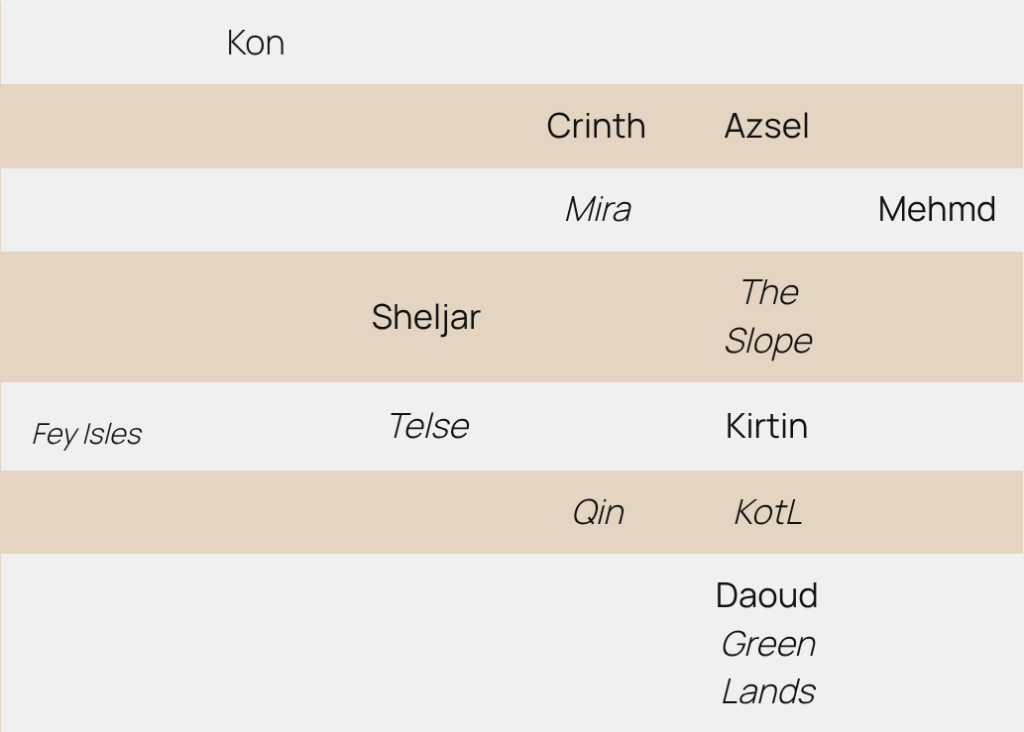
Take the word map of the Six Kingdoms. It shows the relative locations and rough distances between the various kingdoms, their major cities and the other lands that interact in the World of the Everflow.
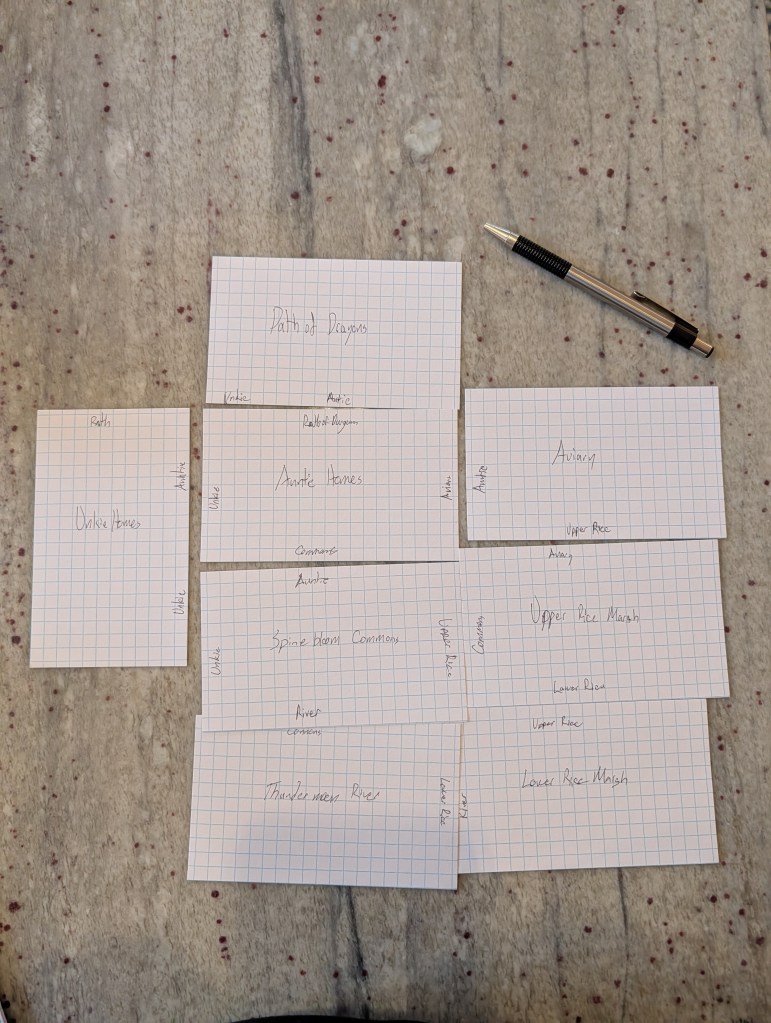
Word maps can also represent a homestead, village or neighborhoods of a city.
Any player can take a quick glance and know what each location is and what they connect to within the compound. More thorough descriptions in a blog post and in the character’s notes, but these quick notecards reminds us of Spinebloom Farms at the table.
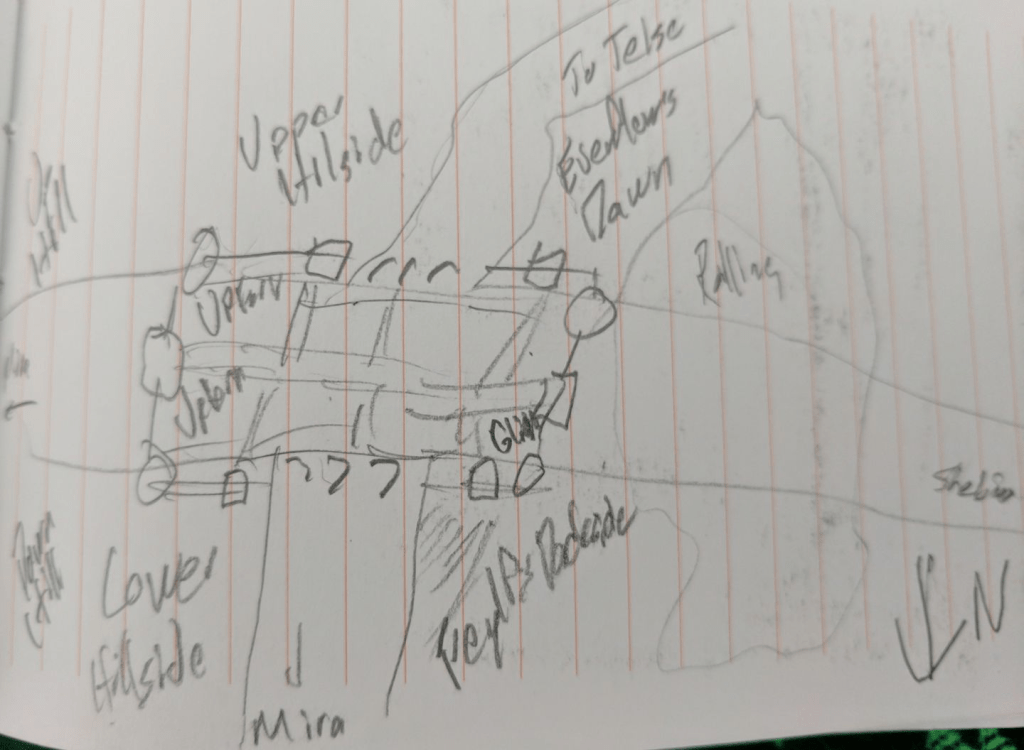
Fort Ooshar is a bridge-town that turned into a fortress when Sheljar fell to the Necromancer. This quick sketch lays out the neighborhoods of the bridge-town, the gates, the fields and the nearby hills.
Yes, a better mapmaker would be better. My favorites are Deven Rue and Dyson Logos. I support both via Patreon and use their works in my games.
But sometimes I want something that is unique to my world. That leaves me with my lack of art. I then build a word map.
Keys to making a quick word map.
Decide on the central space
Build outward using relative distance to represent a unit of time
Include evocative names, especially when in tight focus
If building a dungeon, point crawl or town having connective tissue — this can be a road, river, or other path
Leave yourself space to build details and add discoveries
Doing this as a player
Old school D&D involved at least one player making highly detailed maps. But a word map may be all that’s necessary to prevent your party from getting lost. Using a room-and-halls word map by the player helps represent how the characters think.
In essence you are channeling the concept of ‘turn left after the big red barn, go over Herringbone Bridge, take the third path’ into a simplistic drawing.
These are quick, simple and can be done on a 3-by-5 card or as a sketch in something as simple as Paint, Slides, Canva or even in a Spreadsheet (the Six Kingdoms started as a spreadsheet).
One of the special powers of the word map is that they’re quick. You don’t need to search for anything. It’s a sketch that can be done in a few seconds.
Whether as a player or a DM this tool can help you understand your fantasy world better than without a map at all.
Professionals fail all the time — in roleplaying games, in elite athletics, in special operations, in life.
The idea that they shouldn’t miss in a game is built on a foundation of water, not even sand.
There are still some valid reasons that one wouldn’t roll to hit, but they have nothing to do with professionalism.
Matt Colville on Mastering Dungeons
In a recent edition of Mastering Dungeons Matt Colville talked extensively about the business of RPGs. It’s a wonderful listen.
Something stood out to me though.
“You’re professionals; you shouldn’t roll to hit.”
Now, the idea of not rolling to hit is part of Colville’s quite intentional design. I’m certain he’s said it before and will say it again. There are reasons in games to not roll to hit.
Let’s break down the idea of professionals not needing to roll to hit.
Elite Failure
Elites fail regularly. They fail when contested. They fail when on their own. Failure at elite levels may not be as common as for us normal people, but it happens.
This is true for the real, actual elites, not those mere professionals. My personal history is blessed to experience a few elites in fashions that many do not.
Special operations
Assigned to 5th Special Forces as a peacetime soldier my Army days were defined by the Quiet Professionals — the Green Berets. Working alongside these masters in warfare I saw failure every single day.
On the range those trained to be snipers, an uncontested contest in gaming terms, missed. There are reasons for each miss, but missing happened.
When soldiers, even in highly trained units such as the Special Forces, go to war they miss even more. The human brain does not like to kill things, plus there is chaos all around you. Errors happen. They always will.
Elite failure isn’t limited to elite warfare.
High-level sports
Leaving 5th Group I decided I wanted nothing to do with my high school dreams or hard journalism. I turned to sports. During that era I worked as a producer for the Sonics broadcasting network, baseball’s best postgame show, as an on-air analyst for soccer and founded Sounder at Heart.
At the field and court level I’ve watched Ichiro, Ken Griffey Jr., Gary Payton, Michael Jordan, Megan Rapinoe, Kasey Keller and many others.
The list of these Hall of Fame talents failing would be immense.
But let’s use hard numbers.
Ichiro is the best contact hitter of the modern era. The ten-time All Star and MVP had a batting average on balls in play forty points higher than his contemporaries, but it was still only .338.
Failure among the elite is regular and normal. They roll to hit and fail.
Business
Pick your favorite business leader and their success rate is higher than average, but whether its Howard Schultz launching a magazine, or Steve Jobs launching NeXT, or Warren Buffet investing in a shoe company, they fail too.
Gaming reasons to not roll to hit
So professionals do miss. Elites miss.
Are there good reasons to not roll to hit? Yes, absolutely, as part of intentional design choices for a style of play that has nothing to do with professionalism of the character
Hit points vs meat points
The long standing D&D debate about hit points being more than meat points can be ignored here. Games developing to-hit rolling or direct-to-damage techniques do not need to burden them with Gygax’s decisions.
Direct-to-damage rolling is excellent when hit points are, as in D&D, a symbol of morale, luck, fortitude, energy and more than merely meat. Since every attempt to physically damage an opponent wears away at those elements you don’t necessarily need to roll to hit. Missing still costs luck, energy, mental health and morale.
The meat of the opponent can be damaged eventually, even without rolling to hit.
Speed of play
Colville did this in MCDM monster design for his 5e books — minions and the like can be hit easily. And then eliminated easily. This speeds up the action at the table and mimics narratives from movies, TV, video games within role playing games. Slicing and dicing through waves of small threats feels great. Having that take only a few moments rather than many minutes is good.
Additionally in games like Draw Steel, with extensive tactical choices being a goal, eliminating a set of rolling helps speed gameplay up. This is a wise and intentional design choice that amplifies the other intent of bundling morale with meat.
This supports the designer’s desires for their game — and need not be connected to reality or even lore.
A wrong justification, with the right idea
Professionalism in the real-world elite activities includes failure. Even the arts that inspire our gaming include failure. Black Widow misses. Skywalkers miss. Robin Hood misses.
Designers should embrace failure when missing, because Ichiro, Rapinoe, every special forces soldier, every business leader, every legendary hero misses.
And when they do design away the miss they should do so with intent that supports their game, no matter what reality and lore suggest. Just as Colville’s done in Draw Steel.
Over the past decade the 5th edition of Dungeons & Dragons grew three main offshoots from its original 2014 release by Wizards of the Coast. These three trunks are all now in the Creative Commons thanks to Kobold Press’s announcement this week.
A5e is the Systems Reference Document for LevelUp, from EN Publishing. This branch of 5e places much greater emphasis on social and exploration, while also being a more complex combat engine. It’s “advanced” 5e.
2024 D&D by Wizards of the Coast (the 5.2.1 SRD) is an evolution of the most popular version of the game in history. It adds minor layers of complexity, and removes most bioessentialism.
Now, Black Flag, the SRD for Tales of the Valiant is also in the Commons under the CC BY 4.0. The primary changes within Black Flag are replacing Inspiration with Luck, adding Dread and similar to A5e uses both nature and nurture to define an upbringing.
All three modern offshoots add a unique element to every monster. Rather than have merely have bigger numbers, monsters do something different — a Commoner in Black Flag has Angry Mob, while in A5e Commoners have a Stone (they can also be a Group) and in 5.2.1 they have Training.
What can a DM/GM/designer do with all four in the same license?
I am not a lawyer. Nor am I your lawyer. Use an actual lawyer if you have questions and are publishing for money.
Read all relevant SRDs as well as their related FAQs.
Find the place you want fiddle with and become an expert at that before you try to be an expert at everything.
At your home table, borrow liberally from every system. If you don’t find yourself handing out 2014 Inspiration and don’t like 2024 D&D’s mechanical implementation, use Luck from Black Flag. Use everyone’s monsters — they’re balanced enough for the elastic system that is 5e — your players will have fun interacting with different commoners doing different things.
Maybe you’re thinking “that’s nice advice Dave, but what are you going to do?”
Each of the main trunks of 5e do something different from the 2014 version of the game. That’s good! Your table can use a Background from any of the modern versions and there will be no balance issues. That means dozens of more origin stories for your heroes.
For myself it means my eternal project becomes a simple project. A few dozen new Backgrounds with methodology to fit in all four trunks of 5e.
Custom Backgrounds for 5th edition Dungeons & Dragons
This week the Tinker is my most popular Background. Tuning it for each version of 5e doesn’t take much.
2014 5e by WotC
It’s already released, but the key point is the feature “I Can Fix It.” The feature helps in exploration situations, mostly, as it means the Tinker will usually have a way to MacGyver there way through a problem even if they don’t have the proper supplies.
2024 5e by WotC
If you leave Ability Score Improvements within the Background rather than have them float the Tinker would choose between Dexterity, Intelligence and Charisma.
Connections – Tinkers might know a caravanserai, an innkeeper, a ferien, a smith, a group of bandits, a sergeant from a warring nation, a local farmer, a maker of fine meed, a faerie that’s a cheesemonger.
Memento – Tinker memento options could include a letter from home, a chapbook of poetry, a metal they’ve never been able to bend or smelt, a strap of leather from their first failed project, the stein from their favorite inn, or a book of cantrips though they don’t know any.
Adventures and Advancement – A Tinker who repaired a notable authority’s broken item may be granted a writ of access granting the Tinker expertise on Persuasion rolls.
Feature – same as the original on Full Moon Storytelling.
Now, these examples are quick looks at a future project that will include the score of Backgrounds already on the site, plus the four Everflow specific Backgrounds that didn’t get their own entry. And more as my reading expands.
With four versions of 5e available in the Creative Commons (CC BY 4.0) how will you create for your table?
The Ferments are a rough land of geysers, lava flows, fast glaciers, waterfalls, hot springs, tornadoes, earthquakes — the raw power of the world. From this land the best alcohols of the Six Kingdoms come. The peoples of the Ferments are dispersed, spread over the many miles with four main towns. They generally live in defensible homesteads interacting when they need goods or during festivals.
Campaign Premise
Our eventual heroes start out as the primary defender of a homestead. They know how to contact other homesteads for help when needed, but mostly they are on their own hoping to remain safe from a world where dragons came real, magic became powerful and kaiju returned.
Grand Conflicts
Elementals burst from the land, stronger than before and with a hungry intelligence that threatens the land. Outsiders fleeing the wars of Six Kingdoms come for safe harbor. Dragons and their Ken continue to search for more scholars.
Each homestead has a book, collection of scrolls or other devices that helps them control an element (earth, air, fire, water) or paraelemental (smoke, magma, dust, ice, steam, mud, etc). These start out with each PC knowing Elementalism, limited by their choice of element. Each was passed down since the time of Gallinor, before the time of dragons.
Factions
Every player will create either an ally or adversary family besides their own. They may also have a connection to one of the families (not all families share blood-ties) of other characters.
Adversaries
Allies
Rumors
This section will fill over time.
Kaiju roam as in the time of Gallinor — some even are ridden. Word is they come from the Kirtin-in-the-Sky and the Cliffs of Gallinor.
Facets
Exploring the zero-to-hero tropes, friendship with animals, and who gets to control knowledge.
Player options must be consistent within the ruleset (i.e. if you play a Mechanist all options should be from Tales of the Valiant for that character).
There is a campaign set up on DnD Beyond. Email me to get an invite.
Start at 1st level.
Use point buy or standard array for starting attributes. If you want something random, the redrick roller gives random point-buy-valid stats.
Each session will offer the opportunity for a short rest. Long rests are between sessions.
Practicum
Sessions are on Sundays from 1-4 when my main campaign isn’t being played. We’ll meet at Logan Brewing, usually. I’m willing to do duet play outside of that timeline as well.
Each character should be built in a session zero discussing their personality, homestead, allies/adversaries and key abilities.