Tag: World of the Everflow

  • An afternoon with Prva Metzr caretaker of the Everflow

    An afternoon with Prva Metzr caretaker of the Everflow

    Prva rows in the heat of a summer swelter. The water isn’t choppy. He’s still struggling a bit. Deep, pulling cuts to get to the Font of Two Paths quickly.

    Most of the other font-kids stay in when it’s this hot. Prva knows he can make a few coin, and safely because Vrda his river otter companion will splash through the lake to make it more comfortable.

    Most thems with birds and dogs won’t get the splashies. Vrda is the reason Prva can work a day with this sun.

    A quick j-stroke stops the boat, right near the Font. He tosses a knotted rope to the otter who chomps a big knotted end. Then the work of getting the jars ready starts.
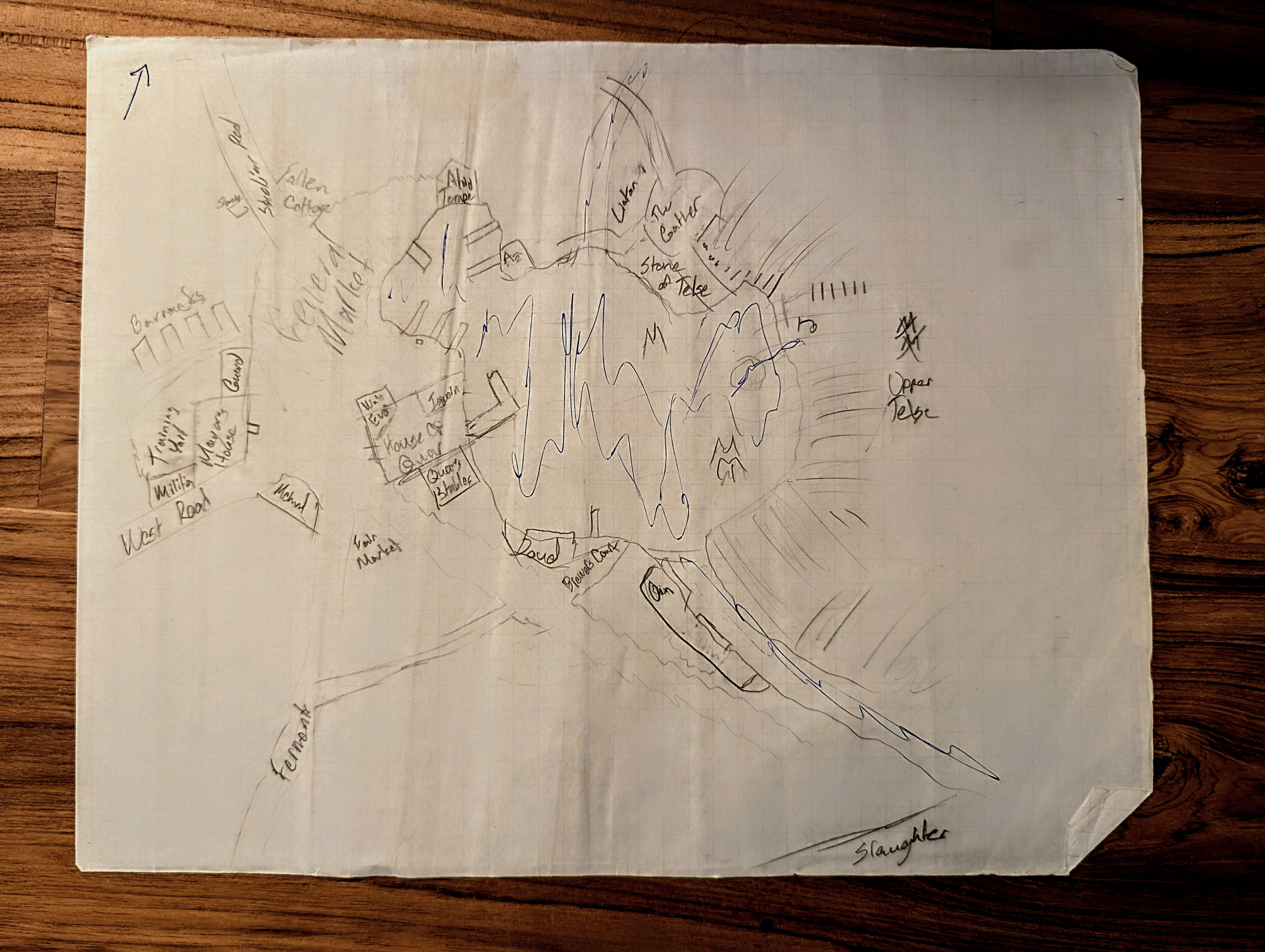
    The image portrays a hand-drawn map on graph paper placed on a wooden surface. The map features various locations marked with labels and lines connecting them. It appears to depict a fantasy or fictional setting. On the left, "General Market" is written near several labeled areas including "Fallen Cottage," "Watch Tower," "Training Grounds," and "Barracks." A "West Road" branches out below these areas. In the center, there is a drawn area marked with wavy lines labeled "Inner Harbor of Tolse," surrounded by "Lake," "Forest," and a "Quarry Rubble." To the right, "Upper Telse" is written beside some abstract shapes. Additional labels scattered across the map include "Old Bridge," "New Mine," "Farm," and "Slaughter."

    Already set in order. Lids off. Getting them ready for pure waters of the Everflow direct from the Font as it falls from cliffside. An attempt to stay stable underneath kind of works, mostly because the little otter is pushing the small boat back towards the fall.

    Prva bows his head. His lips moving.

    That big rush of noise under the fall with the rough waters would obscure his words if anyone was close. No one is close though — the heat.

    They wouldn’t hear him anyway. He’s performing, not praying. He learned long ago that Quar didn’t care about prayers or belief. The pure waters heal.

    But he still pretends to pray. It’s a job. The performance matters.

    All the jars are full. Flip caps are on.

    Then the row back to Quar’s dock, where the acolytes hand the harvested Everflow off to the Orthodox Church of Quar. It’s a trip he’ll make a few more times today. There’s a small bonus when he’s willing and other ain’t.

    Boat isn’t his. That’s tied off for the next one to do the work, the jar racks now empty.

    Vrda crawls up the quay side. Dripping the waters of the lack behind them. They’re off for some fish and a chilled tisane of pine and limon from Daoud.

    Legendary magic was big and powerful, life changing. Modern magic is a cold drink on a hot day after heavy labor. Modern magic is also the ability to make oneself just a little big wet during the worst heats.


    This narrative slice of life was an attempt at Tuesday Afternoon, a technique to test world building to see if the created world makes sense for normal people.

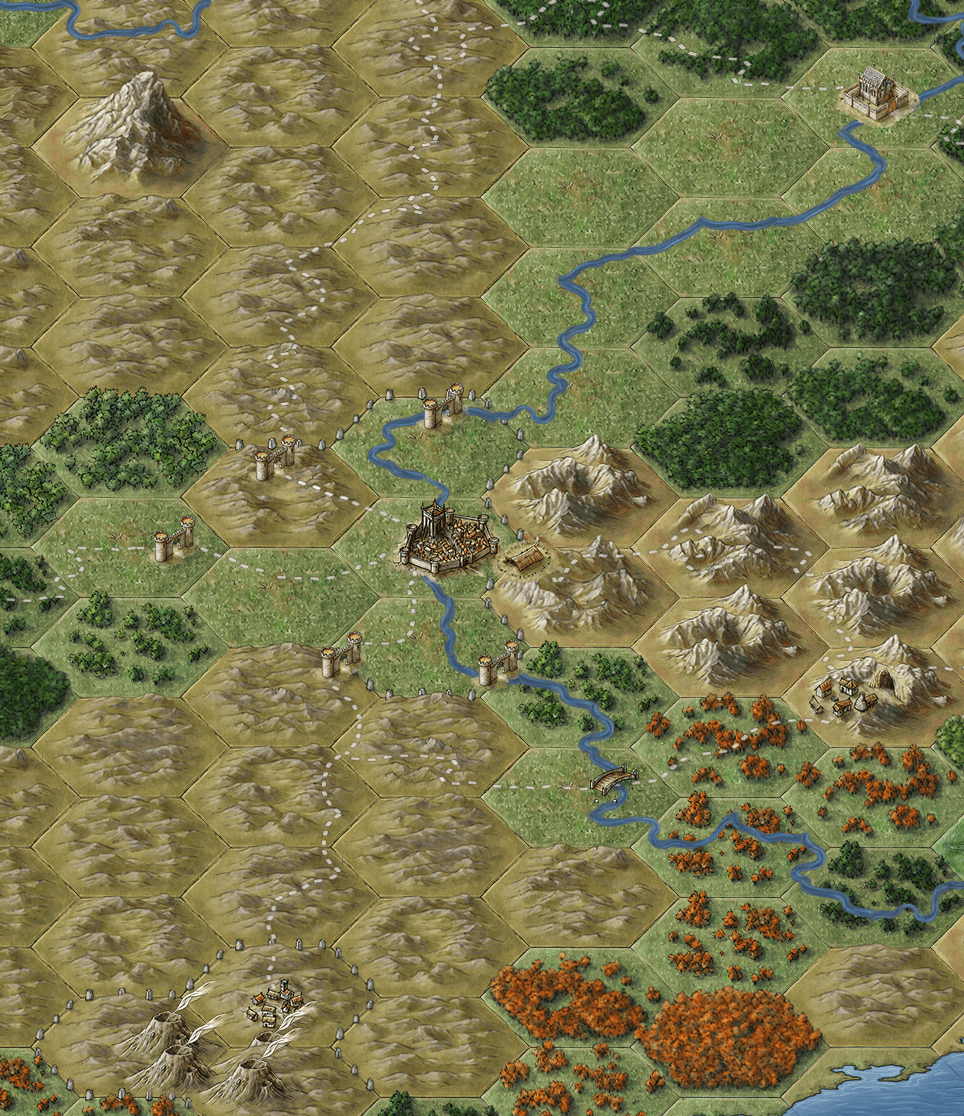
    The image features a hexagonal grid map depicting a diverse terrain. The landscape includes mountains, forests, rivers, and bodies of water. Mountain ranges stretch across the northern, eastern, and western areas of the map, characterized by sharp, brown peaks. Forests, in varying shades of green, are spread throughout, with dense patches in the central and northern sections. Rivers snake through the terrain, connecting to blue coastal waters that line much of the western and southern borders. There are patches of reddish-brown terrain, suggesting arid regions or desert-like areas. The map is bordered by white space, emphasizing the land's irregular shape.
    Telse and the Western Wildes j

    Telse was the center of my first 5e campaigns. It is the source of the Everflow, the healing waters that feed into the Font of Two Paths. The Church of Quar controls access to the lake, the Font and the Everflow. That mercantile-faith is the origin of the common tongue in the World of the Everflow.

    Once part of the empire of Sheljar, Telse is now a free city like most of the Western Wildes. Both the Orthodox and Reformed Churches of Quar are based in the town. Despite being a small city or large town, Telse has embassies from the other kingdoms and free cities due to its healing waters.

    Prva Metzr is an acolyte of Quar with a river otter bonded companion named Vrda. Metzr is a human in their mid-20s. He considers his faith a job more than a duty or calling.

    Fediverse Reactions
  • Using word-maps for quick reference during your games

    Using word-maps for quick reference during your games

    You don’t have to be a map maker to make adequate maps for gaming. A map can be as simple as showing the relative relationship between distance and location of the important elements. Even putting a few words on a page can be a map.

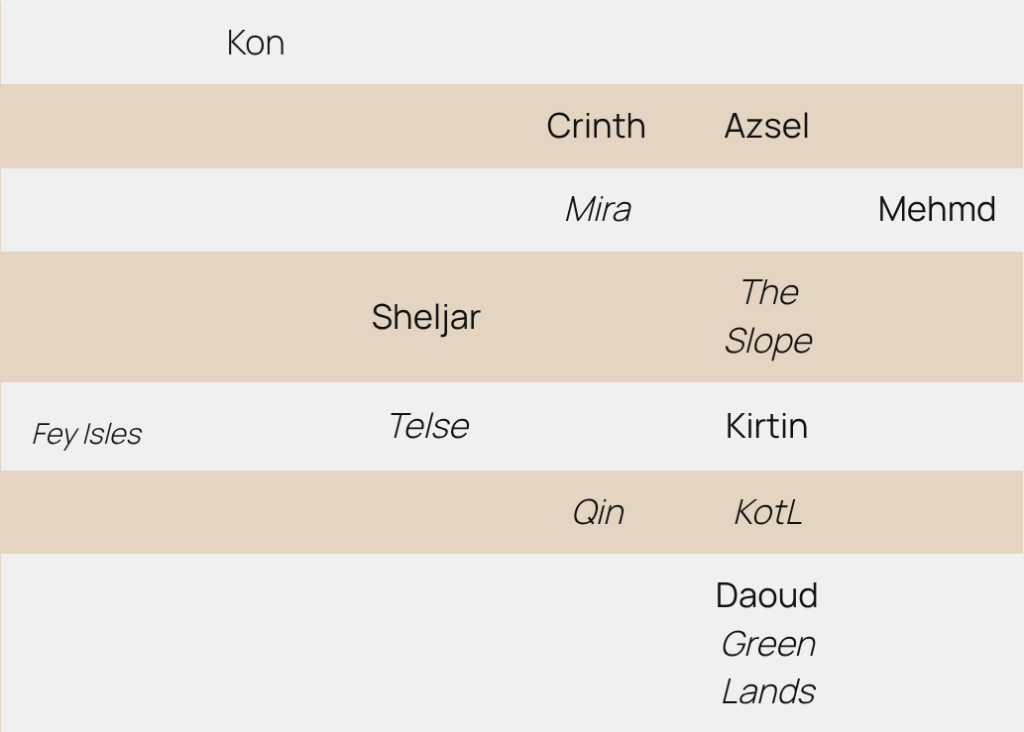
    Take the word map of the Six Kingdoms. It shows the relative locations and rough distances between the various kingdoms, their major cities and the other lands that interact in the World of the Everflow.

    Word maps can also represent a homestead, village or neighborhoods of a city.

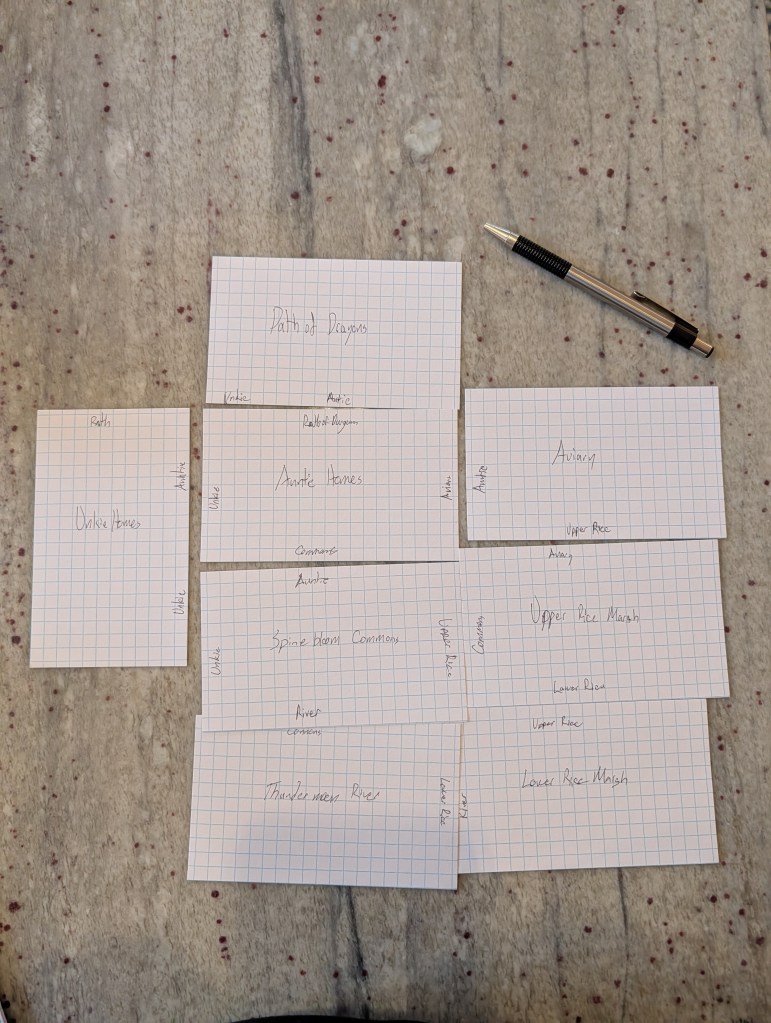
    The image shows a group of seven index cards laid out on a speckled stone surface. Each card features a grid pattern and contains handwritten text in pencil. On the top left, there is a small vertical card with "Path" and "Divide" written along its edges. Adjacent to it on the right is a horizontal card labeled "Path of Dreams" with "Prairie" and "Auntie Houses" along the sides. Below are three more cards: the left card reads "Prairie" and "Auntie Houses," the middle card reads "Spine Bloom Common," and the right card says "Upper Rice Marsh." The bottom row features two horizontal cards, one labeled "Thunder Maker River" and the other, "Lower Rice Marsh." A pen with a black grip lies horizontally above the cards to the right.

    Any player can take a quick glance and know what each location is and what they connect to within the compound. More thorough descriptions in a blog post and in the character’s notes, but these quick notecards reminds us of Spinebloom Farms at the table.

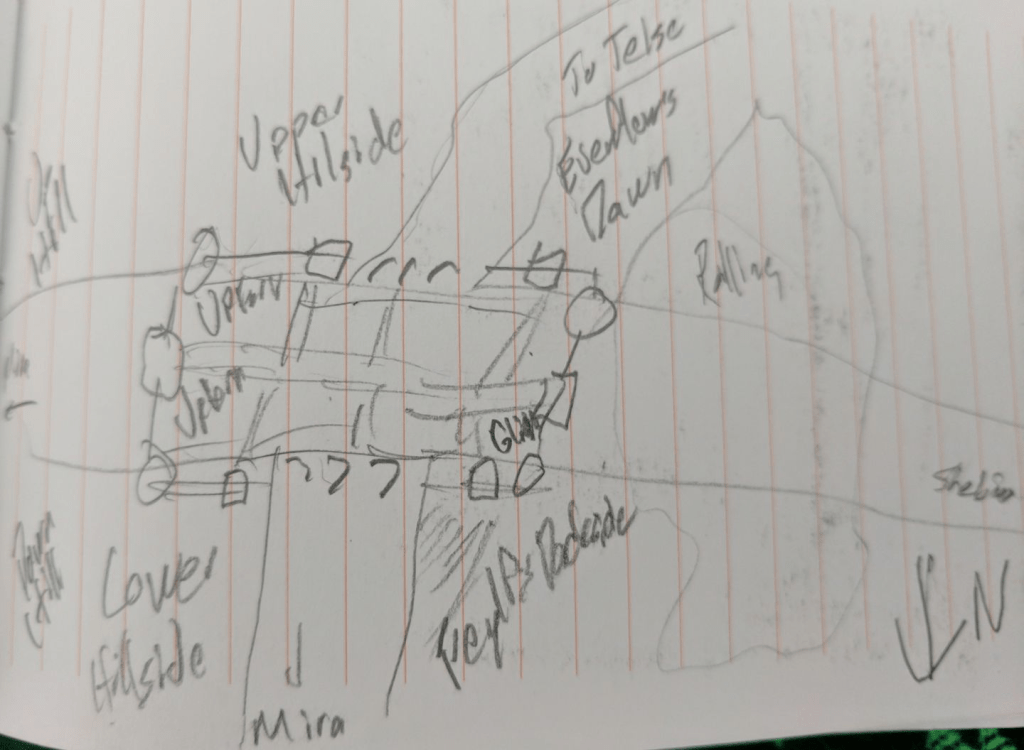
    The image is a hand-drawn sketch on lined notebook paper, depicting a rough map layout with various labeled areas and arrows indicating movement or direction. The map is oriented with "Up Hill" on the left and features several labeled sections, including "Upper Hillside," "Lower Hillside," and "Rolling." There are geometric shapes, such as squares and circles, possibly indicating buildings or points of interest, with some labeled "Upper," "GLAV," and "Verde Breezde." Lines and arrows point toward different labeled areas like "To Telee" and "Esedelens Tavern."

    Fort Ooshar is a bridge-town that turned into a fortress when Sheljar fell to the Necromancer. This quick sketch lays out the neighborhoods of the bridge-town, the gates, the fields and the nearby hills.

    Yes, a better mapmaker would be better. My favorites are Deven Rue and Dyson Logos. I support both via Patreon and use their works in my games.

    But sometimes I want something that is unique to my world. That leaves me with my lack of art. I then build a word map.

    Keys to making a quick word map.

    1. Decide on the central space
    2. Build outward using relative distance to represent a unit of time
    3. Include evocative names, especially when in tight focus
    4. If building a dungeon, point crawl or town having connective tissue — this can be a road, river, or other path
    5. Leave yourself space to build details and add discoveries

    Doing this as a player

    Old school D&D involved at least one player making highly detailed maps. But a word map may be all that’s necessary to prevent your party from getting lost. Using a room-and-halls word map by the player helps represent how the characters think.

    In essence you are channeling the concept of ‘turn left after the big red barn, go over Herringbone Bridge, take the third path’ into a simplistic drawing.

    These are quick, simple and can be done on a 3-by-5 card or as a sketch in something as simple as Paint, Slides, Canva or even in a Spreadsheet (the Six Kingdoms started as a spreadsheet).

    One of the special powers of the word map is that they’re quick. You don’t need to search for anything. It’s a sketch that can be done in a few seconds.

    Whether as a player or a DM this tool can help you understand your fantasy world better than without a map at all.

    Fediverse Reactions
  • How my campaign changes when a new product drops

    How my campaign changes when a new product drops

    The recent addition of Drops subscription content to DnD Beyond is going to challenge me.

    I’m running only a single intermittent 5e campaign right now. The Ferments uses 2024 as its base set, but permits things from Black Flag, 2014 and A5e in general, with a quick scan to make certain that the addition fits within the campaign themes and the setting’s common lore.

    In the past it’s been easy to judge what works and doesn’t. Book releases are heavily themed. Most grimdark will not fit in The World of the Everflow. Dragon stuff always fits. Giant stuff rarely fits. The new dinosaur book added to Beyond fits well in an undiscovered-to-this-point land.

    But now there are weekly drops. The player facing stuff needs a quick review. Maps and stickers won’t matter because we aren’t using the Maps VTT. The cosmetics are fine, because they help a player connect with their character.

    Teos explains the broader program.

    Evaluating the content to fit The Ferments and The World of the Everflow

    First off, the five feats added are all extra planar in a way that has not been explored in our games through the several hundred sessions of play plus writing and backstory. There’s only been a single Warlock.

    Those are going to be easy to ignore. If I could toggle them off at the campaign level I would.

    • All five feats = no
    • Pact Seeker background = with lore tweak and different feat
    • Astral Flood = yes, fully
    • Buzzing Bee = yes, fully
    • Insidious Rhythm = yes, fully
    • Leomund’s Lamentable Belaborment = yes, fully
    • Sticks to Snakes= yes, but DM content only

    The Pact seeker background doesn’t fit as written. The lore doesn’t work because of the demand that the pact is extraplanar, but if a player wanted to rework that and take a new origin feat it would be allowed. Maybe they are seeking a pact with a religious figure, an elder dragon, a scholar or something similar.

    There are also five spells in the first Drops.

    Astral flood fits unchanged. The Astral and Ethereal are somewhat merged in my world and opening that up to the physical realm would be devastating.

    Buzzing bee is excellent. My first encounter with Bee was the useless cantrip from Unearthed Arcana back in the 80s. This is better and needed. It fits the use of animals for the Kin too.

    Insidious Rhythm is a fun spell too. The magic of performance by Bards and others would be the path of introduction.

    Leomund’s Lamentable Belaborment may not fit combat well. It does fit in social and political settings. Players will definitely find a way to turn a crowded room into a debate-disaster.

    Sticks to Snakes is a classic spell, but this version is quite underpowered for 2024. It adds in-combat complexity for low damage. It reads more like a 2nd level spell and not a 4th. For narrative purposes it fits the world well. But it’s a waste for a player. This will be DM content only.

    Eleven player facing items this week needed to be reviewed. Next week there will be more. And then there will be more. And more.

    It’s going to be too much.

    And each drop and each book from every publisher stretches and pushes a world. But fantasy worlds are not only defined by being permissive. They are also defined by what’s forbidden.

    Every world a DM and their tables creates can choose to be a global fantasy (kitchen sink) or be as neatly defined as the group wants.

    With Drops the default in the Everflow will not be for permission, but to evaluate what a player wants to add as they want to add it in order for us to continue to explore the themes of the world — how strong can the love between person and animal be, who gets to control access to knowledge, how can our local connections make the world better for most.

    Fediverse Reactions
  • Using Feats to expand your setting: Church of Quar

    Using Feats to expand your setting: Church of Quar

    In the new Forgotten Realms books, Strixhaven, 5e Dragonlance and a recent Unearthed Arcana official D&D is using Feat trees/chains. Every published instance so far is a set of two.

    While there are mechanical reasons to have tiered Feats every expression to this point also leans quite heavily into the story elements added. In Strixhaven the feat-taker goes from early student to late in the class. In Dragonlance a squire becomes a knight. In the Realms you are early in a Faction and then a powerful member of it.

    The Feat helps tell the story in ways that a subclass wouldn’t because in all cases the feat has two expressions in Tier 1 available where a subclass gets a single expression. By the end of Tier 2 a subclass gets two expressions while a Feat chain can be up to four. There’s more space for story.

    An initiate becoming an expert is the most common example. The chain (I prefer that to tree as the published versions are two options linked) naturally fit this.

    Let’s explore how a Feat chain could tell a story in my homebrew world by looking at three feats connected to the Church of Quar.

    In the Six Kingdoms of the World of the Everflow the Church of Quar is a hybrid church-healing center-merchant guild. It controls access to the healing waters of the Everflow at the Font of Two Paths in Telse. Their tongue became the common language of the Six Kingdoms because of the strong influence of their healing elixir in a world without magic.

    No faith, no kingdom, no magic school after magic returned to the land has the influence of the Church of Quar. They’re in every town. That does not mean that every town has an Acolyte, a formal role represented by a member of the faith who is becoming a hero.

    The following three feats expand the story of the Church of Quar for heroes (and villains) using the Feat system.


    Acolyte of Quar

    Origin Feat

    You gain the following benefits.

    Cultured. You learn an additional culture (or language).

    Balm of rest. During a Short Rest you create a balm using a Healing Potion that removes one level of exhaustion and grants the creature advantage on a saving throw versus one condition with a save.

    Blessing of the Everflow. When you administer a Healing Potion to a creature they may use a Hit Die to heal as well as gain the benefits from the Healing Potion.


    Minister of Quar

    Feat (prerequisites: Acolyte of Quar, 4th+ level)

    You gain the following benefits.

    +1 to Charisma or Wisdom

    Oratory. You have Advantage when using Influence Action with Indifferent or Friendly peoples with which you share a culture or language (and Hostile creatures who are members of the Church of Quar).

    Lord of Life. You learn the Aid spell and may cast it one time a day without using a spell slot. It becomes a known spell for you.

    Lord of Rivers. You know how to create a Healing Potion (vial of Everflow) with only water and herbs. This lesser potion costs only 5 gp and can be created during a Short Rest. This potion is only half as effective as a standard Healing Potion. Sharing this concept is forbidden.


    Free Minister of Quar

    Feat (prerequisites: Acolyte of Quar, membership in the Reformed Church, 4th+ level)

    You gain the following benefits.

    +1 to Charisma or Constitution

    Rivers and Roads. You learn two cultures or languages and the Religion skill (or another skill if you are already proficient). You have Advantage on Constitution checks brought about by Environmental Effects.

    First Aid: Taking one minute you can grant a Hit Point to a stabilized creature. They are also subjected to Blessings of the Everflow if you have a Healing Potion available.


    Together these dual Feat chains tell the story behind the Orthodox and Reformed Churches of Quar.

    In just the tiniest bits of flavor text you see examples of how two branches of the faith are different, not just in their ability to be heroes, but what is expected from their most ardent believers.

    Where a subclass gains features at 3rd, 6th and 10th level (mostly). Classes have feats at 1st, 4th, 8th, 12th (mostly). By 8th level a member of Quar’s faith could take all three faith feats, going on a journey from being part of a merchant-church to dedicated hedge healer.

    This story doesn’t need to be connected to a class because they aren’t spellcasters. Plus, in the fiction inspiring the game contains people who are faithful without being clerics or druids or paladins.

    Maybe another feat deals with Quars pantheon. After being an Acolyte of Quar the individual is a Devotee to Belsem the Untamed (leaning into animal companionship?) or a Teacher (adherent to Glight becoming an expert at knowing things). These would emphasize branching, which fits the pantheon.

    The other pantheons may start dispersed and then unify (The Siblilngs) or emphasize bonding (Az and Sel) or only be about fellowship (Mehmd’s faith).

    Maybe an aspect of your world is a military organization and feats could be ranks or branches. Does your world lean into magical schools like Strixhaven? A feat chain from underclass, to senior student, to teacher, to dean could work. A setting that anchors the horrors of the environment could use feats as a way to describe various paths to survival (water, shelter, food, community).

    Feats are a discreet, light space that empowers all classes to carry bits of lore that connect to the world mechanically.

    Fediverse Reactions
  • Sharing your world: The power of co-DMing in the same space

    Sharing your world: The power of co-DMing in the same space

    This is a story about The Dragon.

    Which is a moon, not a big dragon. I don’t know why I called the biggest and slowest moon “The Dragon.” It was probably in honor of The Wheel of Time, one of my foundational fictions in the world. But the name never really came up in play.

    The 21-year cycle did come up. That generational marker (key for many goliaths and the Crinth Confederation) marked a cycle from the Born Generation to the present era.

    But, by expanding play in the world to a second DM The Dragon also finally became a point of clear fiction. It’s named that because during the Age of Myths that’s when the leading dragons on the Council retreated from society — Draakenmoten.

    That’s about to come up in the campaign I’m playing within my own world.

    Playing in the world I’ve invented has expanded the stories in ways I never expected. While I’ve included player concepts in world development in the past, including DM concepts in the world requires trust and grants wonderful opportunities for story-threads to be pulled into new places.

    Other things added to my world through sharing the experience;

    • Evil fungal druids that dabble in necromancy
    • Dragon Council, a ruling body of dragons and their magical allies who control the continent in a federal system.
    • Les Remoden Eisha, the intelligence and security branch of the Council.
    • Necromancy as the forbidden school of magic.
    • Elemental airships. Unlike the era where I DM, magic is common enough that it powers the airships, unlike the clackety, smog xips of the goblins.

    Those first four elements seem to be growing into the major division that leads to the sundering of the world, separating the continent with the Everflow on it from all the magical spaces in the rest of the planet. Those councils and forbidden magicks could grow into the dragon-founded schools with their abusive Proctors, supplicant Scholars and limited magic in a world that has merely love for companionship, healing waters and hope.

    Tips for Sharing a World

    First, have the creator DM and non-creating DM talk about history and key elements. Discuss where the foundational elements of the world are necessary in each campaign. Unlike Uprising & Rebellion (and the other ‘modern’ campaigns set in the World of the Everflow) the current campaign doesn’t have a foundational element about animals as life companions for example.

    Understand that things that happen in history don’t have to be understood in the future. Did Xabal discover tar-trees? Maybe someone else claims that 3,000 years later. Unless the details are vital to a plot point minor differences in the way myth-legend-history are known aren’t important. They can even both be true!

    Second, play and act with trust. Going back to point one, the details don’t matter if they don’t matter. Does the now co-DM get the name of a city wrong? That doesn’t matter. Keep playing at the table. Don’t even bother to correct it. Many cities in the real world have multiple names. That’s the way worlds work.

    Borrow heavily from each other. This is part communication, but also because you’re seeing each set of stories (every table is a set of stories that is some combination of the total number of people playing and their interactions) from different angles.

    Is there a new nugget dropped that you want to be permanently part of the tale? Take note in heavy ink and add it to your own version of the world document. Just like when a player adds something new to the world let the co-DM do the same thing.

    Be a player — you aren’t the DM, so don’t be a co-DM at the table, unless asked. The only time to speak up about some out-of-character element related to previous campaigns or lore is when the DM asks. Then you answer.

    Bonus points if you can work that into something that your character would know/do/say. I didn’t do this most recently, but wish I had. The current DM asked me what Sheljar, the bog-city, was like in the Age of Myths. I gave an encyclopedic answer rather than the answer Xabal would give.

    It’s been so much fun opening the world to more tales set within. We’ve added fantastic spaces, myths and histories that wouldn’t have existed if the World of the Everflow was merely my setting with nearly two dozen players. Adding a second DM to the world has changed the story dynamics in an exponential rather than additive fashion.

    My hope is that after this Age of Myths campaign we return to the modern era with new tales too.