You don’t have to be a map maker to make adequate maps for gaming. A map can be as simple as showing the relative relationship between distance and location of the important elements. Even putting a few words on a page can be a map.
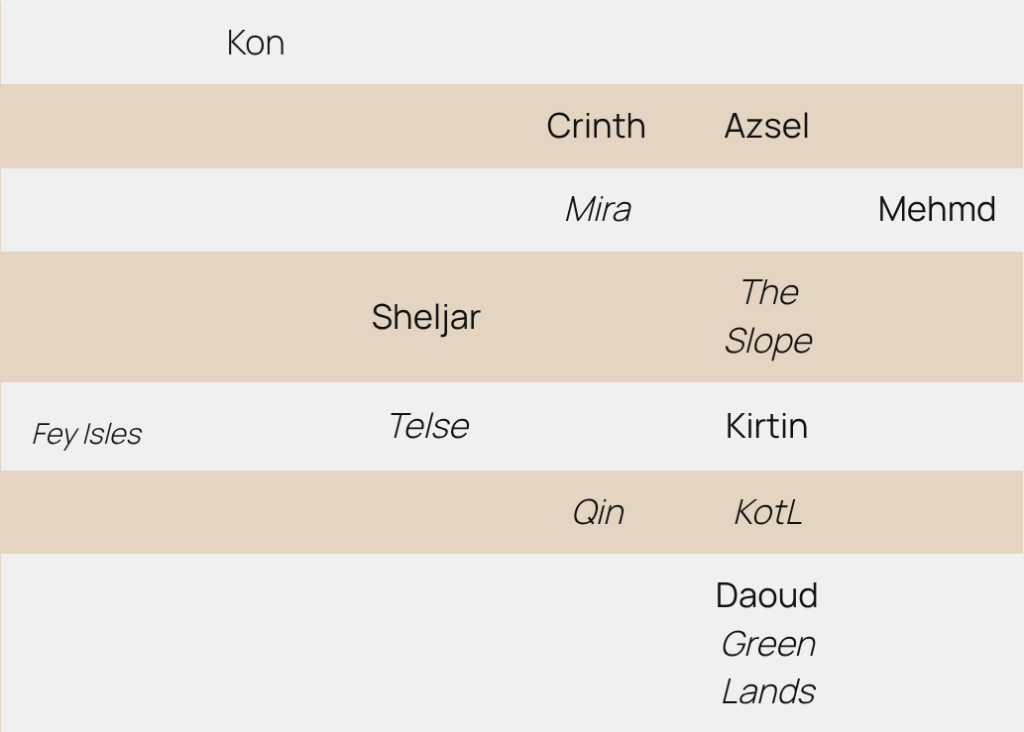
Take the word map of the Six Kingdoms. It shows the relative locations and rough distances between the various kingdoms, their major cities and the other lands that interact in the World of the Everflow.
Word maps can also represent a homestead, village or neighborhoods of a city.
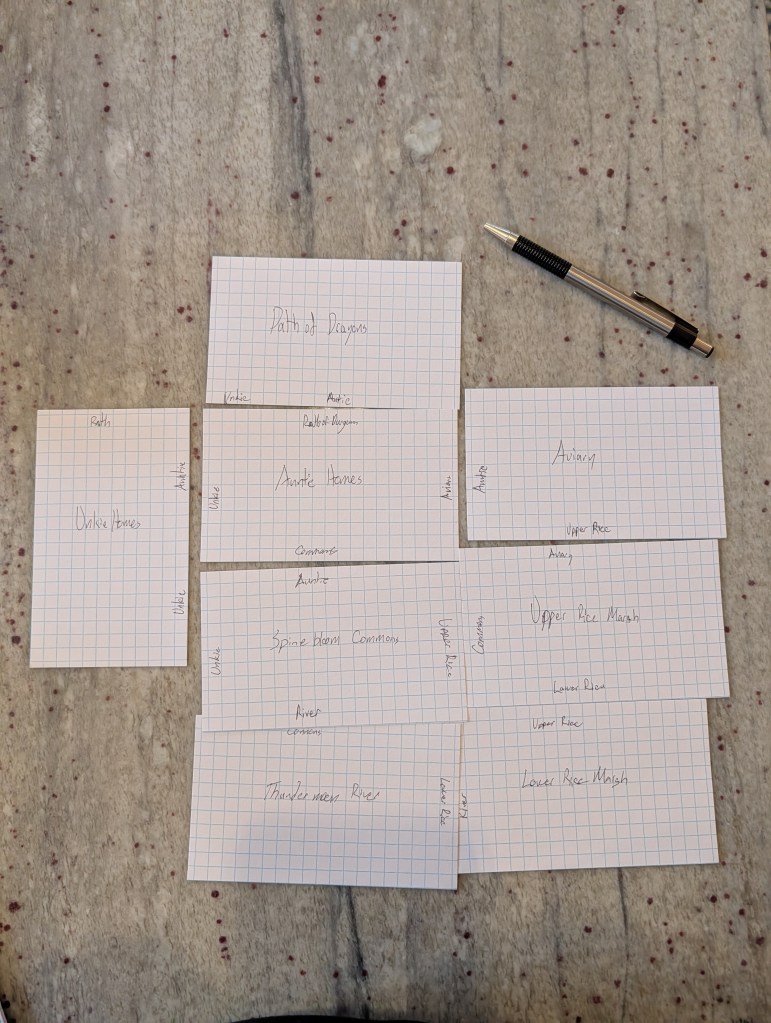
Any player can take a quick glance and know what each location is and what they connect to within the compound. More thorough descriptions in a blog post and in the character’s notes, but these quick notecards reminds us of Spinebloom Farms at the table.
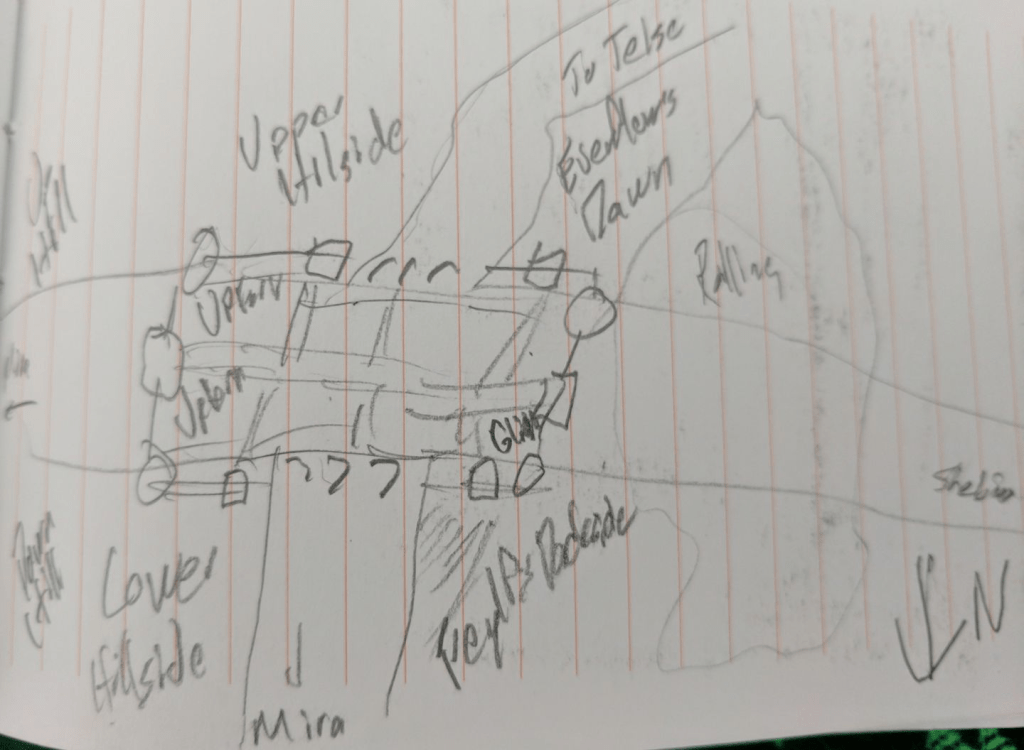
Fort Ooshar is a bridge-town that turned into a fortress when Sheljar fell to the Necromancer. This quick sketch lays out the neighborhoods of the bridge-town, the gates, the fields and the nearby hills.
Yes, a better mapmaker would be better. My favorites are Deven Rue and Dyson Logos. I support both via Patreon and use their works in my games.
But sometimes I want something that is unique to my world. That leaves me with my lack of art. I then build a word map.
Keys to making a quick word map.
Decide on the central space
Build outward using relative distance to represent a unit of time
Include evocative names, especially when in tight focus
If building a dungeon, point crawl or town having connective tissue — this can be a road, river, or other path
Leave yourself space to build details and add discoveries
Doing this as a player
Old school D&D involved at least one player making highly detailed maps. But a word map may be all that’s necessary to prevent your party from getting lost. Using a room-and-halls word map by the player helps represent how the characters think.
In essence you are channeling the concept of ‘turn left after the big red barn, go over Herringbone Bridge, take the third path’ into a simplistic drawing.
These are quick, simple and can be done on a 3-by-5 card or as a sketch in something as simple as Paint, Slides, Canva or even in a Spreadsheet (the Six Kingdoms started as a spreadsheet).
One of the special powers of the word map is that they’re quick. You don’t need to search for anything. It’s a sketch that can be done in a few seconds.
Whether as a player or a DM this tool can help you understand your fantasy world better than without a map at all.
D&D and its variants are often referred to as “combat simulations” or “tactical combat games” or “dungeon crawling miniature games” in a somewhat dismissive way that seeks to reduce the other things that players have their characters do during sessions and campaigns.
These mostly heroic characters do have a lot of combat support. A vast majority of the rules support violence portrayed in what is now six-second rounds. Combat’s scenes in 5th edition are done in expanded time taking many real minutes for less than thirty seconds of cinematic action.
But combat is not all of modern Dungeons & Dragons. Other pillars are supported.
The three main pillars of D&D play are social interaction, exploration, and combat.
Social interaction in the modern game is mostly done in scenes lasting a few minutes. These scenes take place in real time at the table. Ritual spells do not make sense in the context of social interaction because of the nature of social interaction. Other spell casting is less frequent than in combat, while it can still fit. The main engine of social interaction within the rules are skills (Charisma, Wisdom and Intelligence) and a light dusting of feature from class, archetype, feat or species.
Taking a longer period of time, historically measured in ten-minute chunks, is Exploration. This is abstracted in an opposite fashion from Combat in that where combat sees time expanded, Exploration compresses it. Some, but not all travel makes sense as exploration. Rituals are frequently used. Spells are common. Certain spells and features may make classic exploration challenges meaningless (Goodberry or Find & Remove Traps). But Exploration, the delve into dungeons, the searching the wildes, the entry to a wondrous temple or the site of a majestic floating city is and always will be a part of the D&D genre.
Between the 2014 core books, and Xanathar’s there are 37 sometimes overlapping options for what can be done with Downtime. The 2024 core books and the Forgotten Realms expansions add many Bastion and Crafting options onto this.
Most downtime choices are measured in weeks, though small projects are within days. These scenes are time-compressed frequently taking only a roll or two per character to resolve as weeks, months, maybe even seasons pass. In film, TV and books the montage is how downtime is presented. Pick your favorite heroic montage — we’ll get back to it.
Every class supports downtime activities in some capacity, especially with the 2024 ruleset adding on Bastions. Skill challenges, as adopted to 5e by some homebrewers, make sense as resolution systems for downtime, exploration and sometimes social events.
But downtime is often viewed by players and DMs as accounting, boring academics, spreadsheet management.
Even the name is boring.
Downtime has a branding problem
Stories and adventures are an assembly of beats, eventually leading to rising action, climax and resolution. There are sometimes downbeats, setback.
Downbeats.
Who wants downbeats? Who wants downtime.
Even how downtime is presented, either by name or by style of play (Bastions and Crafting), it is shown as an appendage with little support. Downtime is a thing to rush past, not to enjoy.
A Bastion offers a character temporary refuge from the dangerous world of adventuring, and it provides opportunities for a character to craft magic items, conduct research, harvest poisons, build ships, and carry out a range of other activities.
They do want the ability to craft magic items, research mysteries, harvest fantastic elements, carouse, gamble, set sail across an astral sea, or plot the overthrow of a corrupt regime.
Those are all upbeats, not downtime.
Downtime also a massive part of the game
Acquisitions Inc combines D&D and modern franchise capitalism for fun. It contains franchise rules. It also lists every one of the 2014 options in downtime at its point of publication.
These choices are things heroes do!
The options above belong at your table. At some tables the options in Dragon Heist, Acq Inc, Tasha’s (Group Patrons), Strixhaven (schooling) and other official and unofficial books expand your campaign in ways that make sense too.
Think of your favorite montage scenes in your personal Appendix N. Do they involve plotting the overthrow of a corrupt leader? Do they involve building a guild? Do they involve carousing to gain information? Do they involve long study to craft a previously unknown spell? Do you have a favorite montage that includes sowing rumors? Or mayhap one that involves training for new skills? You probably have one where the heroes prepare for a test of skill, chance or magic?
In traditional D&D that’s downtime.
In the fiction these things advance the plot and add excitement.
making intelligent, secret plans, often to deceive others
behaviour or activities that involve making clever secret plans intended to deceive people
In British English schemes aren’t necessarily deceptive or secret. They are plots and advancements, plans and procedures. They are the many days, weeks, months processes.
Both versions work for modern D&D, but the American concept of intelligent, secret plans especially fits my preferred themes.
Why Scheming? Other considerations
Concerns – while this captured the idea of the character being in charge of things it felt less involved in the plot and continued the ‘set aside’ concept of Downtime.
Occupations – but who wants to do work? That’s spreadsheet life, not plot advancement and fantastic discoveries.
Rejuvenation – is wonderful for healing, but poor for plot advancement and heroic actions over time.
Strategic play – this conveys the proper tone and your schemes should be strategic while other pillars are tactical.
Schemes involve rising action by heroes and antiheroes to get ready for the messy work that needs doing. Schemes are active plots and machinations (maybe that belongs above). Sometimes they are down notes, sometimes they are upbeats. They build rising action.
Unifying disparate subsystems into Scheming
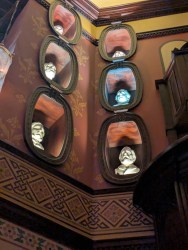
Oracles ready to provide advice after a sacred rite (Photo by Dave Clark)
Crafting, Bastions, Franchises, Group Patrons, Schooling, Carousing, Sacred rites, Grand rituals, Research, Business operations, Running a faction, Guild matters, Training militias, Communal defense, Grand voyages ….
The list goes on.
When these are schemes they are multi-check montages where failure matters and the results fuel the story. They either help or hinder a character or party on their quest. They take time.
Whatever you take to calling downtime (and do include Bastions and Crafting when appropriate for your campaign) you need to unify this set of systems together.
Describe the quest with the amount before the pace of action changes again. Set the expectation that there is time to Scheme.
Players describe their goals using the above activities or a combination thereof to achieve that goal within the amount of time (measure in weeks).
Narrate the results of the actions. These may require skill checks, use of various features or cooperation in the party. If there isn’t meaningful failure there is not a check unless extraordinary success matters. Use an odd number of checks (3 or 5 are best) mimicking skill challenges or use group checks if everyone is cooperating. Or combine the two.
Move on from the Scheme into action with a faster pace taking note of how much time passed and what that means for those that oppose the group.
If that resolution system feels familiar it is because it is the basic rhythm of play at the table, while capturing the montage and compressed time nature of a Scheme.
It’s not a scheme if the activities are passive. It’s not a scheme if it doesn’t advance a quest or plot. It’s not a scheme if it is fast. It’s not a scheme if it is tactical.
Frankly it’s not worth doing at the table if the activity is passive and/or doesn’t advance the quest
Schemes are strategic, long-term, montage-y activities that advance the action fitting a rising narrative building the eventual heroes towards a climax. They should not be the climax, nor the resolution. A denouement can be a scheme as it preps for the next campaign.
Ways to add Schemes to common campaign types
Try working in schemes into your campaign. Use a timehop that creates challenges because the enemy is building a grand army. The timehop also gives the heroes time to train a militia (as in Wheel of Time).
In a heist adventure use a scheme as the way to collect the necessary materials or information, setting up the background before the strike on the location (as the Crows in Shadow & Bone).
Maybe the scheme is to collect a group of allies to help the party cross a perilous ocean or astral sea, commissioning a ship and its crew (as in One Piece).
Play a scheme at your table inspired by the fictions that inspire your D&D.
Professionals fail all the time — in roleplaying games, in elite athletics, in special operations, in life.
The idea that they shouldn’t miss in a game is built on a foundation of water, not even sand.
There are still some valid reasons that one wouldn’t roll to hit, but they have nothing to do with professionalism.
Matt Colville on Mastering Dungeons
In a recent edition of Mastering Dungeons Matt Colville talked extensively about the business of RPGs. It’s a wonderful listen.
Something stood out to me though.
“You’re professionals; you shouldn’t roll to hit.”
Now, the idea of not rolling to hit is part of Colville’s quite intentional design. I’m certain he’s said it before and will say it again. There are reasons in games to not roll to hit.
Let’s break down the idea of professionals not needing to roll to hit.
Elite Failure
Elites fail regularly. They fail when contested. They fail when on their own. Failure at elite levels may not be as common as for us normal people, but it happens.
This is true for the real, actual elites, not those mere professionals. My personal history is blessed to experience a few elites in fashions that many do not.
Special operations
Assigned to 5th Special Forces as a peacetime soldier my Army days were defined by the Quiet Professionals — the Green Berets. Working alongside these masters in warfare I saw failure every single day.
On the range those trained to be snipers, an uncontested contest in gaming terms, missed. There are reasons for each miss, but missing happened.
When soldiers, even in highly trained units such as the Special Forces, go to war they miss even more. The human brain does not like to kill things, plus there is chaos all around you. Errors happen. They always will.
Elite failure isn’t limited to elite warfare.
High-level sports
Leaving 5th Group I decided I wanted nothing to do with my high school dreams or hard journalism. I turned to sports. During that era I worked as a producer for the Sonics broadcasting network, baseball’s best postgame show, as an on-air analyst for soccer and founded Sounder at Heart.
At the field and court level I’ve watched Ichiro, Ken Griffey Jr., Gary Payton, Michael Jordan, Megan Rapinoe, Kasey Keller and many others.
The list of these Hall of Fame talents failing would be immense.
But let’s use hard numbers.
Ichiro is the best contact hitter of the modern era. The ten-time All Star and MVP had a batting average on balls in play forty points higher than his contemporaries, but it was still only .338.
Failure among the elite is regular and normal. They roll to hit and fail.
Business
Pick your favorite business leader and their success rate is higher than average, but whether its Howard Schultz launching a magazine, or Steve Jobs launching NeXT, or Warren Buffet investing in a shoe company, they fail too.
Gaming reasons to not roll to hit
So professionals do miss. Elites miss.
Are there good reasons to not roll to hit? Yes, absolutely, as part of intentional design choices for a style of play that has nothing to do with professionalism of the character
Hit points vs meat points
The long standing D&D debate about hit points being more than meat points can be ignored here. Games developing to-hit rolling or direct-to-damage techniques do not need to burden them with Gygax’s decisions.
Direct-to-damage rolling is excellent when hit points are, as in D&D, a symbol of morale, luck, fortitude, energy and more than merely meat. Since every attempt to physically damage an opponent wears away at those elements you don’t necessarily need to roll to hit. Missing still costs luck, energy, mental health and morale.
The meat of the opponent can be damaged eventually, even without rolling to hit.
Speed of play
Colville did this in MCDM monster design for his 5e books — minions and the like can be hit easily. And then eliminated easily. This speeds up the action at the table and mimics narratives from movies, TV, video games within role playing games. Slicing and dicing through waves of small threats feels great. Having that take only a few moments rather than many minutes is good.
Additionally in games like Draw Steel, with extensive tactical choices being a goal, eliminating a set of rolling helps speed gameplay up. This is a wise and intentional design choice that amplifies the other intent of bundling morale with meat.
This supports the designer’s desires for their game — and need not be connected to reality or even lore.
A wrong justification, with the right idea
Professionalism in the real-world elite activities includes failure. Even the arts that inspire our gaming include failure. Black Widow misses. Skywalkers miss. Robin Hood misses.
Designers should embrace failure when missing, because Ichiro, Rapinoe, every special forces soldier, every business leader, every legendary hero misses.
And when they do design away the miss they should do so with intent that supports their game, no matter what reality and lore suggest. Just as Colville’s done in Draw Steel.
This post will not contain spoilers for Season 5 because I haven’t yet watched Season 5 of Stranger Things, though I do know it features more Dungeons & Dragons than Seaons 2-4 combined.
If you were to go into Target this fall you’d see a massive Stranger Things display somewhere in the store. Part of that display would feature the D&D boxed set Welcome to the Hellfire Club, which is a continuation of Eddie’s D&D campaign. It felt late, because Eddie isn’t part of season 5.
It was not late.
Welcome to the Hellfire Club sold out at Target. It sold out on Amazon. A light informal survey of local-to-me stores have it as sold out. The physical boxed set can still be ordered on DnDBeyond.
Sure, that could be a lack of ambition from Wizards of the Coast by not manufacturing enough of the sets.
It’s much more likely that the heavy lean back into D&D by Stranger Things Season 5 drove more desire for D&D the game than previous seasons, Critical Role and Baldur’s Gate 3. BG3’s drive of interest into D&D is hard to quantify, but has an extended window over several years.
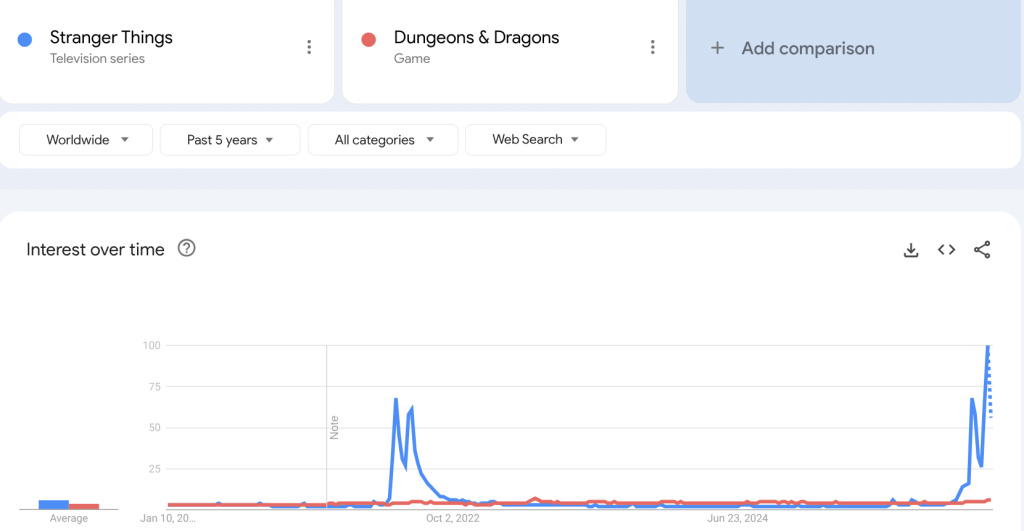
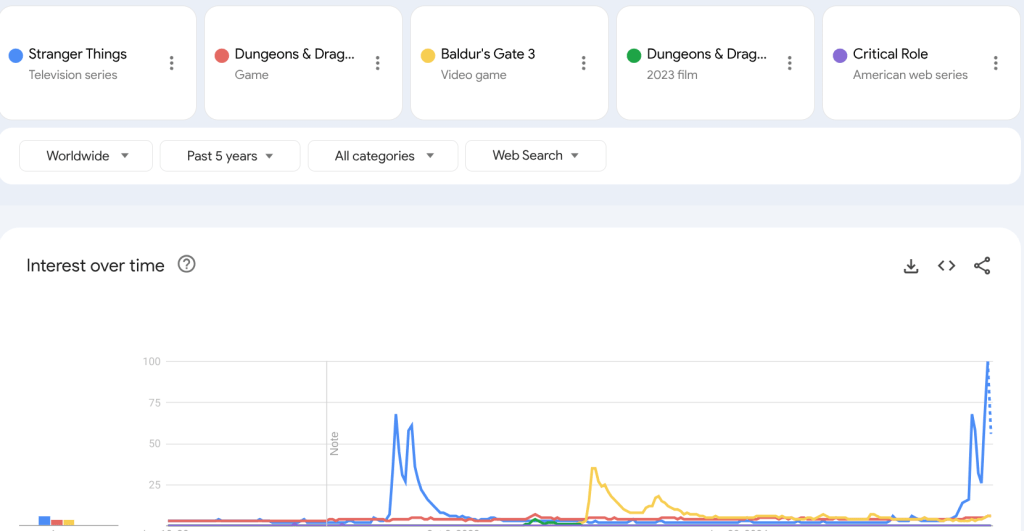
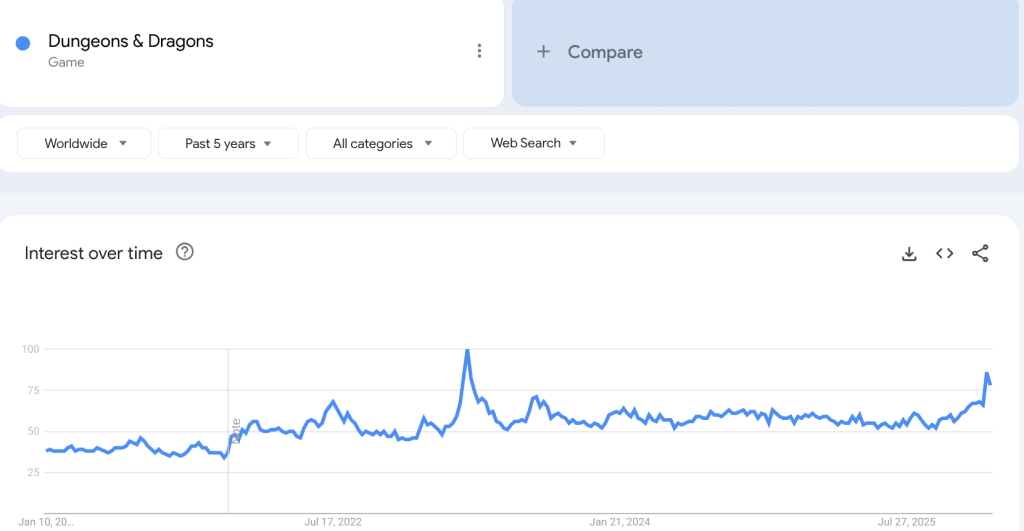
Google Trends can show you.
Search trends for Stranger Things
Here are the four adjacent media and D&D
Stranger Things is more popular than the others by far.
D&D, the game, had its biggest boom from the movie, but…
Stranger Things Season 5 nearly matches D&D: Honor Among Thieves
There’s one major difference — lack of tie-in gaming products.
Rime of the Frostmaiden contained a single adventure related to the movie. There was a boutique NPC download related to the movie, but nothing like the amazing boxed set Stranger Things got. Baldur’s Gate: Descent into Avernus was barely related to the video game and its release timing was horrible.
Nothing sold out because of Honor Among Thieves, the best D&D marketing in the history of the game, because D&D wasn’t run as a franchise system with business units failing to talk to each other.
Both the current starter set and Welcome to the Hellfire Club are selling out.
What’s that mean for us Dungeon Masters?
Be welcoming to new and returning players.
Reduce house rules when they join you.
Talk about the intent of your table and what type of play you focus on .
Be familiar with the most popular products.
Help teach your current players to DM.
See if local cafes, libraries, schools, pubs, etc need DMs.
We are responsible for growing this glorious hobby. Thanks to the Creative Commons, various SRDs, the eternal nature of homebrewing and the thousands of other roleplaying games there is always something that’s right for someone.
Find what’s right for your family, your friends and your community.
People are interested. It’s up to you to be the reason they stay interested.
Somewhat overshadowed by the release of several high-fantasy systems not based in 5e D&D is that Wizards of the Coast has two starter sets, a two-book/three-pdf Forgotten Realms set, and Eberron expansion coming out from September through the holidays.
Additionally, other 5e systems inspired by D&D are also cranking right now.
There’s a plethora of choice, right as genre TV’s most D&D related property is coming back — Stranger Things season 5 releases Thanksgiving, Christmas and New Year’s in the U.S. Several of the early monsters based on Dungeons & Dragons are making a comeback.
Your normie (non-RPG) friends may be interested in the game again thanks to the combination of product releases, the Mighty Nein release, Stranger Things and the general zeitgeist around being big heroes with power in a world where that feels missing.
What game or books are the right system for them right now?
If you read Full Moon Storytelling it is likely that you are a DM/GM. It’s also likely that you lean towards 5e D&D. That will be the focus, with a small discussion of the other systems capturing attention (million dollar+ Kickstarters and the like).
Are you the GM/DM?
Go with what you like best, what fits your world, and be welcoming. Cut back on house rules and homebrew, at first, as the people who are new to the game can be overwhelmed with normal rule sets that can stretch to 1,000 pages.
Fold the new invitees into your world by asking them what they enjoy about high fantasy roleplaying. Finding out what your table’s Appendix N always helps, but it is the most helpful knowing what someone new (or returning from long ago) to the hobby wants.
If they want something simple, but familiar like the D&D of the 80s, but modern there are a few routes. Sticking with 2014 5e one can still get the older starter sets from Target or Amazon. Dragons of Strormwreck Isle is under $16 at Target online, and some physical stores may have it. Check with your local gaming store to see if they are offloading old product.
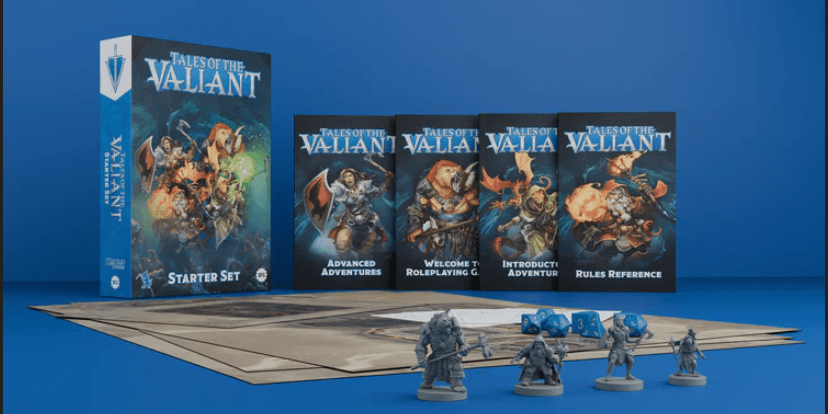
You can also intro them to 2014 via Kobold Press Tales of the Valiant Starter Set. It is under $14 at the time of publishing. The primary differences between Wizards of the Coast 2014 D&D and Tales of the Valiant lies in Tales having character creation that separates nature and nurture, luck replacing inspiration and the insertion of unique abilities on every monster.
I’d recommend Tales of the Valiant over 2014 D&D because of those changes, even if it doesn’t have the branding your friends expect. It also comes with minis! If Stormwreck Isle is 5.1 5e, ToV is probably 5.3.
Stranger Things: Welcome to the Hellfire Club
Maybe your friends didn’t get into D&D from Stranger Things season 1, or 2, or 3, or 4. Or maybe they did, but didn’t have the time, energy or mental space to play the game.
Welcome to the Hellfire Club uses Wizards of the Coast’s modern take on starter sets — lots of tokens, handouts, cards and a written approach that blurs the line between board game and roleplaying game.
modern take on starter sets — lots of tokens, handouts, cards
The presentation includes a look that borrows from 80s nostalgia as expected. The four adventure books include trade dress that would make Gary Gygax and TSR proud.
This is the second starter set built out of Stranger Things by Wizards of the Coast. Both lean heavily into using the voice of the character from the show that was the featured DM, lean into the mythology of the TV show with its ‘not quite D&D monsters, but monsters that middle/high schoolers would think are D&D monsters.’
The first Stranger Things set was rather linear in nature, which fit the times and works fairly well for people newer to roleplaying. Welcome to the Hellfire Club uses 2024 5e D&D rules.
D&D Starter Set: Heroes of the Borderlands
Similar to Stranger Things pulling out 80s nostalgia to pull people into its world, Wizards of the Coast uses Dungeons & Dragons most popular adventure from the foundational period to inspire its new general purpose Starter Set.
Keep on the Borderlands is now Heroes of the Borderlands, with three adventures. Using 2024 5e D&D’s rules, card-based character creation, tokens and maps, the intent of Heroes is to again bridge that gap between board game night and RPG night.
Because it is 2024’s rules rather than 1974s, the set is massive. Those three little folios that could fit in a small lunchbox are gone. Instead Heroes has more than 400 cards and tokens, a quick start, a set of rules, and three adventures.
The game of D&D is simultaneously more complex and more approachable than it was in the 70s and 80s. Being a more pervasive part of the culture is part of that. Also the decades of exposure to computer RPGs changes how one approaches teaching the game.
Forgotten Realms expansions
A massive two-book, three-digital book expansion coming with the brilliant marketing around “The Realms will know your name” these books aren’t necessarily great for first timers to tabletop roleplaying, unless…
You know people who were heavy into the lore of Baldur’s Gate 3 and/or D&D: Honor Among Thieves and/or the once dominant fantasy novels set in the Realms. Those legends exist within the expansion, but the point of D&D and RPGs in general is to tell your story.
Only dive into this if you are being joined by people who absolutely love those non-tabletop versions of the Forgotten Realms. These expansions include 50 micro-adventures that fit an on-the-fly DM rather well (similar to those in the 2024 DMG).
Those playing with your classic group you need little guidance. If you are using the 2024 D&D rules, or at a table that permits a broad swath of 5e rules, the expansion is handy if you want to borrow factions, subclasses, new species and nuggets of lore to insert into your homebrew.
In total the Realms expansions add about 30% more character creation options while dramatically expanding the story through the lore expansions.
Eberron: Forge of the Artificer
High fantasy doesn’t have to take place in a world that’s pseudo medieval/Renaissance and Euro coded.
It can also include pervasive magic, spread widely among the populace in a world that echoes tropes related to early Industrialization with great Houses, lightning rails, elemental airships and a ‘war to end all wars.’
That’s Eberron.
Forge of the Artificer is a lightweight updated to the setting originally invented by Keith Baker.
Don’t get Forge of the Artificer unless you already have Rising from the Last War or you really want to have the magitech Artificers at your table or you are a completionist. I’ll be getting it for the first two reasons. I’m currently playing a goblin Artificer.
The Artificer in Forge is updated for 2024 with a brand new subclass as well. From what was in the Unearthed Arcana developing this coming version of the Artificer it looks to have the quality of life improvements I would expect.
Other RPGs
LevelUp
LevelUp is built on the 5.1 5e chassis, but advances it. This does make it a more complex version of high fantasy role playing. Some of the greatest improvements come from expanding the social and exploration pillars. This helps tell a wider variety of stories. Like every offshoot of D&D from the 5e era it separates nature and nurture.
There’s now a Starter Set available. Yes, it has tokens and multiple adventure, because that’s what modern starter sets do. EN Publishing’s Starter Set is an excellent way to try on a different version of the game you already know.
Cosmere RPG
If you enjoy Brandon Sanderson’s writing you might enjoy the Cosmere RPG. It is not based on 5e. It is the highest earning RPG kickstarter of all time.
Cosmere is beautiful, complex and the most extensive lore heavy game upon release likely ever.
Draw Steel
While not the level of Kickstarter success of Cosmere, Draw Steel was still a massive earner. The design team from MCDM is mostly people who produced wonderful 5e products, but are now releasing a system that emphasizes combat (tactical, heroic, cinematic) even more than D&D. The rules are crafted so that the feeling of conflicts is a reminder of watching a movie or TV show’s fight scenes.
Daggerheart
If Draw Steel is inspired by D&D, but wanting to be more combat, Daggerheart is inspired by D&D, but wanting to empower more story. Like Draw Steel and Cosmere, Daggerheart is a wholly new system. Most simply defined there is a Hope/Fear mechanic attached to the double-dice roll of players. Additionally it covers more ground about how to communally create the worlds and social interaction. Coming from Critical Role’s Darrington Press Daggerheart is designed to showcase the types of stories Critical Role excelled at.
Similar to Cosmere and D&D there is a wealth of media associated with it already — with more coming from the media arm of what was once a D&D actual play, but is now a multimedia company.
There are plenty of other games too — listing them all is foolhardy. Pathfinder and Starfinder, Legend of the Ring, Warhammer, Shadowdark and the list could go on.
But the zeitgeist right now seems to be focused on 2024 D&D versus a few upstarts with million dollar or more crowdfunding campaigns all coming out in the second half of 2025.