Tag: subclass

  • Rogue: Propagandist – a literary revolutionary

    Rogue: Propagandist – a literary revolutionary

    This archetype has been banging around my head for some time. The ability of words to inspire rebellion, to move nations, and to inspire people to be better is quite clear. Dungeons & Dragons kind of wraps this into the College of Whispers Bard, but that’s quite supernatural. The Rogue: Propagandist is mundane, based in historic examples such as Thomas Paine and Benjamin Franklin, as well as in certain versions of Assassin’s Creed.

    The design intent is to empower more play in urban and/or political campaigns. This attempt, which is essentially version 1.5, uses new mechanic for the rogue, one that demonstrates that people who publicly advocate for rebellion are often known, but still effective. The Propagandist most powerful abilities are powered by their Sneak Attack dice. This seemed to fit better than making them weak Bards in an Arcane Trickster variant like the Society of Veil and Shadows.

    Most of the lore description is removed from this pre-publication draft in order to focus on the mechanics, which are complex and new. The Swarm of Commoners and the Printing Press tool are just shells of what they will be in the future as well.

    Rogue: Propagandist

    Rebel and Pamphleteer

    You rose from the underbelly of empire to demand a better life for all. Your pamphlets and speeches can inspire hope, or fear. Whether from the soapbox or via playbill your proclamations turn the tides of rebellion or keep a government in power.

    Propagandist Features

    LevelAbility
    3rdWordsmith, Rabble Rousing
    9thProclamations
    13thGrand Voice
    17thMaster Essayist

    Wordsmith

    When you choose this archetype at 3rd level you gain proficiency with the Printing Press and a skill from the following list — History, Investigation, Insight, Deception, Persuasion, and/or Performance.

    In addition you learn one language of your choice.

    At 6th level you may choose the Printing Press for your expertise option.

    Rabble Rousing

    Your words inspire rebellion. You are able to summon a Swarm of Commoners. These commoners are allied with your cause, but are not willing to die for it. You spend an active Sneak Attack die for each use of this ability per short rest. The number of dice used determine how many Swarms you summon. Rabble Rousing takes a minimum 10 minutes to activate via speech, pamphlet, or other communication. The Swarm is summoned at a time and location where some commoners could be expected. The Swarm of Commoners has advantage on saves versus fear and are considered under the effects of the Charmed condition.

    Proclamations

    To issue a Proclamation you spend at least ten minutes creating a pamphlet, playbill, speech, cartoon, etc. These Proclamations grant bonuses to those who experience their call. Those bonuses are equal to the number of Sneak Attack dice spent at the time of proclamation (Proclamation Bonus). The Proclamations’ influence extends to a number of subjects determined by the proficiency bonus + ability score modifier in the skill or tool used to deliver the proclamation. The proclamation can be delivered via speech (Persuasion, Deception, Performance), pamphlet (Printing Press), or cartoon (Calligrapher’s Tools, Painter’s Tools). A tool would use Intelligence (i.e. a 9th level Propagandist with an INT of 14 issuing a Proclamation of Safe Haven via a pamphlet would grant 6 readers the benefits of Safe Haven).

    Proclamations that require a save do so against a DC determined by 8 + Proficiency and Intelligence Bonus.

    List of Proclamations

    • Unrest – A number of Swarm of Commoners determined by the spent Sneak Attack dice gain a Proclamation Bonus of temporary HPs and gain the same bonus to damage rolls. These Swarms will attack on the Propagandist’s initiative roll minus 10. The Proclamation inspires a rebellion.
    • Rally – Subjects regain hit points in the number of the spent Sneak Attack dice plus a Proclamation Bonus (ie. 2d6+6) as these Proclamations rebuild the morale of wounded forces.
    • Urgency – Subjects gain a Proclamation Bonus to their next initiative roll. Subjects are eager to join the fight.
    • Power – Subjects gain a Proclamation Bonus to their damage rolls during their next combat. Those attentive to the Proclamation recognize that they are powerful.
    • Warning – Subjects fall under the Frightened condition if they fail a Wisdom Save versus your Proclamation DC. They are wary of the forces working against them, afraid of any Swarm of Commoners and/or the Propagandist. They are overcome with this fear for one hour.
    • Safe Haven – Subjects are able to gain the benefits of a short rest via the calming words of the Proclamation.

    Grand Voice

    Beginning at 13th level your words can invigorate your allies. You can use a Reaction to have an ally reroll a failed Intelligence, Wisdom, or Charisma saving throw. You have a proficiency bonus number of uses of this ability per long rest.

    At 17th level you may also remove one level of Exhaustion via your Grand Voice, as long as the level of Exhaustion is not level 5 or 6. You may only remove one level of Exhaustion per ally in this manner.

    Master Essayist

    The strength of your words lasts. At 17th level any of your Proclamations (except Safe Haven) issued using a Printing Press grant their benefits/disadvantages until the target takes a short rest.


    Swarm of Commoners

    Huge, Neutral

    • Armor Class 10
    • Hit Points 21 (6d6)
    • Speed 20
    STRDEXCONINTWISCHA
    10 (0)10 (0)10 (0)10 (0)10 (0)10 (0)
    • Saving Throws
    • Damage Resistances Bludgeoning, Piercing, Slashing
    • Condition Immunities 
    • Senses Passive Perception 10
    • Languages Common (or 1 language of a peoples)
    • Challenge Rating

    Swarm. The swarm can occupy another creature’s space and vice versa. The swarm can move through any opening large enough for a Medium commoner. The swarm can’t regain hit points or gain temporary hit points except via Proclamations.

    Actions

    Club. Melee weapon attack: +4 to hit, Reach 5 ft., one target. Hit: 6 (3d4) bludgeoning damage. This attack assumes multiple commoners are attacking as one.

    The Swarm of Commoners can be adjusted if made up of a single humanoid race. Usually their weapons are clubs, but in some cases they may all use a specific simple weapon.

    Any ally of the Propagandist, or the Propagandist themselves, that attacks from within the Swarm of Commoners has advantage on their attacks. They may also use the Swarm for half-cover, attempt a Stealth/Deception check as a bonus action. Upon a success the individual within the Swarm of Commoners is considered invisible.


    Printing Press (tool)

    These are the necessary tools to create pamphlets, books, and playbills. The press itself is too large for adventuring, but you would still have ink, a sheaf of paper, scissors, a few letter blocks and one or two signet blocks.


    Thoughts?

  • Fighter: Conscript, version 1.3

    Fighter: Conscript, version 1.3

    In general I’m fascinated with Tier 1 play. But there’s another trope that I enjoy — the old-timer who retreated from the life of adventure and war, but who for some reason gets called back into it. They’ve done their best to avoid violence. Instead violence seeks them out. The Fighter: Conscript (final name TBD) has seen things. Things no one else should see.

    When they get the call to return to their former life they are no longer concerned with having the best weapon and the best armor. Their wits and experience taught them that any tool can be used for any job.

    Design Goals

    With this subclass the desire was to build a character who attempted to retire from their life of violence. They still know how to fight, they just stopped. Then, for whatever the cause, they re-entered the realm of warfare. Most often this transition occurs when they are on their farm, in their tavern, working their forge.

    They use the weapons at hand and the armor of peasants, and yet fight like the mightiest warriors. The build should support the use of simple weapons and lesser armors with Strength being the primary stat.

    Fighter: Conscript

    You are a light fighter who once served as a conscript in a standing army or militia. While there you learned the horrors of war. You also learned how to survive. You fought with what was available. Then, the war ended.

    Now, you attempt to forget your past. Your neighbors may look at you as a hero or a villain. That depends on your behavior and their opinion of the forces for which you fought. You go about your days, an expert smith, carpenter, vintner, or other artisan.

    Recently you’ve felt the call. You are duty bound to pick up your sickle, spear, gambeson, and those well-worn boots again. Your people need help, and you are called to serve.

    Tough as Nails

    Starting at third level you may choose to use your Strength bonus to Armor Class rather than Dexterity when wearing any light armor or medium armor.

    Plowshares into Swords

    At third level you gain the following abilities as a reflection of your life after service.

    • You are proficient in improvised weapons.
    • When using simple or and improvised weapons you gain +1 to damage on a successful attack.
    • You gain proficiency in an Artisan’s Tool. If you are already proficient in an Artisan’s Tool you may instead choose to have expertise in that Tool.
    • When recovering spent ammunition you recover all of it, rather than half.

    Wise Beyond Years

    At seventh level you gain proficiency in Insight and Intimidation. If you already have one or both of these skills you may take any Wisdom skill instead.

    Heart of the Lion

    At tenth level you are noted for refusal to give up the fight. You have advantage on saving throws that would impose the following conditions: Charmed, Exhaustion, Frightened, or Stunned.

    Rally from Defeat

    At 15th level you inspire your teammates. When an ally within 30 feet fails a saving throw that causes damage you may use a reaction to grant them temporary hit points equal to your Fighter level + your Wisdom bonus and they may reroll the saving throw. They must accept the second result. Your ally must be able to hear you. This ability may be used proficiency bonus number of times per long rest.

    Bones of Steel

    At 18th level your Armor Class is adjusted by both your Strength and your Dexterity Bonus. This bonus is not subjected to a limit based on the armor. When you take damage you may use a reaction to spend a Hit Die to recover Hit Points as if you were taking a short rest.

  • Monk: Way of the Frayed Knot

    Monk: Way of the Frayed Knot

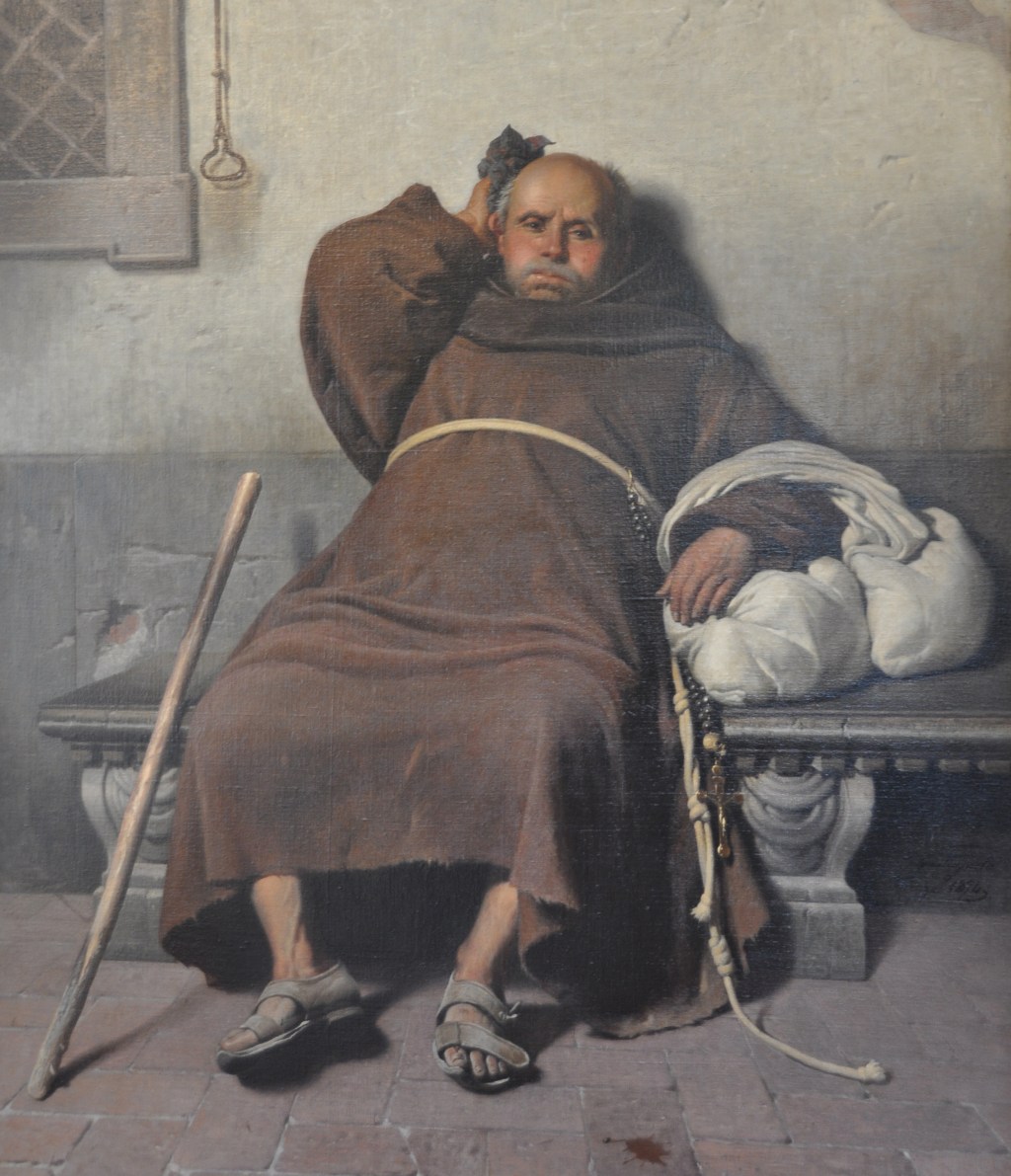
    The Way of the Frayed Knot is a Monk subclass that attempts to feature some Western fantasy tropes. The most common of these is Friar Tuck from Robin Hood, but there are other studious, religious types that fought alongside rogues and pirates.

    Some ignored their ideals. Others felt that the ideals of the gang or troop were more in common with their religious beliefs. In the magical settings of most versions of D&D the Way of the Frayed Knot will have some amount of overlap with a Cleric. While these Monks commonly use bludgeoning weapons, it is not required mechanically, though I’m tempted to make it so.

    This is a work in progress for a subclass of Monk. Language still needs adjustments to meet 5e. My purpose in sharing is to garner feedback about the concept as it fits the description and entertainment within most 5e paradigms. A lot of the power is wrapped up in Cleric spells as rituals.


    Cloistered Student

    The Drunken Monk, Mansion House, Cardiff
    The Drunken Monk, Mansion House, Cardiff by Michael Gwyther-Jones (CC BY 2.0)

    At 3rd level, when selecting this Monastic Tradition, you gain proficiency in Religion (or another Intelligence skill if you already have Religion) as well as a proficiency in one of the following artisan tools — Brewer’s Supplies, Calligrapher’s Supplies, Mason’s Tools, Painter’s Supplies, or Woodcarver’s Tools.

    Circle of Life

    At 3rd level you gain access to the ability to Channel Divinity. You have one use per short or long rest at this level. At 8th and 18th level you gain an additional use of this ability.

    Some Channel Divinity effects require saving throws. When you use such an effect from this class, the DC equals your spell save DC (8 + your proficiency bonus + your Wisdom modifier).

    The Channel Divinity options available are Preserve Life and Sacred Weapon (with Wisdom being the attribute connected to that Paladin ability). You may also use 3 Ki Points towards a Channel Divinity. This cost replaces the per rest cost for that specific usage.

    You may pay 1 Ki Point to cast the following Cleric spells as Rituals at 3rd level;

    • Ceremony (XGtE)
    • Detect Magic
    • Detect Poison and Disease
    • Purify Food and Drink

    At 5th level you gain access to the following Rituals, at the cost of 1 2 Ki Points;

    • Gentle Repose
    • Silence

    At 9th level you gain access to the following spells as a Ritual, at the cost of 1 4 Ki Points;

    • Feign Death
    • Water Walk

    At 13th level you gain access to the following spell as a Ritual, at the cost of 1 7 Ki Points;

    • Divination

    At 17th level you gain access to the following spell as a Ritual, at the cost of 1 11 Ki Points;

    • Commune

    Live to Fight

    Monk
    Monk by Vladimer Shioshvili (CC BY-SA 2.0)

    Starting at 6th level you are able to cast Prayer of Healing at the cost of 2 Ki Points. Your spellcasting ability modifier for this Prayer is Wisdom.

    The use of an additional Ki Point increases the spell level by 1, granting an additional 1d8 of healing to the spell.

    You also gain proficiency in Healer’s Tools if you do not have this proficiency. If you do have this proficiency, you are granted double your proficiency bonus on checks for this tool.

    Submission

    At 11th level your blows are now so potent that Stunning Strike no longer costs a point of Ki.

    Kneel Before the Gods

    At 17th level when you Stun a creature they fall Prone. You also gain an additional two blows from Flurry of Blows. Those blows can be against any target within your reach.

  • Society of Veil and Shadows

    Society of Veil and Shadows

    The Society of Veil and Shadows are a group of rogues dedicated to obscuring and protecting their guild from spies — both arcane and mundane. While able to contribute to the uprising’s success via sneak attacks and other clandestine abilities their true power is their ability to cast a few spells, most of which help keep the rebellion secret.

    This is a work in progress for a subclass of Rogue. Language still needs adjustments to meet 5e. My purpose in sharing is to garner feedback about the concept as it fits the description and entertainment within most 5e paradigms.

    Spellcasting (3rd Level)

    Similar to what is described for the Arcane Trickster, but the two schools allowed are Abjuration and Conjuration. Every member of the Society learns the spell “Block.” This spell is one of the cantrips learned at third level.

    Block (3rd Level)

    cantrip abjuration

    • Casting Time: 1 reaction
    • Range: touch
    • Components: V S M (steel ring)
    • Duration: until next turn
    • Classes: Wizard, Cleric
    • When an Enchantment, Divination, Illusion, Transmutation spell is cast targeting yourself or an ally you can touch, you grant the target advantage on saving throws versus that spell and on any saves versus spells until your next turn.

    Safehouse (9th Level)

    You have learned certain rites and patterns in order to cast any ritual from the following schools of magic – Abjuration, Conjuration, Divination, Illusion. The spells must be on the Wizard spell list. To cast such a ritual you must have a spellbook, or similar, in your possession. These rituals may only be cast once per long rest, each.

    Cloud of Doubt (13th Level)

    You may create a 30′ by 30′ cloud of patchy fog. Any target within the Cloud of Doubt is partially obscured. In addition, any creature entering the the cloud must make a Charisma saving throw or shift its demeanor towards the positive (hostile become indifferent, indifferent become friendly). The cloud is centered on a space up to 60′ from yourself. You must maintain concentration on the Cloud of Doubt, or it dissipates in 8 hours.

    You may create a Cloud of Doubt a number of times equal to your Intelligence bonus (minimum 1) per Long Rest.

    Unchained (17th Level)

    When in shackles, handcuffs, jail, and the like, while conscious and able to speak, you are able to cast Misty Step without using a spell slot. If you cast using a spell slot you may take a number of allies with you equal to the level of spell slot used.

    Misty Step no longer counts as a known spell for you.