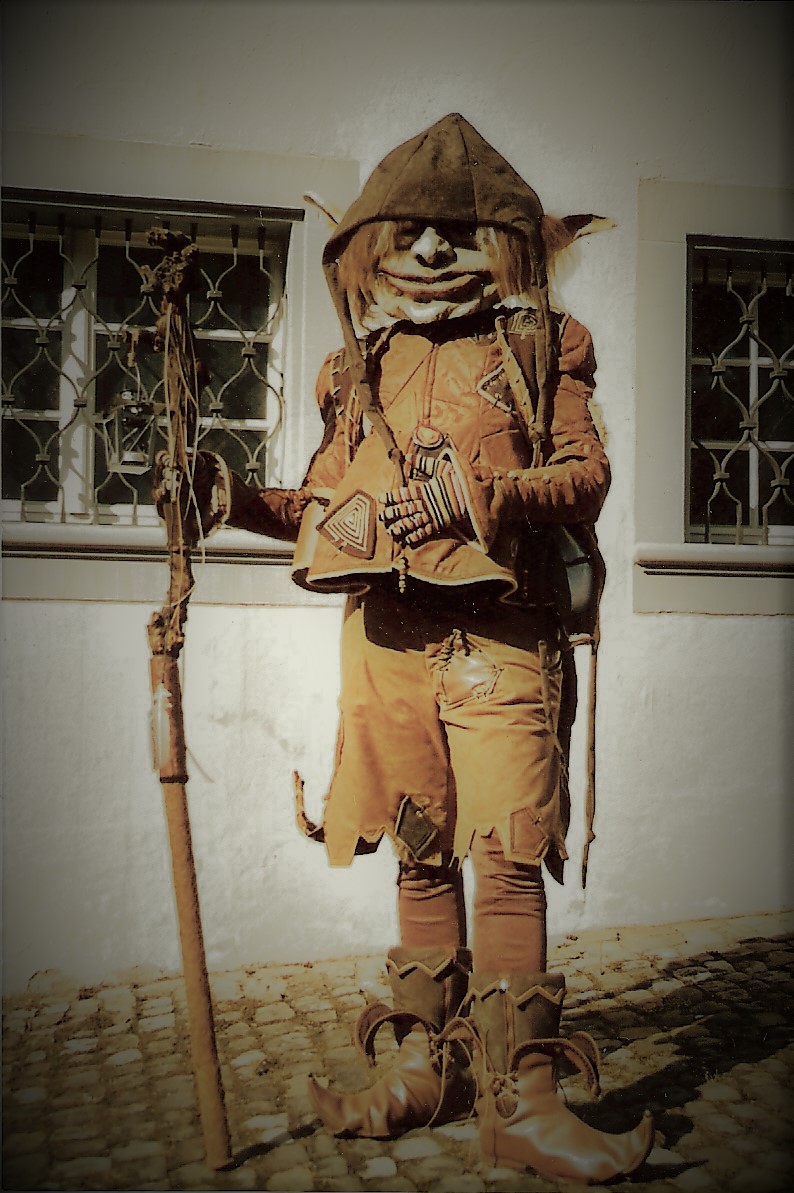
There are two important things in a goblin’s lyfe. I’m talking about all of us, the gobkon, the hobkon, the mulkon — all of us — our relationship to the Queen and our Guild. This is hard for you humans, with all your divergent nations and cities and faiths and disgusting menagerie animals to understand.
By creanita design und ausführung by nina saner (CC BY-SA 2.0)
I’m a printer, part of the Ratxet Guild. My engines run on the power of muls (best!) or whoever else I can hire. The clockwerks give that comforting noise as sheaf and stamp press against each other leaving words behind.
We’re into gears, mostly. But also some other interesting clockwerks. Frankly, we do better with springs than the Union does. Sure, they’ve the Queens’ Stamp – so we cannot sell to others. In our builds we don’t buy from the Union anymore.
My first engine was a climbing device. Lean it up against a feral tar-tree and you’ll be able to get to the top on a platform to work that tree with nary your own effort. It was a tough build, because I needed it to be strong enough for a hob. Without a brother there were no hobs to help me. Sis rode atop my shoulders during the entire testing phase.
At Test it showed a new mechanic for the tar-tree. A Baroness blessed the family via flag and decree. Mother’s standing improved, and the full family took on that glory.
Now, sister is part of the Airxip Syndicate. They’re relatively new. Taking our bike-props and bladders from the Sisterhood, and the Federation’s tar stacks, the Syndicate built those awesome airxips. I don’t understand her werk. There’s something about steampipes. She’s done well for mother. Her flags came from a Countess, one for her and one for mother. Blerxa left on the First Flight with me.
I’m Phatha Phioxa Baroness-flagged of the Guild. Sis is Blerxa Phioxa First-Countess Flagged and Many Unfurled of the Syndicate.
We are what we build and how much the Ladies, may they serve the Queen, reward us for our werks.
A few more daughters like us and mother could be a Lady. If Blerxa and I hadn’t left for the untamed lands of the Kin Blerx may have earned mother the knighting on her own.
Our werks are trapped from knowing since we are far from Queen, so I expect mother to have a few more gobkon. Maybe I’ll find out if I go back, not until after I figure out how to use the power of horses in my next werk. They smell, but they are even stronger than mulgobs.
Whether it’s a critical failure (the dreaded 1 in combat) or forgetting your own abilities leading to tactical error every character will have to deal with defeat at some point, likely often if you aren’t into optimization. These losses are an opportunity.
Not all tales of heroes are about victory. Within pain and failure is the contrast to success.
Recently, in the final battle within Lost Mine of Phandelver the party was completely overwhelmed. We knew of 14 opponents, to include the adventure’s final boss. There are 7 of us. Awf is overconfident by nature. As a Hill Dwarf Bladesinger he wades into the frontlines accepting damage as part of raison d’être.
The problem with that became rapidly apparent as he attempted a rear guard action. Eventually four different bugbears were piling on the broadshouldered dwarf. No one was surprised when he fell unconscious and took a death save from another attack.
Norran, our Half-elf Assassin, slid through the traffic of combat to administer the only healing potion available in that part of combat. With the party split things looked dire for the rear guard group. Bring Awf back up gives Norran and Ambrose, Half-orc Beastmaster, and Awf a bit of hope, when things seem hopeless.
Our session ended in mid combat – and that’s when I remembered that Awf has a Staff of Defense.
AFTER taking numerous blows that dropped him. Through poor play as a player, I forgot about Awf’s 8 charges of Shield that he could use as reactions to limit the battering his body took.
It’s a dumb error.
Except, upon review it is exactly the type of error that Awf Hornjaw et Loragwyn would make in combat. It’s part of who he is and how he operates. My error was in fact playing to type.
Personality Traits I enjoy being strong and like breaking things. I face problems head-on. A simple, direct solution is the best path to success.
From Awf’s Background
And this is where embracing the failure becomes an epic tale. In next week’s session Awf’s overconfidence will disappear. Every single turn a Shield spell will be used to protect either himself or his companions that he placed in danger. Rising from his stupor he learned.
Being in danger is part of the joy of role-playing combats. There will be times that the danger is overwhelming.
Now, due to failure Awf will have a fireside tale that isn’t just about the failure, but also about the success. The mistake of the player will become the character’s epic song.
In wine, beer, coffee, etc there’s the concept of the perfect pairing. At its simplest, the concept is to find foods that complement that specific flavor notes of the beverage. More completely you can find ways to do this through similar and disparate notes – sometimes hitting opposites on the flavor wheel gives the taster an experience that highlights both the food and the beverage.
Pairing beverages with gaming in something I just do. When playing Awf I always have a beverage. Sometimes that beverage is inspired by his personality – drinking an earl grey lavender toddy out of a masonry mug to highlight his duel cultures of dwarf and bladesinger. Other times the beverage connects to the adventure that Droop’s Brigade is going – Skookum Caverns, a barrel aged strong ale, as we enter Wave Echo Cave.
The use of flavor here helps inspire the story being told during that gaming session. The flavors evoke a mental space where Awf’s unique history of annoying elves enough that they taught him bladesong, despite his being a stubby dwarf, is brought to the forefront. Or, the dangers and darkness of a cave are brought to the front of mind through can art and the potency of a strong ale.
Flavor does wonderful things. Pairings aren’t just about maximizing the flavor experience. The connection between taste-smell and memory is powerful. People buy Kona coffee because it awakens memory, much more than due to its quality. A margarita on a cold winter day can put your headspace back to a nice beach vacation. Hot cocoa in front of a fire, even while home alone by yourself, will send you dreaming back to a Christmas visit to a small town.
As roleplayers, in Dungeons & Dragons or any other game, we can use the magic of flavor to help us. The foods and beverages of your game night are important. Make those small choices that aid gaming, just like you would a token, art, or cosplay.
Rather than confine yourself into using flavor as a way to connect your current character, you can also use flavor to inspire new characters.
Each of those characters started with the simple prompt related to a beverage and the object out of which it is consumed. From there decisions were made not just regarding the race, class, and background, but also to inform the skills, attributes, spells, and weapons chosen.
Rum connected to sailors, pirates, merchants, or water genasi. Carbonation was an indication of something light, refreshing. Salt a connection to authority. The mistaken belief that halflings are just old children popped into the head with the root beer.
What those various prompts did was start internet searches into the techniques used to create certain beverages, into their history, into their cultural significance. Chasing those touchpoints and activating them through D&D and by including others in the process, my character portfolio expanded. These are now new NPCs, or maybe even PCs, that would never exist.
Food and drink can inform your characters just as art, books, movies, shows, music and media can. Great cooks say that their meals tell stories. Adapt that into your PC and NPCs.
Empower flavor to empower the stories you tell.
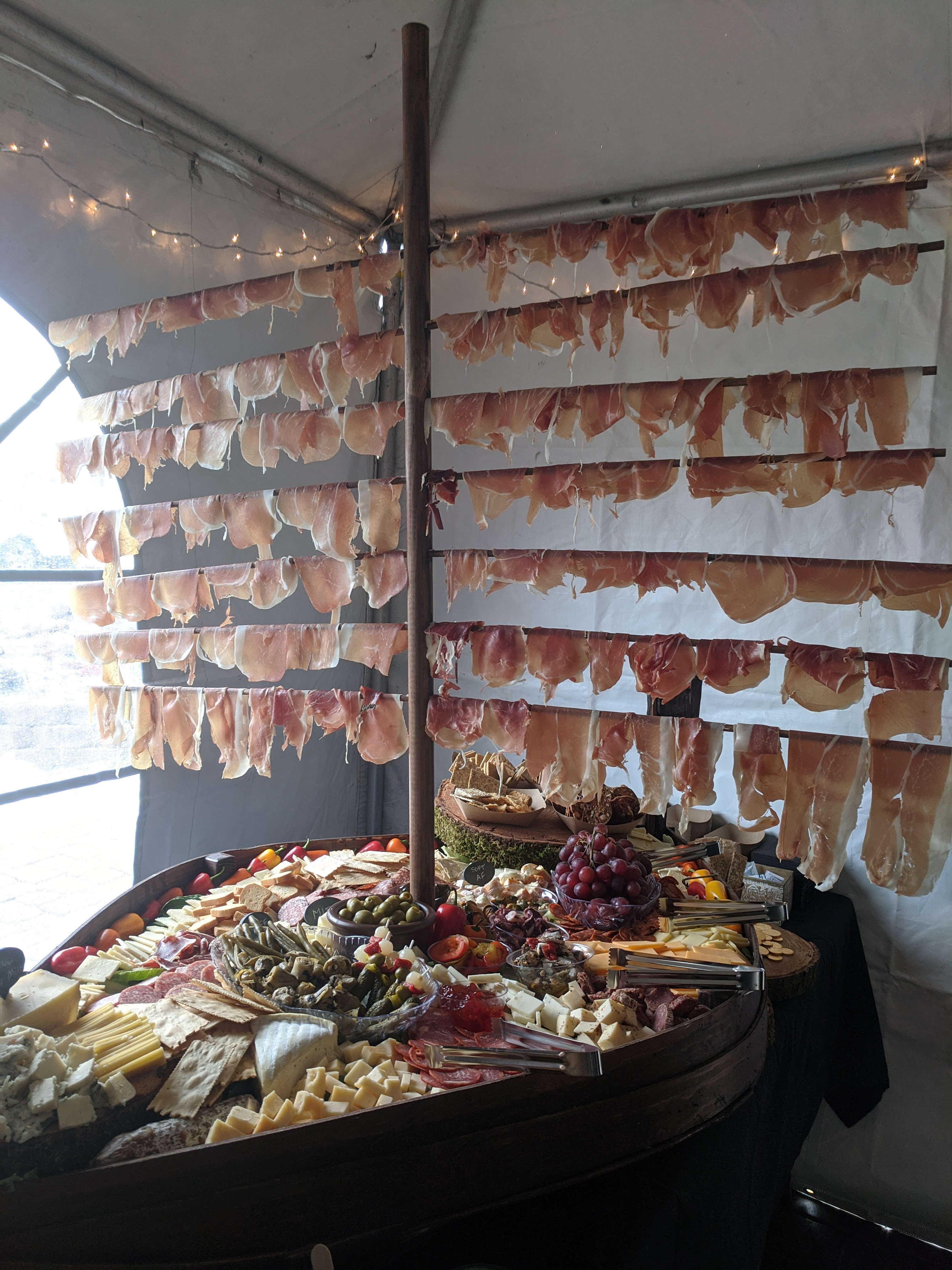
What type of character builds a replica longboat and uses it as a charcuterie table? How does that inform who they are?
In general I’m fascinated with Tier 1 play. But there’s another trope that I enjoy — the old-timer who retreated from the life of adventure and war, but who for some reason gets called back into it. They’ve done their best to avoid violence. Instead violence seeks them out. The Fighter: Conscript (final name TBD) has seen things. Things no one else should see.
When they get the call to return to their former life they are no longer concerned with having the best weapon and the best armor. Their wits and experience taught them that any tool can be used for any job.
Design Goals
With this subclass the desire was to build a character who attempted to retire from their life of violence. They still know how to fight, they just stopped. Then, for whatever the cause, they re-entered the realm of warfare. Most often this transition occurs when they are on their farm, in their tavern, working their forge.
They use the weapons at hand and the armor of peasants, and yet fight like the mightiest warriors. The build should support the use of simple weapons and lesser armors with Strength being the primary stat.
Fighter: Conscript
You are a light fighter who once served as a conscript in a standing army or militia. While there you learned the horrors of war. You also learned how to survive. You fought with what was available. Then, the war ended.
Now, you attempt to forget your past. Your neighbors may look at you as a hero or a villain. That depends on your behavior and their opinion of the forces for which you fought. You go about your days, an expert smith, carpenter, vintner, or other artisan.
Recently you’ve felt the call. You are duty bound to pick up your sickle, spear, gambeson, and those well-worn boots again. Your people need help, and you are called to serve.
Tough as Nails
Starting at third level you may choose to use your Strength bonus to Armor Class rather than Dexterity when wearing any light armor or medium armor.
Plowshares into Swords
At third level you gain the following abilities as a reflection of your life after service.
You are proficient in improvised weapons.
When using simple or and improvised weapons you gain +1 to damage on a successful attack.
You gain proficiency in an Artisan’s Tool. If you are already proficient in an Artisan’s Tool you may instead choose to have expertise in that Tool.
When recovering spent ammunition you recover all of it, rather than half.
Wise Beyond Years
At seventh level you gain proficiency in Insight and Intimidation. If you already have one or both of these skills you may take any Wisdom skill instead.
Heart of the Lion
At tenth level you are noted for refusal to give up the fight. You have advantage on saving throws that would impose the following conditions: Charmed, Exhaustion, Frightened, or Stunned.
Rally from Defeat
At 15th level you inspire your teammates. When an ally within 30 feet fails a saving throw that causes damage you may use a reaction to grant them temporary hit points equal to your Fighter level + your Wisdom bonus and they may reroll the saving throw. They must accept the second result. Your ally must be able to hear you. This ability may be used proficiency bonus number of times per long rest.
Bones of Steel
At 18th level your Armor Class is adjusted by both your Strength and your Dexterity Bonus. This bonus is not subjected to a limit based on the armor. When you take damage you may use a reaction to spend a Hit Die to recover Hit Points as if you were taking a short rest.
All of these backgrounds vary from the system as outlined in the Player’s Handbook (2 skills and 2 languages/kits/games/instruments/tools). They are slightly more powerful, but also have limitations in regards to origin kingdom and maybe negative features. The bonuses include an extra non-damaging cantrip, a bit more equipment, a single weapon or companion points. A DM running a game outside of the World of Everflow should take caution in adding these to their campaign, but they may be needed flavors within their world.
The backgrounds are: Street Mage, Glight’s Monitor, Keeper of Everflow, Tinker, Farmer/Rancher, Messenger Service, Villien
This post was updated on 5/24/2020
Street Mage
Performing on the streets earned you a few coin, and the feeling that you are constantly hunted by those that wish to limit magic. You’ve found a way to take the new magic and use it to entertain the common man. You can be a hustler, an entertain, and some even call you a charlatan, but you know that magic is real and there is potential for so much more to Kin than a few animals and stodgy rituals.
In most of the West street mages are welcomed in the ghettos while watched by the Guard when they visit good neighborhoods. In Qin they are often found dead in alleys, unless they are part of the Ashen Scarves.
Skill Proficiencies: Performance, Sleight of Hand Tool Proficiencies: None Languages: Two languages Equipment: Gaming set, Fine clothes, 3 shells or similar, belt pouch containing 15 gold
Feature: Prestidigitation and Wanted
Word of your powerful magic (it’s not necessarily powerful) has spread. You heard you were being hunted and now know you cannot stay in one town too long as word will get out that you have learned to control magic. There are many who distrust magic, as the Awakening and magic lead to the fall of Sheljar and other cities around Kin.
These itinerant teachers visit small villages on the Day of Glight. They encourage reading, study and a knowledge. In all villages they are a welcome distraction from day-to-day life. The Day of Glight ensures that everyone has a bit of an education in how the Kingdoms came to be and what the various faiths are. But none can explain the Awakening and these magics that are now real, rather than legend.
Glight has the second most followers in the West. These teachers are common throughout Kin, even in Azsel.
Skill Proficiencies: History, Religion, Arcana Tool Proficiencies: None Languages: One of your choice Equipment: Folding chalkboard, chalk, common clothes, history book, belt pouch with 10 gold
Feature: Pupil in power
A former student of yours is now in a place of influence. During your traveling and teaching you taught hundreds. One of those is now in a position that can help guide you towards finding the answer to a question or the merchant that sells the rare, but needed equipment.
Characteristics: Sage
Keeper of the Everflow
Prerequisite: Must be a follower of Quar.
The Church of Quar and Bishop Ollium lead the largest faith in the West, Kirtin and Daoud. Due to the Everflow’s powers Quarites are popular in the other Kingdoms as well. The Keeper of the Everflow is part merchant, part cleric. They heal and serve the people, for a price. You serve this powerful Church spreading the word and maintaining its influence in all the Kingdoms.
Shrines and churches to Quar dot the landscape throughout Kin. The Church’s historical control of the Font of the Everflow and Lake of Two Paths empowers them to limit all other faiths’ potency.
Skill Proficiencies: Religion, Persuasion Tool Proficiencies: Calligrapher’s Supplies Languages: One of your choice Equipment: One vial of the Everflow, 5 sticks of incense, vestments, common clothes, belt pouch with 5 gold
Feature: Gift of Quar and First Aid (Spare the Dying if played outside of the World of the Everflow)
When you visit a temple of Quar you can ask the ruling deacon to give the gift of the Everflow. If they have the resources and find your needs worthy you will get one vial.
At non-Quarian temples you can still make this request but the chances of success are minimal. Most faiths will make an exchange for a lower price than typically asked.
Characteristics: Acolyte
Tinker
Tinker’s travel between farmsteads, hamlets and villages that lack most smiths. They use both natural and magical means to repair metal goods. In the evening they share news or stories from history and legend. You don’t have a home, and have long left your family. Now, wandering the world you discover new tales and new ways to fix the problems that keep people from doing the things they love.
They are particularly common in the less organized West as well as areas under sway of the Crinthian Confederation.
Skill Proficiencies: Performance Tool Proficiencies: Tinker’s Tools Languages: Two of your choice Equipment: donkey/mule/pony, Tinker’s Kit, 1 pound each tin, copper, iron, pack saddle, traveler’s clothes, pouch with 5 gold
Feature: Job Seeker and Mending
Whether fixing small metal objects or telling tales in the local inn, you find a way to survive at a modest level. This can be through a mix of both activities or just one. If fixing objects all of a morning or afternoon of most days is occupied. If at an inn every evening and some afternoons are occupied.
Characteristics: Folk Hero
Farmer/Rancher
You raise crops or animals for food. At some point your property, or that of your neighbors needed defense. Some of your friends and family were unable to survive the raid from the bandits, but you did. That’s when you discovered there’s more to life that a cock-a-doodle-do at dawn, milking goals, shearing sheep, weeding, swinging a scythe. Your people need protection. You are their hope of a simple, safe life.
Many farmsteads and ranches in Telse lose family members to quests, adventures and those that are searching for better lives. In Kirtin every man or woman must serve, some do not come back from service. Daoud, Azsel, Mehmd and Crinth all have portions of the populace that start as mere serfs and become greater.
Skill Proficiencies: Animal Handling or Athletics, Nature Tool Proficiencies: Farmer’s Tools, Vehicles (Land or Water) Languages: None Equipment: Farmer’s Tools, common clothes, a beast of burden (mule, donkey, dog, flightless bird), lantern, flask of oil, week’s rations, pouch with 1 gold and 17 silver.
Feature: Druidcraft and Foraging
In occupied lands you know how to take just enough food to live without most farmers/ranchers noticing, unless you do so for more than 2 days.
Characteristics: Folk Hero
Messenger
Prerequisite: Your bonded companion(s) must be a messenger bird/dog or a riding horse. You gain an extra companion point.
Messengers work throughout Kin and the Lands of the Everflow. Their birds, dogs and horses carry news, treaties, love letters and more between the cities and towns that remain in the post-Awakening world.
Skill Proficiencies: Animal Handling Tool Proficiencies: None Languages: Any three Languages Equipment: Common clothes, map case, ink, quill, 5 pieces of paper, pouch with 15 gold
Feature: Service Connections Past messages have been sent to two major cities as well as two small towns in the past. Your bonds know how to get to these places, to your home and to yourself.
Characteristics: Folk Hero
Villein
When a youth comes of age they or their family visit the local Villein. While some, particularly Crinthians, do not use a service, many Kin find their first companion through the services of those who know animals as well as any.
Most Villeins deal with mammals, though some in Daoud have experience with fish. Those in Mehmd deal with saurs and lizards.
Skill Proficiencies: Animal Handling (Expertise), Nature Tool Proficiencies: None Languages: None Equipment: 50 gp worth of non-bonded animals, common clothes, pouch with 5 gold
Feature: Domesticating beasts
You are able to calm the semi-wild beasts and prepare them for a bonding session. You also have two additional companion points but must have more than one companion.
Characteristics: Guild Artisan, your art is raising animals.