They’re different from novels, short stories, comics, theater, movies, and most other forms of storytelling. That does not remove the tale being told nor the concept of story.
If anything they are most similar to communal storytelling around a campfire and improv dramas. For the most part roleplaying games are communal events with a group.
How did I bump into this well-worn debate? Via a recent thread on EN World, the rare bright spot in RPG discourse.
My response there focused mostly on the story and plot aspects, and the power of having more voices (something rare in written fiction, but common in other forms of storytelling).
There are people who are not good authors, nor good directors, nor good actors who are good roleplayers/gamemasters/etc. By leaning into the ways that community, plot and play-to-find-out work the creation displays, maybe even demands, story emerges.
Sometimes conventional Western storytelling formats can lean into the things that make the emergent and divergent story that happens in RPGs. This can be magical — because it shows how all story is really a reflection of point of view, or in our hobby — spotlight.
RPGs-as-story feel messy when considered through a lens of a literature class or mainstream television.
But, stories are quite messy
Two people can read the same story, watch the same film, listen to the same podcast and come away with different meanings, see different main plots even.
To me, RPGs are stories in the way that campfire tales are. They involve a lot of wandering, forgotten threads, lack firm outlines and are at their best when the tale is woven through multiple voices providing input.
Can they be a traditional novel after the campaign? Absolutely! But during the telling of the tale they are similar to writers who don’t edit as they go or a director who over films alternative concepts that aren’t on the script.
One of the more thrilling things about RPGs is that it is an ensemble cast of both PCs and recurring NPCs. Together they’re important, but the tale and spotlight as to who is most important can easily shift. Use any of them as the point of view to change the story as you understand it. Each can be vital.
The messiness is the fun part of RPGs as story.
The messiness is what helps me discover tales I cannot tell on my own. That’s part of the power of the table and broad casts in ensemble stories.
You think you’ve seen stories like this before, so you can guess what’s going to happen. Who’s important and who isn’t, but that’s because you’re trapped in your POV. – later – When you file people away as sidekicks you don’t realize their importance to the story, and this story belongs to a lot more people than you think. Where to shelve a book, it’s not a little thing. You’re telling the world what to value. Who to value.
From The Magicians, Side Effect (S4, E7).
RPGs are very much like that.
They remove your assumptions. You don’t know what’s going to happen. The POV constantly shifts and the importance of the broader cast shifts constantly.
From RPGs-as-Story we learn what and who to value by including others.
It’s incredibly difficult to capture what D&D can be in 30 or 60 seconds. That may be part of why the latest advert for the Starter Set, Heroes of the Borderlands is 75 seconds.
That’s also a short amount of time.
My sessions are typically three hours. We’ve played nearly a dozen campaigns in 5th edition from 2014 to the present averaging a game session every other week for the past 11 years.
Critical Role plays closer to four hours on average with the main campaign playing about 40 sessions a year over that same stretch.
How do you introduce the layers of play, the layers of friendship and the depth of potential in a minute?
Wizards of the Coast did that by showing a generation of players who said yes to adventure in the 90s and now play with their kids.
Saying that first “yes” to playing D&D
The people who introduced me to Dungeons & Dragons way back in the 80s introduced me to science fiction, to creative writing, to journalism and debate.
Later the second group I played with introduced to the concept of joining the Army, anime/comic books, writing my own game, and British comedy because we played Twilight:2000, Albedo, TMNT, Synnibarr, MERPS and of course D&D.
Saying yes to Vampire: The Masquerade helped me during language school, when the stresses of required success were overwhelming and I needed an escape from the combination Army-university life.
A year later saying yes to D&D with another nerd in 5th Special Forces Group helped me be myself while being all I could be and more. Those duet sessions created an escape and creative outlet.
Then I stopped.
Saying yes later
As my soccer blog matured and jobs came-and-went 5th edition D&D came out. I didn’t have a group. I hadn’t played in two decades except for those dozen or so sessions with a combat medic.
But, I was intrigued.
I asked my friends who wrote with me, who edited, who advised a small soccer blog as we grew.
Those first sessions of 5e included grand friends who helped each other learn the new system, remember our pasts and tell tales of glory through fellowship.
Those campaigns tuckered out and then ceased due to a wonderful job opportunity and then the pandemic.
Yes during covid
My last yes to adventure was when one of those friends asked me to DM again. During the pandemic I’d stopped running sessions. I still played, but online play and my DMing style don’t get along. I tried it once, in an actual play.
This yes meant getting a new group together. The old groups had scattered. Unlike the characters in that D&D advert I’ve never managed to maintain a group across decades. Not even my brother who was part of that first yes still plays.
This yes has our group playing in public, right in front of other people who don’t know what D&D is. We played with strangers who became friends. We introduced others to the game.
Marketing D&D
Saying yes to playing role playing games took me a lot of places.
And in 75 seconds the marketing team behind D&D reminded me of all of that. Taking us backwards on a journey of glory, of watching a child grow up, of a pregnant woman playing the game and a group of friends who stick together from 1995 to the present is brilliant.
Where will yes take you?
To the Caves of Chaos and The Ferments. To rolling d20s at a brewery and getting on stage at a security event. To Krynn, to Theros, to Sigil, to Exandria, to Trinyvale, to The Strix, to Wagadu, to al-Qadim, to Grim Hollow, to Drakenheim, to Midgard, to Obojima, to Eberron, to the darkest crypts and the glorious eternal afterlife, from dragons to halflings.
But mostly it will take you on a journey of friendship and discovery of the stories that you are unable to tell yourself.
That’s what saying yes does — it opens you up to things beyond what is contained within your own being.
Somewhat overshadowed by the release of several high-fantasy systems not based in 5e D&D is that Wizards of the Coast has two starter sets, a two-book/three-pdf Forgotten Realms set, and Eberron expansion coming out from September through the holidays.
Additionally, other 5e systems inspired by D&D are also cranking right now.
There’s a plethora of choice, right as genre TV’s most D&D related property is coming back — Stranger Things season 5 releases Thanksgiving, Christmas and New Year’s in the U.S. Several of the early monsters based on Dungeons & Dragons are making a comeback.
Your normie (non-RPG) friends may be interested in the game again thanks to the combination of product releases, the Mighty Nein release, Stranger Things and the general zeitgeist around being big heroes with power in a world where that feels missing.
What game or books are the right system for them right now?
If you read Full Moon Storytelling it is likely that you are a DM/GM. It’s also likely that you lean towards 5e D&D. That will be the focus, with a small discussion of the other systems capturing attention (million dollar+ Kickstarters and the like).
Are you the GM/DM?
Go with what you like best, what fits your world, and be welcoming. Cut back on house rules and homebrew, at first, as the people who are new to the game can be overwhelmed with normal rule sets that can stretch to 1,000 pages.
Fold the new invitees into your world by asking them what they enjoy about high fantasy roleplaying. Finding out what your table’s Appendix N always helps, but it is the most helpful knowing what someone new (or returning from long ago) to the hobby wants.
If they want something simple, but familiar like the D&D of the 80s, but modern there are a few routes. Sticking with 2014 5e one can still get the older starter sets from Target or Amazon. Dragons of Strormwreck Isle is under $16 at Target online, and some physical stores may have it. Check with your local gaming store to see if they are offloading old product.
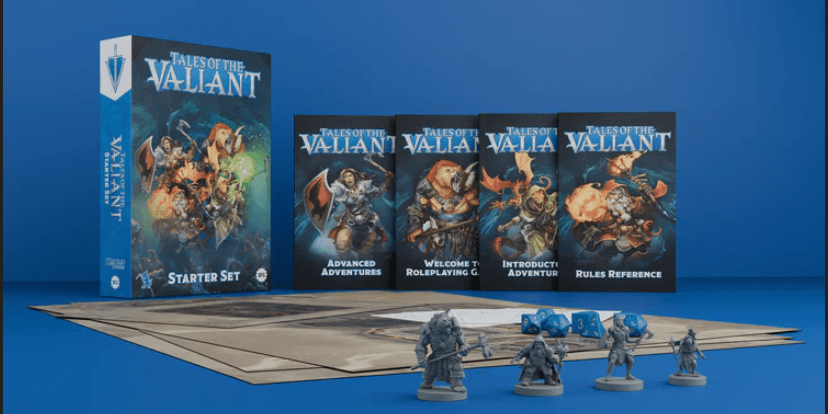
You can also intro them to 2014 via Kobold Press Tales of the Valiant Starter Set. It is under $14 at the time of publishing. The primary differences between Wizards of the Coast 2014 D&D and Tales of the Valiant lies in Tales having character creation that separates nature and nurture, luck replacing inspiration and the insertion of unique abilities on every monster.
I’d recommend Tales of the Valiant over 2014 D&D because of those changes, even if it doesn’t have the branding your friends expect. It also comes with minis! If Stormwreck Isle is 5.1 5e, ToV is probably 5.3.
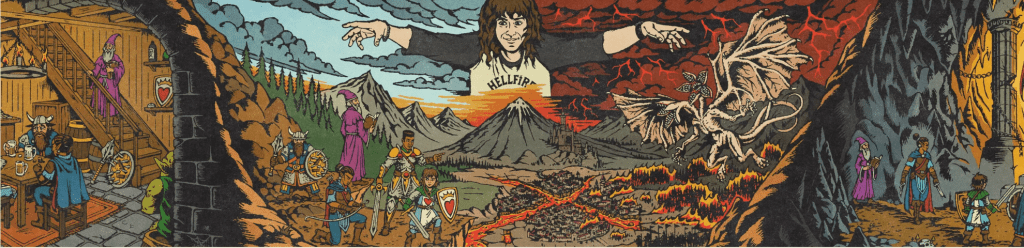
Stranger Things: Welcome to the Hellfire Club
Maybe your friends didn’t get into D&D from Stranger Things season 1, or 2, or 3, or 4. Or maybe they did, but didn’t have the time, energy or mental space to play the game.
Welcome to the Hellfire Club uses Wizards of the Coast’s modern take on starter sets — lots of tokens, handouts, cards and a written approach that blurs the line between board game and roleplaying game.
modern take on starter sets — lots of tokens, handouts, cards
The presentation includes a look that borrows from 80s nostalgia as expected. The four adventure books include trade dress that would make Gary Gygax and TSR proud.
This is the second starter set built out of Stranger Things by Wizards of the Coast. Both lean heavily into using the voice of the character from the show that was the featured DM, lean into the mythology of the TV show with its ‘not quite D&D monsters, but monsters that middle/high schoolers would think are D&D monsters.’
The first Stranger Things set was rather linear in nature, which fit the times and works fairly well for people newer to roleplaying. Welcome to the Hellfire Club uses 2024 5e D&D rules.
D&D Starter Set: Heroes of the Borderlands
Similar to Stranger Things pulling out 80s nostalgia to pull people into its world, Wizards of the Coast uses Dungeons & Dragons most popular adventure from the foundational period to inspire its new general purpose Starter Set.
Keep on the Borderlands is now Heroes of the Borderlands, with three adventures. Using 2024 5e D&D’s rules, card-based character creation, tokens and maps, the intent of Heroes is to again bridge that gap between board game night and RPG night.
Because it is 2024’s rules rather than 1974s, the set is massive. Those three little folios that could fit in a small lunchbox are gone. Instead Heroes has more than 400 cards and tokens, a quick start, a set of rules, and three adventures.
The game of D&D is simultaneously more complex and more approachable than it was in the 70s and 80s. Being a more pervasive part of the culture is part of that. Also the decades of exposure to computer RPGs changes how one approaches teaching the game.
Forgotten Realms expansions
A massive two-book, three-digital book expansion coming with the brilliant marketing around “The Realms will know your name” these books aren’t necessarily great for first timers to tabletop roleplaying, unless…
You know people who were heavy into the lore of Baldur’s Gate 3 and/or D&D: Honor Among Thieves and/or the once dominant fantasy novels set in the Realms. Those legends exist within the expansion, but the point of D&D and RPGs in general is to tell your story.
Only dive into this if you are being joined by people who absolutely love those non-tabletop versions of the Forgotten Realms. These expansions include 50 micro-adventures that fit an on-the-fly DM rather well (similar to those in the 2024 DMG).
Those playing with your classic group you need little guidance. If you are using the 2024 D&D rules, or at a table that permits a broad swath of 5e rules, the expansion is handy if you want to borrow factions, subclasses, new species and nuggets of lore to insert into your homebrew.
In total the Realms expansions add about 30% more character creation options while dramatically expanding the story through the lore expansions.
Eberron: Forge of the Artificer
High fantasy doesn’t have to take place in a world that’s pseudo medieval/Renaissance and Euro coded.
It can also include pervasive magic, spread widely among the populace in a world that echoes tropes related to early Industrialization with great Houses, lightning rails, elemental airships and a ‘war to end all wars.’
That’s Eberron.
Forge of the Artificer is a lightweight updated to the setting originally invented by Keith Baker.
Don’t get Forge of the Artificer unless you already have Rising from the Last War or you really want to have the magitech Artificers at your table or you are a completionist. I’ll be getting it for the first two reasons. I’m currently playing a goblin Artificer.
The Artificer in Forge is updated for 2024 with a brand new subclass as well. From what was in the Unearthed Arcana developing this coming version of the Artificer it looks to have the quality of life improvements I would expect.
Other RPGs
LevelUp
LevelUp is built on the 5.1 5e chassis, but advances it. This does make it a more complex version of high fantasy role playing. Some of the greatest improvements come from expanding the social and exploration pillars. This helps tell a wider variety of stories. Like every offshoot of D&D from the 5e era it separates nature and nurture.
There’s now a Starter Set available. Yes, it has tokens and multiple adventure, because that’s what modern starter sets do. EN Publishing’s Starter Set is an excellent way to try on a different version of the game you already know.
Cosmere RPG
If you enjoy Brandon Sanderson’s writing you might enjoy the Cosmere RPG. It is not based on 5e. It is the highest earning RPG kickstarter of all time.
Cosmere is beautiful, complex and the most extensive lore heavy game upon release likely ever.
Draw Steel
While not the level of Kickstarter success of Cosmere, Draw Steel was still a massive earner. The design team from MCDM is mostly people who produced wonderful 5e products, but are now releasing a system that emphasizes combat (tactical, heroic, cinematic) even more than D&D. The rules are crafted so that the feeling of conflicts is a reminder of watching a movie or TV show’s fight scenes.
Daggerheart
If Draw Steel is inspired by D&D, but wanting to be more combat, Daggerheart is inspired by D&D, but wanting to empower more story. Like Draw Steel and Cosmere, Daggerheart is a wholly new system. Most simply defined there is a Hope/Fear mechanic attached to the double-dice roll of players. Additionally it covers more ground about how to communally create the worlds and social interaction. Coming from Critical Role’s Darrington Press Daggerheart is designed to showcase the types of stories Critical Role excelled at.
Similar to Cosmere and D&D there is a wealth of media associated with it already — with more coming from the media arm of what was once a D&D actual play, but is now a multimedia company.
There are plenty of other games too — listing them all is foolhardy. Pathfinder and Starfinder, Legend of the Ring, Warhammer, Shadowdark and the list could go on.
But the zeitgeist right now seems to be focused on 2024 D&D versus a few upstarts with million dollar or more crowdfunding campaigns all coming out in the second half of 2025.
A few years ago it was the heyday of big, high fantasy TV series. Yes, the grit of Game of Thrones and Witcher were still popular, but there were also a selection of shows with a higher level of magic, higher level of heroism and a set of characters who you wanted to win. It was the era of peak fantasy TV.
Slowly but surely these faded away.
Screenshot of Willow on Disney+
Some series got a reasonable run — The Magicians reached a conclusion. Some series were cut quite short — Willow, ended with more story to tell.
Universes were announced to be expanding. Shadow & Bone went from having the Six of Crows spinoff announced to the entire project dying.
There was big money in fantasy for a bit. These weren’t Brit TV specials like Merlin or modern attempts at low budget like Xena.
The biggest money of them all is still around. Rings of Power, the prequel-ish endeavor by Prime Video churns along at price points that are normally saved for theater or Andor.
The wheel weaves as the wheel wills, always turning.
Sometimes the wheel destroys the things you enjoy, like Wheel of Time — especially the last half of season 2 and all of season 3 with strong reviews and great fan appreciation. While there was enormous pushback against the changes made to adapt to the shorter run time of a book plus a bit per season, as well as pushback against the attempts to be less coded and more openly diverse, the series was generally well received. It was generally profitable.
Playing games in those worlds is active participation in the fandom, and helps build out that word of mouth.
You don’t need to have an authorized book in order to play. Any fantasy series, movie, video game, book, comic, etc can show up at your table.
You can instead borrow the themes, cultures, characters and put them in your world. Sure, you could play pure within the world created by Robert Jordan or Lev Grossman or Jonathan Kasdan.
The power of roleplaying games is that the tale is yours, no one can take it from you. The rules can be simple enough to fit on a business card or so complex it fills bookshelves.
What happens to Jade, Kit and Elora?
That’s up to you.
What happens to Mat, Perrin, Elayne, Min and the rest?
That’s up to you.
Take the themes, tropes and world of that story that a committee decided was no longer worth being told and tell it yourself.
That’s why I fell in love with D&D and RPGs in the 80s.
The unfinished trilogy, or maybe not
Back in my youth my bookshelves were covered with science fiction, fantasy and encyclopedias. Words on a page were meant to be consumed by me, like a black hole consumes a galaxy.
I’d shop at a used bookstore, looking for a new series to start. Except sometimes I’d never find book 2, let alone the inevitable trilogy. Sometimes I would start with book 3!
One of my favorite tales, and I say this as someone who had pets but didn’t really discover the love of pets until my 30s, was a story about a fading order of knights who rode giant tigers. The hero wasn’t really part of the order. His family was and he had that extremely large cat. In this dying world they journeyed, starting as outsiders and immediately recognized as legendary. But they were just a dude and a great cat.
They didn’t want to be heroes. It was so compelling, this story of man and beast who wanted to be normal while the world needed them to be great.
I never found book 2.
But I had already discovered Dungeons & Dragons. A character paralleling that tale was created. We roamed the worlds that Erik and Justin and Chis and Abel and Hayes and Jacob and Colin and Andrew and others created.
We finished that tale.
Wheel of Time is over, unless it isn’t
The series explored slightly different things from the books. One of those was how tales are told. There’s a suggestion from the meta of the series that within a world where there are endless retellings of tales and history.
What changes, and what stays the same is part of that story.
Your RPG could lean into that by playing similar characters at different levels, at different times with a power to oncer per month to have a past power show up, maybe ramping faster as time goes by.
Another possible exploration from the Wheel of Times series and books is how power corrupts. The nature of saidin is that man with power lose control of themselves — mentally, emotionally, physically.
Want to toss a saidin power into your D&D?
Maybe your Rand-ish character is a Warlock that has to roll on the Wild Magic table every time they cast a spell.
Of course, one of the most potent tales from the books that is amplified in the series is that women are not side characters. They are as important to the story, and powerfully so, as anyone else.
You don’t need special rules for this. The modern versions of D&D encourage this.
From Willow there is a connection in the series to the tales from the movie (history is a massive throughput in Wheel of Time as well).
To see this at your table means connecting a current adventure or campaign to one that ended a decade, a century, a millennia, an age ago.
A D&D campaign that builds off of former campaigns is a structure that generally needs some continuity of players, but can also be done through one-sheets, common knowledge pages and a regular re-telling of special moments.
This could happen around the campfire, on the steps of a temple, inside a tavern or any place where the PCs meet NPCs.
Find what’s important from these tales and make them your own
It’s rough to lose a special story.
You have your memory. You have your hope.
You have a game to help you continue the legends that are important to you. You don’t need Rafe or Sera or Kasdan.
There’s a lot of guidance on how to be a better DM. There’s some guidance on the player-side of the table. The most prolific of the player-side guidance is about character builds.
Instead of focusing on the character or DM, we’re going to focus on the player. What can a player do to prep for their next session? How can they help their group move at a pace that matches the genre of the game?
While the examples provided relate to Dungeons & Dragons, the fundamentals apply to most roleplaying games. You should be able to prepare in less than 30 minutes. These tips may be basic, but they’re steps I take every time I’m a player in my current era and come from my experiences in my bifurcated RPG time (early 80s to mid-90s, 2014 to present).
Review your character’s motivations
Others may push you to look at your powers first, but to me what makes a pen-and-paper RPG (even if it is D&D played on a VTT) special is that you get to act as the character would act. You aren’t constrained by anything but the willingness to be a coherent character.
To do so you should spend a few minutes thinking about your character. That could mean checking what their alignment is, what their personality is, what their goals are, how their family motivates them, etc. Don’t have them act slovenly if they’ve been cleanly in the past. Don’t have them be a chaos agent if they are orderly.
Do talk about how their brother inspired their quest. Do put forth that they are searching for their best friend. Do have them be motivated by riches and treasure.
Reviewing motivations means putting on that character’s face for a couple of minutes.
Review your character’s abilities
Character sheets can be complex. D&D PC sheets can be two-plus pages with spells and feats and features and weapons and masteries and riders — this list can go on. But for most characters you have a primary attack, a secondary attack, a way to interact in social encounters and a way to explore (or other pillars for other games).
Focus your attention on the main things your character does because they are good at them. At the table that’s what you’ll do. Spending a minute or two reviewing the rules for the things you do should speed up play as you won’t be looking up the rules live. This is especially important if the character has recently leveled up, acquired a magic item, or added a new feature.
Also remember what your character shouldn’t do because they are bad at it. You may want to hint at that during play. Maybe you are a Barbarian who shouldn’t be doing ranged attacks, bring that up when the group wants to snipe at distance.
Plan to use an ability or feature you haven’t in several sessions
When you’re looking at your sheet maybe you’ll notice something that your character hasn’t done in a few sessions. Find a way to do that in the session you are prepping for!
Xabal, my goblin Artificer, started using a spell called Caustic Brew regularly. They hadn’t used it in enough sessions that I forgot I had it. This week I committed to bringing it back to the forefront. Xabal blasted an automaton with it and later used it to break open a gate.
Review the party’s names, excellences and weaknesses
In real life most of us don’t forget our friends and coworkers. In a game like D&D, where some of us only play once a month, it’s easy to do so. As a player that’s understandable. It’s not for the characters.
Our recent session continued an invasion of a mob warehouse. Xabal wouldn’t forget the other character’s in the party, what they are good at and what they’d need help with.
The only way to ensure that you, the player, don’t forget the other characters in the group is to take a moment to review their names, their skills, and what they are doing adventuring with your character.
Remember the adventure and campaign goals
You don’t have to be a deep notetaker for this one.
Take the time to think about why the group is on this quest. What does success look like? What does failure look like?
Why is Xabal’s group invading a mob warehouse? Because they were sent there by an organization of mages from the ruling powers who think this mob may be connected with cultish activities that are attempting to overthrow the order in the world.
By knowing what the group’s goals are you may avoid going on that weird side quest or shopping trip or winding up with a 4-hour session in a tavern — you might not avoid it though! That’s the power of playing as real people. Sometimes we don’t do the smart thing or the right thing. We still should be ready to do the proper thing and know why we aren’t
These are my four steps to getting ready to be a player in a D&D session. What do you do to prepare to play?
This isn’t something I talk about publicly much. The stutter and the lisp are a large part of the reason that when I worked full time in sports radio I was an off-air producer. Once in a while the on-air people would mock me.
Years later I would appear as a subject matter expert on those same shows.
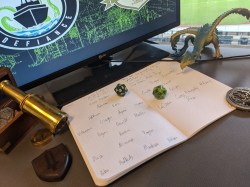
Photo of all the stuff I brought with me when broadcasting on ESPN+ in order to keep my head on straight. The various tokens helped me not think.
I’ve also hosted 100s of podcasts, appeared on many dozen more. I used to be an analyst on ESPN+. I’ve been the MC for crowd events of four figures. Even now I host and sometimes appear as an analyst on security briefings.
Some people may have noticed the stutter. Others might not have. But it’s always something I think about while prepping. I also avoid words that would trigger the lisp — these happen to include the most common names I like for fantasy characters, which isn’t ironic. I think I like those names in writing because I struggle to say them. The lisp will often trigger bad stuttering.
Once upon a time I spent several hours a week in speech therapy for the stutter and lisp. I don’t remember those lessons consciously. They seep into how I grew up and who I became.
Somehow I won trophies in competitive speech while in high school. The stutter was still there.
It was there haunting me today in the Global Security Briefing. It haunts me when I DM. It haunts me when I’m a player.
One of my compensations is to spit out words as rapidly as possible. I don’t permit my mind to pause and think. I just do it, rapidly. My current character Xabal talks this way at the table. It’s easy for me to channel because it’s something I do. Xabal is an Artificer, inherently magical and constantly tinkering. Their speech pattern is part of them and has no impact on their magic or heroism. It’s just who they are.
I think that’s important when you consider playing a character with a stutter, lisp or other ‘issue’ with language. I’m not a weak speaker. It’s nearly been a profession for me. Xabal is different because of their speech, but isn’t weaker because of that.
I know coaches, other broadcasters and pro athletes that stutter. They are very good at their jobs. Yes, like me there are times when they doubt, when they compensate. But they aren’t lesser. They have a trait.
If you play a character with a stutter recognize that this is a trait. Don’t play it as a weakness. Don’t play it as a strength. It is a state of being.
I’ve been rewatching Agents of SHIELD lately. Early in the story cycle Leopold Fitz suffers an injury that causes him to stutter, but it’s because of a brain injury. In this case actor Iain De Caestecker was using the struggle to find the perfect word as a character element that was initially a weakness, but became a state of being.
Watching and rewatching Leopold Fitz develop and not-quite-conquer the stutter helped me open up about my own lisp and stutter. Because De Caestecker isn’t mocking me and others. He’s honoring that struggle. He also does a brilliant job of removing the in-character stutter during the season 4 Framework arc when Fitz is again his whole self, mentally.
I don’t get to remove my stutter.
I’ve listened back to various podcast and broadcast appearances and know when it has happened. I speed up in a way that harms communication because I don’t want to get th-th-th-that moment. I don’t want the obscenely long pause as my brain can’t tell my mouth the words to use.
So I go fast. It’s part of why I was decent at cross-ex and impromptu. I could spew words out rapidly.
But also there are times when I lose track. These tend to be emotional moments. My practice and therapy disappear. Since it happens at highly emotional moments and then the pause or micro-chunks of words happen I get interrupted.
That’s probably the time I get the angriest about the stutter — the interruptions (this is also where De Caestecker got it right). My state of being stops being valued. People can’t wait for me to find the proper word.
I don’t know why this is going up on my mostly D&D blog at this time. Probably because of Agents of SHIELD, probably because of the passing of James Earl Jones a few weeks, who I didn’t know stuttered until he passed. Jones is one of my favorite voices ever. His work in Star Wars, Field of Dreams and as the voice of CNN were inspiring to me, a dream voice that I wish I had!
And yet as a youth who loved those performances I didn’t know a stutterer could be one of the grandest voices in the world. Maybe that knowledge would have helped me be a better speaker, maybe I would have been a radio host.
I’m in a great place without that knowledge. But Jones passing caused me to wonder about my youth.
If you’re a D&D reader who has stuck through this long, remember — a stutter isn’t a weakness. If you don’t have a stutter don’t use a character with a stutter as inspiration for a Wild Mage. If you do have a stutter channeling that trait into magic would be awesome.
Yes, that’s the same general guidance for playing other characteristics that you don’t have. It’s not a joke. It’s not a weakness. Itis. And no, I’m not stuttering right now.
First appearing to the mass market fanbase within 5th Edition Dungeons & Dragons in Eberron: Rising from the Last War and now in Tasha’s Cauldron of Everything, the Artificer is a kind of techno-wizard. For someone without previous connections to Eberron, the setting that exploded on the scene in 3rd edition, the Artificer confused me.
The fiction upon which it is based seemingly is all self-referring, or modern fantastical. There’s a subclass that essentially reads as if it is Iron Man ported back into D&D for example. Whereas most D&D classes stretch into the myths and legends that predate the game itself, the Artificer does not seem to have that convention.
Oddly enough, it was a Christmas movie that reminded me of Artificers within our lore. There are magical techno-wizards within holiday tales. From Christmas elves of tradition, to the inventors of Jingle Jangle, you can find your inspiration for your next Artificer.
These creators take the mundane and imbue it with magic. They create automatons, magically tinker, infuse items, and all the other things you expect from the description of an Artificer.
Masters of invention, artificers use ingenuity and magic to unlock extraordinary capabilities in objects. They see magic as a complex system waiting to be decoded and then harnessed in their spells and inventions. You can find everything you need to play one of these inventors in the next few sections.
Artificers use a variety of tools to channel their arcane power. To cast a spell, an artificer might use alchemist’s supplies to create a potent elixir, calligrapher’s supplies to inscribe a sigil of power, or tinker’s tools to craft a temporary charm. The magic of artificers is tied to their tools and their talents, and few other characters can produce the right tool for a job as well as an artificer.
Opening up a vision of an Artificer to include these amazing gift-gives also helps change how you approach D&D. A character of kindness and generosity, or that thieving Gustafson, expands the stories you can tell. When you visit the village you can brighten the spirits of the community via your infusions and spells.
It may be a Hallmark/Lifetime/FreeForm/UPTv cliche, but there is magic in the holiday season. Incorporating the magic of elves, toys, inventors, Santa, and others into your D&D characters and stories means adding more joy to a game that so often centers violence.
Generosity and joy exist in D&D (even in Barovia). Your Artificer has the power to amplify those feelings (while also being an effective combatant, but there are many places that talk about optimizing in those ways). There are 1,000 times a thousand stories available at any table and any session. Adding a little Christmas to your Artificer is a way to discover more of them.
Be Jeronicus, Jessica, Journey, or even Gustafson. Be Alabaster Snowball, Bushy Evergreen, Pepper Minstix, Shinny Upatree, Sugarplum Mary, or Wunorse Openslae. Roll dice and tell stories about the power of Artifice.
The trope that starts nearly every Dungeons & Dragons campaign is “So, you meet in a tavern.” Which is fitting. For most campaigns start with a diverse group of characters who don’t have strong connections throughout the group. They are a cross-cultural, cross-class, cross-Class, cross-everything group that wouldn’t meet at most places in the medieval-Renaissance-ish fantasy world that is D&D.
But the tavern, via the trope, has become a third place. It’s not home (though it often becomes that). It’s not work (though it often becomes that). It’s the place between. And these places between are frequently where subcultures within a society connect.
Various cultures have had different third places. For modern America it is now the coffeeshop and used to be bowling alleys. In the Ottoman Empire in the classical age had its cafes, where philosophy, music and political debate occurred.
In New England during the American Revolution public houses were the gathering point, for many at that time the first place was a co-located home with work and the second were churches.
The Greeks gathered on the steps of temples. Finns and Russians gather in bathhouses.
Sporting venues have been third places, before they became economically stratified. Travelling carnivals and festivals can be a third place.
No matter the type of third place, it tells you a bit about the culture.
Using third places as a character backstory tool
When creating a PC think about the place where you mingled with peoples unlike you. Where did your dwarf first meet an elf? Where did your farmer first meet a noble? Where did your follower of Lathander meet an unbeliever?
This decision will help tell you about your own history.
It will connect them to a place and associated behaviors that aren’t mechanics, but are fuel for the social pillar. Their own stories about a trip to watch a great debate between philosophers, a visit to the library, or the type of ale they enjoyed at the pub are stories that add more depth to the shared story that is D&D.
Adventurers have the place where they sleep (a cave, a cove, an inn), the place where they work (dungeons), and the places where they spend time meeting strangers with odd quests. Once they start their adventure they have the third place that was cross-cultural communication when they were growing up and now the place between — and that’s up to the whole party of different peoples.
Using third places as a world building tool
Dungeon Masters generally are more active in creating the world. There are a few ways they can use third places in that world.
Collect each players’ third places in your notes. Give them the opportunity to revisit them in new lands.
Start the campaign at the typical third place for the origin culture of the campaign. “So, you meet on the steps of the temple.”
When the group comes to a new land and looks for their comfortable third place (the tavern) demonstrate how that locale is different from their expectation and what the unfamiliar culture would use as their non-stratified place that welcomes outsiders.
Use maps of abandoned third places to show how different the older ages were from the one in which you campaign.
Have an NPC name-drop their favorite third place. This can show how they are familiar to most of the group, or different. Each NPC can have their own place, they should!
Have two third places in the same town share similarities but still be unique beyond their name. Maybe the Rusty Clam is a working pub and the Silver Nail is for the merchant class — and yet the players are welcomed at both.
These are flavor elements, but flavor is story in D&D. And story is what tables build together, usually because Dungeons and Dragons is now our third place.
The smogpunk land of goblins in the World of the Everflow was set apart from the Kingdom of Sheljar, Crinth, and other areas for a few millennia. Within this separation the goblins and hobgoblins changed from the standard tropes.
In the Everflow they answer to the Queen Mother. Everyone is organized around their family’s history of developing teknology for one of the various guilds. Inventiveness and cleverness are more important than fighting and viciousness.
To emphasize these differences, but still capture traditional goblinoid feelings there should be a some differences in language. This discovery of numerals from the 13th century feels proper for the gobkon of the world.
The Cistercian monks invented a numbering system in the 13th century which meant that any number from 1 to 9999 could be written using a single symbol pic.twitter.com/VRuEx4dkPF
— UCL Department of Mathematics (@MathematicsUCL) February 2, 2021
It works in a printing press, scribbled on paper or carved into wood.
Will it ever see the table? Probably not. Or maybe just one or two numbers in a handout for the players to demonstrate the differences between their lands with the languages of Telse (Common) and the rest of the Six Kingdoms.
If there was a campaign book for the World of the Everflow this could be a tiny sidebar for flavor, not a rule for use.













 Full Moon Storytelling