Tag: review

  • Tasting the official D&D coffee: Dragonfire Roast

    Tasting the official D&D coffee: Dragonfire Roast

    Licensing incongruent products is hard. We’ve all seen poor attempts at Big Screen Movie + Pancake House, or French Fries and that other Big Movie Franchise. Getting the proper fit for tie-ins is art and science.

    Dungeons and Dragons attempted bologna in the 80s and these days the lifestyle brand has a $70 two-slice toaster. Those don’t work. Their t-shirts have been great — I strongly recommend the Harper Motto shirt.

    Merging coffee and a brand is also difficult. I’ve been part of this with a major morning show and a coffee brand in the past, that was a fairly natural fit. Gamers of all types and caffeine tends to be a good fit too. Mt Dew and various energy drinks have partnered with numerous video games over the decades.

    D&D’s official coffee does a couple things really well. There’s also a major miss.

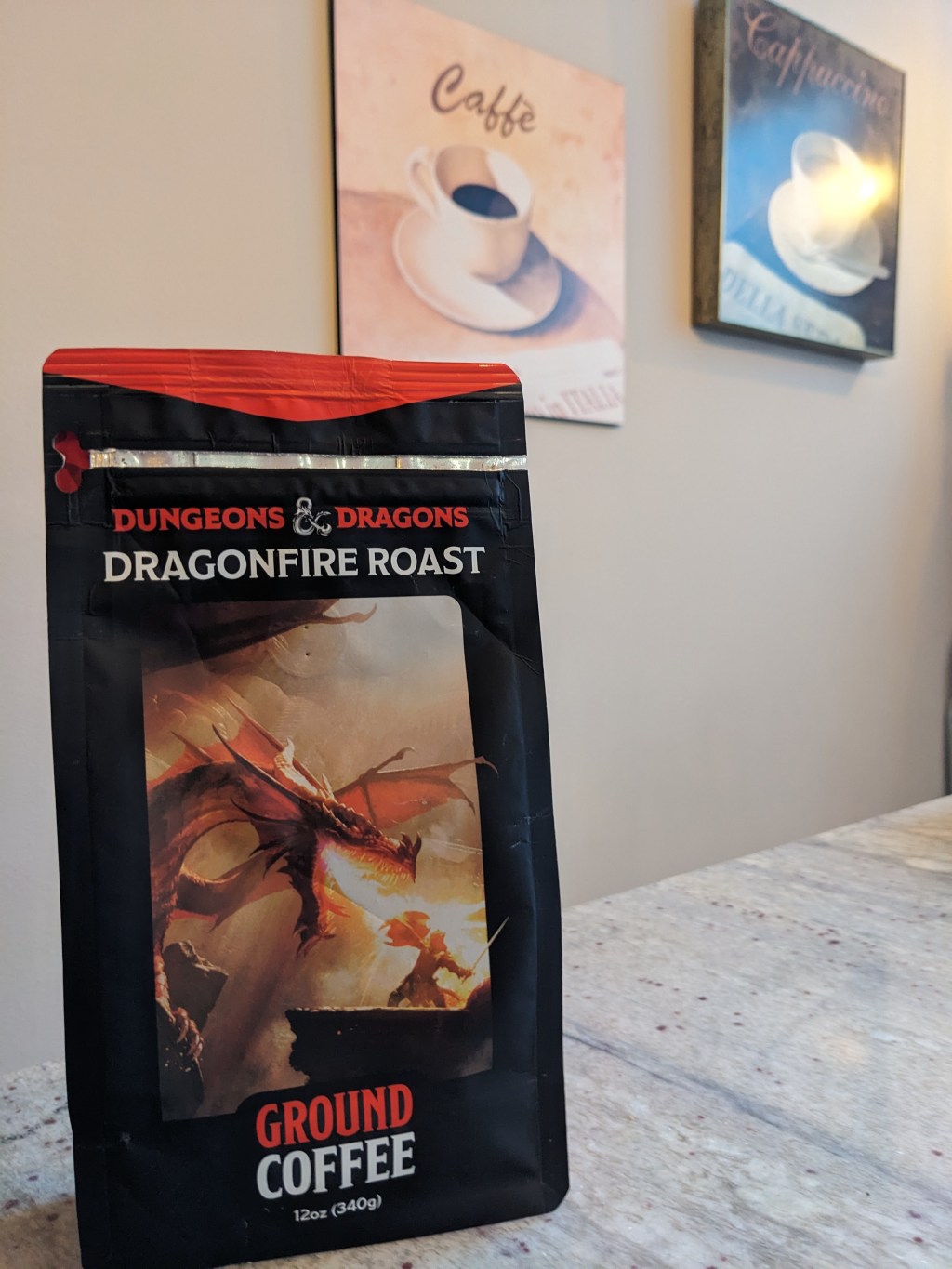
    Dungeon's & Dragons Dragonfire Roast bag with the zip-pull opened. The art shows a red dragon breathing fire on a solitary fighter with a shield. The bag is black. 
In the background are two cafe art pieces.

    The art and branding continuity is perfect. This coffee looks to be a perfect extension of official Dungeons & Dragons and presented by Wizards of the Coast. Easy access to the art is a big reason for that.

    But there are plenty of these kinds of partnerships that get the art and branding wrong, despite the easy legal and marketing access.

    The bag’s language is very 5e D&D in writing style. The ampersand is all over the sidewalls of the bag. That central art piece is tremendous — matching the aesthetic of modern D&D.

    When I was a full-time apprentice coffee taster we focused on four major elements to coffee flavor — body, acidity, flavor and finish. Despite not working in that field for a decade now, that’s still how I approach flavor, including when selling beer or tasting wine for pleasure.

    This is where Dragonfire fails.

    Per the bag it is a medium roast, preground “for any filter” which basically means for various drip techniques/filters and wholly Brazilian beans. The label did not call out 100% Arabica (the website does), but there are no tell-tale signs of robusta or other varieties. It also says that it is “medium flavor.”

    I did not perform a cupping, as the coffee was pre-ground.

    I tasted multiple Chemex pourovers using a metal filter over the past week — my current traditional coffee preference. I also attempted to use it in an espresso machine, but was unable to tamp sufficiently enough to make up for the different grind size.

    Body: fairly low body for a Brazil
    Acidity: essentially neutral
    Flavor: no spikes of premium flavors such as nutty, vanilla, etc
    Finish: very clean, no roughness which can be common in lower grown Brazils (this is where robustas would have been obvious)

    For a coffee fan Dragonfire would not be a coffee I would suggest. As a gift to a non-flavor nerd who likes D&D and drinks coffee with sugar and/or cream it’s a decent choice.

    For the flavor nerd who likes D&D I prefer Found Familiar coffees. I have a bag of Fey Magic waiting for a cupping, espresso tasting and pourover just as soon as I’m through my Middle Fork roaster and right before switching back to Campfire’s Summer Camp.

  • The Willow trailer is more proof that there’s never been a better time to be a fan of fantasy

    The Willow trailer is more proof that there’s never been a better time to be a fan of fantasy

    Back in the 1980s there was a cute little movie called Willow. Featuring Warwick Davis, Val Kilmer and others, the film opened well and then petered out. But among certain fans it maintained this legacy and appeal. There’s a little person (Davis), even littler people (two Brownies), Kilmer with a sword! and extraordinary effects. The story is quite a traditional tale of people without anything in common trying to save the world.

    Eventually when it was on video tape it developed a reputation as a grand adventure and we all loved it.

    Now, there’s a new Willow — with the same message, better effects and even more of everything. The cast is wider and the story more grand. It looks like an epic Dungeons & Dragons tale.

    That trailer shows every member of the party featured in the spotlight. Some are noble. Others are urchins. There are sorcerers and fighters. Davis is back and so are the Brownies. The princess is now longer a baby. Where the original Willow explores just a single continent in the world the new series explores the world and more.

    It’s an epic fantasy tale and another example of the wide variety of fantasy that is available in the 2020s. Sword & Sorcery, Epics, Grim dark, Magipunk, comedy and more subgenres of fantasy are available. Every streaming platform is hoping for a tentpole series, with none dominating right now.

    Like, there’s a lot of fantasy and there’s more to come.

    Honor Among Thieves looks like it will great. Wheel of Time is still in the Top 10 for Prime Video Streams. House of the Dragon and Rings of Power are battling every week to be the most watched non-sports/awards show. Legends of Vox Machina season two is still to come. Witcher season three. Shadow and Bone.

    Outlander, Last Kingdom and Black Sails are genre adjacent in that they are period shows that people who play D&D think of when they play D&D.

    All of this isn’t powered by franchises like Marvel, DC, Star Wars or Star Trek.

    Fantasy is capturing global imaginations and our dreams. We’re watching. We’re playing. We’re creating new stories with the old tropes seen a right angle so as to capture the people who we’ve always been. Fantasy is built around tales of cooperation among those with different backgrounds, skill sets and races. Fantasy is built around the authentic statement that the diverse group is the strong group — it’s been true for the millennia of myths about dragons and the people who fight them.

  • They might be giants, a new Unearthed Arcana

    They might be giants, a new Unearthed Arcana

    A big, hefty Unearthed Arcana was released in late May. Giant Options hints at a something massive — the book could be a Giant version of Fizban’s, the First World’s war between giantkin and dragons, or a new set of player options with this just being the first of a series.

    Some of these will be immediately available to players in my campaign. Others need more work before I would allow them. Overall they are strong and I’m encouraged by more flavorful Feats being added to the game.

    Archetypes/Subclasses

    Barbarian: Path of the Giant

    “Barbarians who walk the Path of the Giant draw strength from the primal forces that are the Giants and their elemental ilk. Their rages surge with elemental power and cause these barbarians to grow in size, transforming them into avatars of primordial might.”

    What I like:

    The Giant Power cantrip makes perfect sense. Connecting rages to growing in size and throwing things is excellent. Elemental Cleaver is basically Thor’s ability, so that will be very popular. Adding a ruleset for the fastball special fits this concept, but I’m hoping to see more mooks used as ranged weapons than friends.

    What I don’t like:

    Unless a campaign uses culture rather than language, learning the language of Giant just because you turn into one makes no sense.

    Will I use it in play:

    Yes. Every mechanic fits the build except for the odd way D&D embraces languages.


    Druid: Circle of the Primeval

    “The Circle of the Primeval teaches that, though the land may change over time, it never truly forgets. By tapping into the timeworn memory of the earth, these druids summon and bond with the spirit of a primeval behemoth — a hulking creature that once ruled the ancient world alongside the giants.”

    What I like:

    While there are other abilities, the main reason you want to play this Druid is for the Primeval Companion. Similar to the new Beast Master Ranger beasts, the Primeval Companion has very light flavor. Want it to be an ankylosaurs or wooly mammoth or a velociraptor? You can. It just starts a bit small than those first two were, but that’s easy to call an adolescent. It’s nice that it can avoid your overflowing blasts, because your dino-companion is probably in the fray while your druid is back a layer. Scourge of the Ancients comes on in the late game, giving 1st level spells purpose.

    What I don’t like:

    Nothing.

    Will I use it in play:

    These fit Mehmd, in my home campaign, very well.


    Wizard: Runecaster

    “Runecrafter wizards enhance their spellcasting through the ancient power of runes. Though the tradition originated with the giant rune casters of old, runecraft magic has expanded to encompass countless languages and practitioners across different worlds.”

    What I like:

    Like most of the non-school Wizards, the Runecaster feels more powerful, especially so in a campaign that ignores material components and spell inscribing costs. The runes themselves have interesting riders when combined with spells — cast a magic missile and boost the health of ally with a Life Rune for example.

    Overall the narrative of the runes is strong and fills a hole in the game.

    What I don’t like:

    Rune Maven is a complicated recovery mechanic. Thankfully Think DM broke down how it works.

    There’s also a disconnect between the narrative and the mechanics. The runes are being cast in less than 6 seconds, but when you think of a runemaster those runes should take time.

    Will I use it in play:

    I’m undecided. It is a bit complicated above level 9. I also must get over my frustration about crafting a rune taking a time


    FEATS

    A few of the feats are meant to be taken at first level, the kind of powers a character might be born with or that inspires them to go out adventuring. Others are clearly too powerful for 1st level and so are gated at 4th or 8th level, which makes sense unless the character is a fighter who gets their second feat at 6th level. These 4th and 8th level feats also don’t make narrative sense. Why would the powers of a giant manifest based on adventuring?


    Feats: Rune Carver Apprentice and Rune Carver Adept

    The two rune feats are meant to be taken in a series. Apprentice first and than at 4th level or higher after taking Apprentice a character make take the Adept.

    What I like:

    Unlike the Runecaster Wizard, these runes are inscribed during a long rest – lovely! Unlike other spellcasting feats, the Rune Carver feats offer a high level of versatility. There are 19 different spells that one may have available. Just one at the Apprentice level and from two to six as an Adept.

    What I don’t like:

    The Apprentice assumes that versatility is more significant than a cantrip and ASI or two cantrips, which every other 1st level spell granting Feat has. My solution would be to add one of the general cantrips as a choice or even more broadly, every cantrip tagged with Utility on DnDBeyond.

    Will I use it in play?

    Absolutely. I love these. I have no idea where they fit in my world, but they belong.


    Feats: Elemental Touched; Outsized Might

    These are the other two feats that don’t have level requirements. Both could connect a character to the primordial or the Giants. One thing that latter-stage D&D does is strongly connect the Giants to elements, but not in the same ways as dragons.

    What I like:

    The spell-like abilities granted by Elemental Touched are perfectly flavored, like Top Chef finale quality flavor.

    Outsized Might is excellent for grapplers and other martial artists. It is also story-full. Imagine a Stout Halfling that carries more than strong Humans. That’s great as a rare ability granted by a Feat.

    What I don’t like:

    The versatility of Elemental Touched removes strong flavor potential. Being touched by every element is part of what went wrong with the Four Elements Monk and it continues to be poor story here.

    Outsized Might overlaps heavily with a few races (Orc, Bugbear, Centaur, Firbolg, Goliath, Loxodon), which isn’t as fun. There’s no practical way for Powerful Build to stack. While the Feat is still useful, there may need to be a way to make up for that.

    Will I use it in play?

    Elemental Touched may be tweaked to connect to a specific element while granting an additional use.

    Outsized Might isn’t great, but I’d allow it.


    4th Level Feats: Fury of the Frost Giant; Keenness of the Stone Giant; Vigor of the Hill Giant

    The three lower power common giants are bundled together and locked in as something a character would take just before they enter tier 2 play. This makes some sense as there are more and more ways to have a Feat at 1st level (my campaign allows a Feat for every 1st level character).

    What I like:

    Keenness of the Stone Giant has a strong connection to their lore as wizened leaders who tend to be less into the violence of other giants.

    Vigor of the Hill Giant is perfect — 100% perfect. The lore of the Hill Giant is wrapped in mechanics that directly connect the character to the big, dumb oafs that use trees as clubs and use hills as pillows.

    What I don’t like:

    Frost giants make you afraid, more than other giants? I don’t get the narrative justification.

    Will I use them in play?

    If a player asked, probably. But I’d have to come up with a story for Keenness and Fury. The core D&D assumptions about Giants aren’t present in my world. I would allow Vigor right out of the box.


    8th Level Feats: Ember of the Fire Giant; Guile of the Cloud Giant; Soul of the Storm Giant

    These big hefty feats are overly delayed for Fighters. They’re powerful, probably the most powerful Feats of 5e and unchained. You don’t have to start with Outsized Might to somehow develop a connection to Giants. Maybe you should. Maybe these should be three-feat chains that include Elemental Touched and Outsized Might.

    What I like:

    The flavor of Ember of the Fire Giant is well done.

    Misty Form from the Cloud Giant is very powerful, a non-concentration casting of blur is encounter changing. It also fits the narrative.

    What I don’t like:

    An attack at 8th level does more damage than Ember of the Fire Giants does, and while there’s an area of effect it isn’t big enough to mitigate the reduction in damage. I might throw on one of the fire cantrips to increase versatility.

    A soft caution on adding a lot of divination to the game must be given. It’s one of the thought spells that can dramatically change the genre of play.

    The Storm Giant grants a defensive bonus, which feels unusual for a giant. How hard can it be to hit a 40′ tall human-like representation of a thunderstorm? But, it’s a great ability. So much so that I wanted to list this as a like, even though my narrative first thoughts are that I don’t like it.

    Will I use it in play:

    I like these, all of them. Even the weak Fire Giant ability is a lot of fun.

    Overall many of the Feats add 5′ and 10′ ranged abilities. These ranges are very tactical and hard to do in Theater of the Mind. I’ve come to thinking that TotM works better with abilities that are 5/15/30 rather than 5/10/20/30.

  • Latest Unearthed Aracana sends us to the Phlogiston (maybe)

    Latest Unearthed Aracana sends us to the Phlogiston (maybe)

    With the announced pace of products picking up, we should also expect Unearthed Arcana’s pace to pick up. Today, Wizards of the Coast sent out the latest Dungeons & Dragons playtest document with six new races to play n the game. They have strong flavors of my favorite settings from the days of yore — Spelljammer.

    Unlike the foundational settings of D&D Spelljammer has no relationship to the real world or literature. The concept is D&D in space, but an odd kind of space with ships that look like dragonflies and mind flayer heads, all powered by hooking up a magic user to a chair/helm/etc that sucks magic from them. Each “solar system” exists within a crystal sphere, and outside of that is a highly flammable sea of a Phlogiston.

    There are prates, even crafter gnomes, space monkeys that can glide, Victorian hippo-people, asteroid trading posts run by beholders, fleets of mind flayers. The whole of the setting is comc book/cartoon joy with themes of exploration similar to Star Trek.

    Some of the new races are also part of the Planescape realm and the thri-keen are one of the signature elements of Dark Sun.

    Astral Elf

    An elf denizen of the Astral Plane who is likely thousands of years old.

    What I like

    Radiant Soul is a cool way to bounce back from death’s door once per day. That you must be down and making death saves in order to use it connects the mechanics to Astral Elf’s planar nature.

    Trance Tools are a non-cultural way to gain proficiency, nifty little mechanic. Maybe my favorite from this drop, which is funny because…

    What I don’t like

    Don’t know why the world needs another elf, ever. There are a lot in D&D these days, with more to come for every new setting. The Astral Elf, if the feedback is strong, will be the 14th elf within official D&D worlds for Fifth Edition.

    Also, just after so many reminders that each playable races is supposed to have a human-like age spectrum, the Astral Elf is even older than normal elves.

    Will I play one?

    Probably not. Elves and all their permutations are my least played race. The idea of an ancient people viewed as the ideal of sapience has little appeal to me.

    Autognome

    A mechanical gnome gifted with free will.

    What I like

    True Life is a brilliant way to empower healing for living constructs. The Warforged need this in the expected minor racial reworks coming with the three-book gift set.

    Built for Success strongly connects the rules of the race to why the race exists. Gnomes created these automatons to be better than gnomes are, at least at certain tasks.

    What I don’t like

    Sentry’s Rest is another variant on Trances. Having a party with a creature that needs 4 hours, and another that needs 6 hours, and most that need 8 hours adds unnecessary complexity to organizing watches.

    Will I play one?

    Yep, I love the little people. Also, I enjoy tool users and specialists. These would make strong Rogues.

    Giff

    A hippo-headed being of impressive size.

    What I like

    They’re big, really big. Playing a super-sized race that doesn’t have to smush itself through most passages is a great way to feel more powerful than you are in real ife. Hippo Build embraces this.

    What I don’t like

    Damage Dealer connects more strongly to Rogues and Paladins than the Giff’s traditional role as a Fighter. Also, that’s it. They only have two traits. The Astral Elf, embracing their racial superiority have seven.

    Will I play one?

    Yep. Absolutely. Anthropomorphic races are cool. The Giff’s traditional Victorian military culture can be fun. There will be a search for another trait that connects to their build, maybe something as boring as Tough Hide which gives them an extra hit point every level.

    Hadozee

    A highly adaptive simian being who uses winglike membranes to glide.

    What I like

    The climbing speed and Glide are both great ways to capture their tree glider meets monkey vibe.

    Dexterous Feet allowing a bonus action to Use an Object is good, but it doesn’t go quite far enough.

    What I don’t like

    Dexterous Feet should include the tail, and to enable more fun, should allow the activity via a Reaction too. Yes, that break the standard for Reactions, but it’s cool.

    Will I play one?

    Maybe. Kinda want to be an Artificer or Wizard, who manipulates their magic components with their feet and tail.

    Plasmoid

    An amoeba-like being.

    What I like

    These things are bizarre, the oddest playable concept in the game. You have no standard form, as you are an Ooze. Shape Self enables you to look kind of like a person and also lets you grow an ‘arm’ up to ten feet long.

    What I don’t like

    The mechanics are great, the ability to be one the creatures mentally needs a lot of explanation.

    Will I play one?

    Not until the lore is revealed. My head needs help wrapping around this concept even more than it does for Lizard Folk.

    Thri-kreen

    A six-limbed, telepathic insectoid.

    What I like

    Secondary Arms is a good solve for how these six-limbed peoples work with the D&D action economy. There is a fun synergy with Two-Weapon Fighting and with light thrown weapons when you have multi-attack or related abilities.

    What I don’t like

    Sleepless Revitalization reveals another Long Rest variant to confuse the party.

    With five racial traits, most with power, they are insectoid elves.

    Will I play one?

    No, but they are absolutely necessary for the world of Dark Sun, and maybe in my own world (spoiler?).

  • 7 Things I Love in Tasha’s Cauldron of Everything

    7 Things I Love in Tasha’s Cauldron of Everything

    Tasha’s Cauldon of Everything is packed with new mechanics to add to the game. The expansion of racial options, which reduces but doesn’t eliminate the bioessentialism in D&D, and the new class options was the focus of most of the attention of previews. Now that the book is in the hands of the masses there a few other things that deserve your eyeballs, your character sheet, and your campaign.

    Wizards provides this handy list about how to get your handses [in voco Gollum] on the book, but we strongly recommend supporting your local gaming store. The main digital play tools all have Tasha’s at this time and are in various stages of integration for what is a massive update and reworking of character creation.

    Lean Into Personalization

    While every player-facing book in 5th edition talks about creating your character’s identity through minor reskinning of features, none go as heavy into this as Tasha’s. There aren’t just lists. Through the ample use of sidebars and even art, the designers make it clear that your character is yours, and how that character presents itself is up to you.

    The art with the chicken-shaped Magic Missiles is the most clear demonstration of this concept.

    I’m leaning into this with a Swarmkeeper Ranger whose swarm is a bunch of terriers. They can nip the opponent’s heals, overwhelm them and force them to move, pull me to safety, and even fetch my spent ammunition after the fight.

    Make the world yours, that’s what Tasha would do.

    Battle Master Builds

    The Fighter’s two non-magical subclasses from the Player’s Handbook can lack the identifying traits that connect them to fantasy literature in ways that every other subclass does. Tasha’s helps solve this by providing some sample builds for the Battle Master.

    Each example includes the fighting styles, maneuvers, and feats that help create a cohesive identity rather than have a character that is merely a collection of mechanics.

    With a sampling of those mechanics and about 50 words your Battle Master transforms into a representation of the legendary heroes of yore, that is uniquely yours.

    Session Zero

    Many, many, many blogs, vids, podcasts and articles over the decades have focused on Session Zero. Nowhere has the concept been laid out as clearly in a book produced by the maker of the game.

    Adding this guide to what will almost certainly be the 4th best selling book in the arsenal of official products will help so many people who want to try the game. New players and new DMs will have a foundation upon which to establish their own social contract.

    Sidekicks

    Puppy! Wait, no warrior-wolf.

    Scheduling play sessions during a global pandemic are a different struggle than they were in the Before Times. Getting a group together, using the same technology. In games with only 1 or 2 PCs having a sidekick can help solve the issues of game balance and limit the chances of a total party kill. They also fit the stories we try to tell.

    Here, again, the creators used art to provide examples of the variety of sidekicks that can be created through the three “classes.”

    The Expert shows up as a tortle scout/navigator, a winged kobold with some kind of charm, and a kenku historian/sage. The three versions of the Spellcaster are a bullywug wizard, a goblin mage (love that pink dress), and a tabaxi oracle with a pack of extra large scrolls. For the Warrior the art is of an aasimar with a sword & shield, a wolf, and a firbolg chef ready to smash someone with a cast iron pan.

    Class Icons

    Each of the 13 core classes (Artificer is in two books, it’s core now in my mind) has a icon that represents them. These small images are not new (they’re in the Player’s Handbook), they are just more obvious in their presentation within Tasha’s Cauldron of Everything.

    They’re a clean look that I hope to see on merch at some point. Many third-party D&D inspired jewelers and apparel companies use class iconography. There is no reason why Wizards shouldn’t embrace this as well.

    Parleying

    People have been homebrewing versions of this for years, but including it in such a common book is important. D&D is, at its core, a combat game. But it doesn’t have to be and more rules to demonstrate that are good.

    Hints, Allegations, Rumors of What’s to Come

    Hidden within Tasha’s in character conversations and the rules sidebars are a plethora of hints about the future of the game. All attempts to figure out what these mean will be futile fun. Search them all and you too can shout “[setting name] confirmed.”

    What are you looking forward to using from Tasha’s?