As part of the Worlds to-go! The Elysians Kickstarter I pitched PJ the idea of adding sports inspired by this magical world that is a conjunction of city-states, godly wilderness and island-hopping villagers. The microsetting we’re going for has some ancient Greek and Roman inspiration, flexing into similar tropes taken by the Percy Jackson series, a dash of Narnia without the chivalry and because I’m me dashes of magic in all things.
It leans into narrative as mechanics. The concept here is to describe the action your are taking using your specialty (an advanced 5e rule), skill and attribute in unique ways.
Normally I ignore individual sports as they can typically be done with a one roll roll-off. But Elysia had to have something inspired by the original multi-national sporting competition. So I added the Pentiad.
As the peoples are emulating the gods (a fun bit of lore I enjoy) there’s no such thing as cheating. Borrowing from The Magicians, I leaned into the concept that the gods have minds beyond people’s minds. Emulating the minds of gods meant no cheating. There’s no cheating! Do whatever you want for victory — that’s what the gods would do. Pursue victory using spells or even attacks. Just don’t kill people.
Throwing Stars is based off an ancient Roman juggling competition, adding in a dash of mysticism around the creation of constellations and turning it into a team event. Combat juggling is a modern thing that should be captured in this lore too. Throwing Stars takes combat juggling with magic and then instead of awarding points on surviving, awarding points on the artistry of the creation — a divine act.
When Throwing Stars what object or magic will you create to impress the gods?
You can check out Sports on the Fields of Elysia for free for a few days. It’s a proof of concept, not a final rule set. If the Kickstarter continues on its strong path you may seen the final version of the rules, along with two other team sports.
Try out the rules for sports. Tell us what you think.
Working with PJ over at Homebrew & Hacking, I’m helping put together a set of backgrounds and other elements for a micro-setting for use in the 5e D&D variant Level Up. Our project is tightly focused on a culture of temples, philosophers, oracles and city-states — Worlds to-go! The Elysians.
One of the reasons I chose a Level Up project rather than traditional 5e Dungeons & Dragons is that Level Up puts a large emphasis on Backgrounds and Cultures. Things like NPC connections, mementos and even advancement in that pre-heroic profession are featured in a Level Up Background. That fits how I want to tell stories using D&D.
I also listen to PJ’s podcast quite a bit, which I guess PJ just found out.
For the project some of my previous Backgrounds will be adapted, but there are also new ones that help fill the micro-setting of the Elysians.
Head over toKickstarterand click on “Notify Me On Launch” to see the project when it is live. The team PJ is putting together will provide you with some simple tools to help expand your D&D stories and maybe even tell the future.
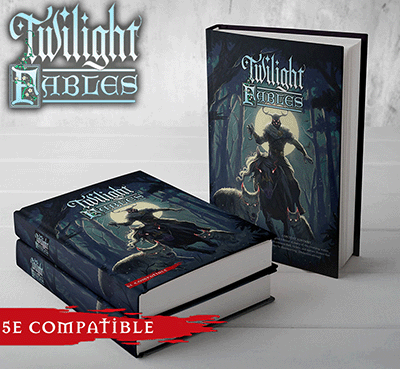
As an active participant on ENWorld, I watched the Twilight Fables project grow from idea to concept through approach and playtest. As an already funded project, supporting it on Kickstarter means my readers will not be backing a failed project — it’s done. The books have had proofs printed. Rod Waibel has a different approach than typical for this Kickstarter.
So I invited him to share it with the readers of Full Moon Storytelling, because you might enjoy a few more monsters for your D&D game.
Note: The original folklore was dark with mature themes and may include triggering subjects. Think more Brothers Grimm and less modern fairy tales. Reader discretion is advised.
Twilight Fables is a sourcebook designed for 5e focusing on the original European folklore as it was told generations ago. More Brothers Grimm and much less Disney, if you will. When Dungeons & Dragons was created, most of the monsters were based, albeit loosely, on folklore. However, it was in the vision of those who were creating it, so creatures like drow, kobolds, goblins, etc. don’t resemble anything like the folklore that created them. 5e D&D has been out a while, and there has been a ton of content created for it, but I found this area lacking.
Wizards of the Coast recently came out with a fey-themed book, and while a great product in its own right, it was nothing like original folklore. I felt that those old stories, approached with the appropriate caution, could lend to exciting and interesting adventures of their own. I say “approach with caution” as no accident. For those unfamiliar, many of those stories were allegories of caution directed toward children. “Stay away from that creek, because there’s a terrible monster there that will eat you!” “Remain pure and chaste or you’ll turn into a terrible creature!” That sort of thing.
Since much of folklore was created during dark times (literally the Dark Ages), there are several instances of abuse and suffering. For example, the original story of Hansel and Gretel is even darker than most realize when you learn why they kept getting lost in the woods. Ableism, sexism, child abuse, and consent issues show up often in those stories. Therefore, I made it a point to address this right up front in the book, and put a disclaimer on the cover. People can skip right past those sections that deal with these issues easily by a displayed marker if they want to avoid any triggering event.
[Dave here: Rod and his team put a disclaimer on the individual creatures that are most likely to bring up the worst memories people have.]
You may be asking yourself, “Why bother creating something that has so many problematic themes?” Fair question. Quite frankly, it’s because outside of those few monsters, the lore is rich with great stories and potential. As long as we approach it with an informed perspective and have the agency to control which portions we use, there’s a ton of value in this book. And it’s good to have the option. I did my very best to minimize those problem areas and advise that such issues should not be included in the typical game. I stress how consent among all the players at your table is recommended before incorporating any potential problem areas.
Now that that’s out of the way, what exactly does Twilight Fables include?
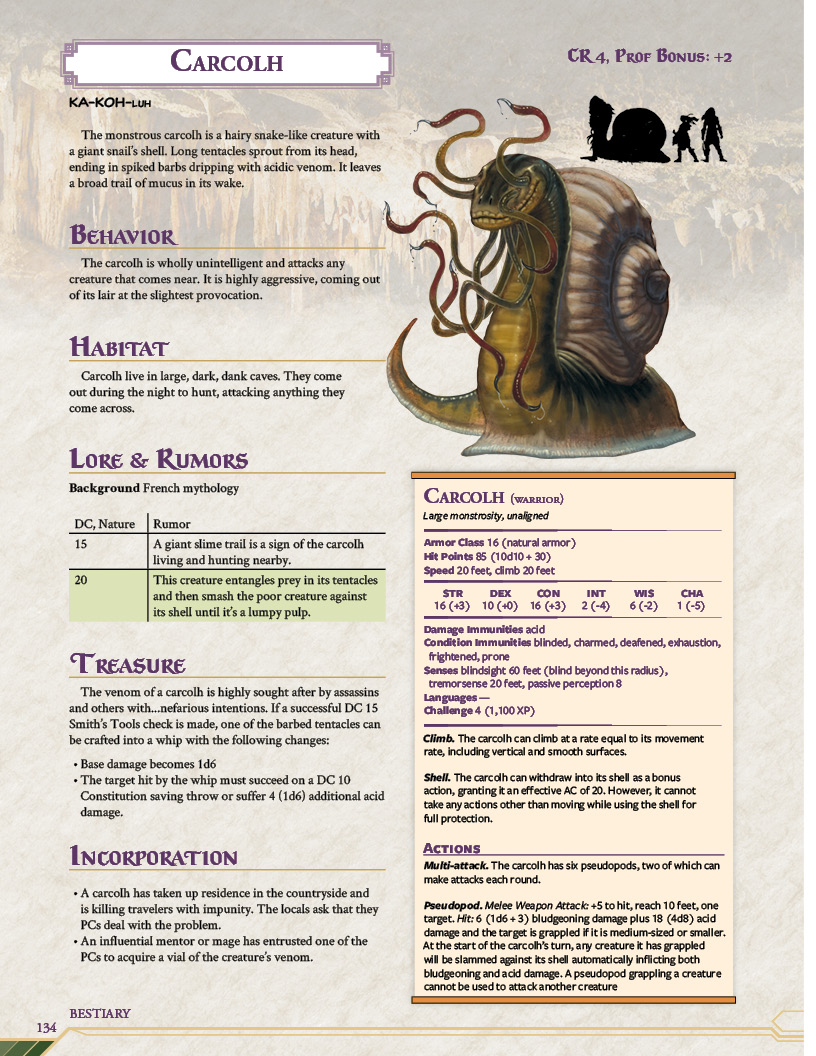
There are more than 200 creatures, all with detailed page entries. Reference the included screenshots to see some of the changes that the core books did not have. These include but are not limited to quirks, lore, suggestions on incorporating them into your game, spell lists within the stat block have been removed and replaced with detailed spellcasting abilities, etc.
[Dave here: the expanded lore and quirks are a great addition to the game]
Dozen of magical artifacts pulled from mythology and lore
Crafting rules
Tons of player options, including warlock patrons, cleric and ranger subclasses, races, feats, and spells.
Lore of the Otherworld (Fey Realm) as it was explained in folklore, including living in the Fey Realm, the Seelie and Unseelie Courts, and becoming an Archfey yourself!
A plug-in-play campaign that can be used in your existing campaign to shake things up a bit.
Let’s say I want to get this, what do I get if I back the Kickstarter?
I’m taking a slightly different approach to running this Kickstarter from other companies. Most companies offer a PDF and a hard or soft copy. That’s great, because that’s what the majority will use. However, when I did Chromatic Dungeons last summer, I learned it’s just as important to listen to the minority, because they deserve to get what they want as well. So for Twilight Fables, the digital package includes a PDF like usual of the main book. But then it also includes a PDF with no background, for ease of reading and printing. And it includes an RTF version for those with visual impairments and for those who want to cut and paste information easily. Also included are tokens and markdown files for those who use VTT gaming. That’s all for LESS than most companies are asking for just a core PDF.
Beyond that is the actual hard copy option of the book. I’ve had the advance copies in my hand already, and I was pleased with the quality. I’d love to get the $50,000 stretch goal because that allows me to get offset printing with glossy pages, gilded pages, and ribbon bookmark. But if that doesn’t happen, it’s OK because the Print on Demand book is still of very good quality.
And that’s pretty much it! No crazy stretch goals that put the project at risk for delivery.
Let me close in saying how much I appreciate the support from everyone. From the great artists I got to work with, including the legendary Gerald Brom and Darlene the Artist, to all of the backers who support me!






 Full Moon Storytelling