Tag: Dungeons and Dragons

  • Integrating pop songs into the five-room dungeon system

    Integrating pop songs into the five-room dungeon system

    You have limited time for gaming. Pulled in so many directions, you need to find ways to reduce prep time and focus the game on action.

    Two innovations help those efforts quite a bit when playing a D&D style game.

    But, you’re still left trying to be creative within those techniques.

    Take the five-room dungeon, the short essay of dungeons. It’s an introduction/guardian, puzzle/social encounter, trick/setback, climax/big bad, and the resolution or plot twist.

    This generally follows the basic plot graph in literature. It’s familiar, fast and can be done in one sitting if you time things well.

    How do you fill that out? What’s the source of creativity?

    Use pop songs!

    No, really, they often follow a similar arc, but have a chorus that echoes the main theme of the song. This idea first sprung to mind with Apollo, by SYML.

    Rather than five-rooms, we’re going to go with seven events because of the chorus. The song provides the creative prompts to fill these out.

    Introduction/Entry — on the steps of a temple the party sees a golden altar being shined, hears talks of other wonders when a dark cloud blots the sky. A raven and a wolf rush to the altar, tossing it aside, fleeing to the countryside.

    Note: after the intro the PCs determine the order of approach.

    Social encounter — Interview the group talking of other wonders and the goals for the faith. Secrets and clues include a song that is unsung and a build up of a military force by the faith.

    Choral echo — Tracking the raven and wolf leads to a moonlit glade with an empty space framed by 7 monoliths.

    Setback — The huntress on wolf back, she rides with bow drawn, ready to fight. If the party sings the unsung song there is an attack. She only appears at night, under a full moon.

    Choral echo — If the party rights the altar themselves and shines it to bright gold they discover a medallion that prevents the poison on the arrows from taking effect on the group (immunity from the poison condition in an emanation of 10′ from the one wearing the medallion).

    Climax — The songmaker arrives when one of the party bends their knee (falling unconscious qualifies, as does voluntary submission)

    Resolution (always last) — When the songmaker and huntress are both defeated a flock of ravens blots out the full moon. The wonders fall and a song echoes at their altars “I am. I was. I will be.”

    Yes, that’s quick and dirty. Tuning that to a party shouldn’t be too difficult. Maps and expanding on the secrets can turn it into a decent short adventure facing off against avatars of gods in any D&D world.

    Sure, that works for Apollo, but what about other songs?

    Quicker and dirtier with Last Great American Dynasty by Taylor Swift.

    Intro — In history there was a party with many attendees scheduled at any outsider’s home. Celebrations are held in town honoring the host and diminishing the current leaders

    Chorus — One of the hosts dies, their partner is blamed in efforts by the current leadership to reduce influence

    Puzzle — How did the person die? Clues include a neighbor’s dog, poor health, a nearby sea, a long drink together prior to the party

    Chorus — The commoners in the community ignore the other surviving families, focusing instead on the surviving partner as both suspect and hero

    Setback — Both partner-hosts haunt the house, interfering with ideas at solutions, causing the group to collect extra clues that may or may not be relevant.

    Climax — PCs discover that the old money in the area is the reason for the death, as they didn’t want the new money to interfere. If the PCs share this with the commoners there is an uprising.

    Resolution — The house remains haunted, after the PCs solve the mystery of the death, though the group can live there undisturbed.

    Did you just use a Taylor Swift song?

    Yes, I did.

    Not every pop song will work

    Just like not every TV show, movie or book is a good inspiration for a D&D adventure or campaign, not every song is.

    But, if you find out at 9 in the morning that you’re DMing in the afternoon you can adapt the five-room dungeon using the chorus to help with theme and secrets.

    Playing the song that inspires you on repeat can help you focus your energy. Sketch out the quick map including notable fantastic elements, make certain your secrets and clues work in a multi-nodal fashion.

    Fill the monsters or opponents that fit the song (ravens, wolves, ghosts). The NPCs are in the song as well (commoners from LGAD or clergy in Apollo).

    Connect a couple events to the characters and/or past adventures.

    The chorus can either be tucked into various other scenes, can be dream sequences, portents, or speeches from various NPCs rather than specific events.

    Have fun gaming

    Fediverse Reactions
  • Capturing the magic of the mundane Utilize action

    Capturing the magic of the mundane Utilize action

    The rules for the 2024 D&D Utilize [Action] are rather simple per the Free Rules and the Player’s Handbook. The magic is hidden in the siege engine blurb in the Dungeon Masters Guide.

    Simply, Utilize lets you use non-magical items that take more than a bare moment to activate.

    You normally interact with an object while doing something else, such as when you draw a sword as part of the Attack action. When an object requires an action for its use, you take the Utilize action.

    Free Rules

    Within the siege equipment rules, you can see the potential for Utilize. There, each engine has a different number of utilizations that it takes — frequently these are things like aim, load, fire. Each engine requires between one and five rounds for a single person to use these massive elements of war.

    What’s the magic in a catapult? Nothing, normally.

    But an enterprising DM will realize that there is an implied crew in siege engines. Full staffed these can be used within a normal combat round.

    Also, and probably more intriguing, is the implication of time pressure.

    Imagine now an opponent using mangonel. It takes two Utilize to load, two to aim and one action to fire. In our example we’ll use a crew of three, which lets the mangonel fire every other round and the crew do some other annoying things.

    Our heroes are on a mission to take out the emplacement of the siege engine.

    The weapon itself has an AC of 15 with 100 HP. It could take a long time to damage it.

    Taking out the crew is easier, of course. And thanks to the number of Utilize [Action] required the DM and PCs know the time it takes to make the mangonel no longer effective at attacking their allies. Each loss of a crew member slows down the enemy and grants your allies time to act in other ways.

    It’s a clock, without a clock.

    You can also use this technique for a chase scene!

    Let’s say your PCs run to the docks, board a sailing vessel and need to get going fast. Maybe it’s a ketch, with a main mast and an aft mast and foresail.

    Quick and speedy let’s say that setting the sails requires two at the aft, one at the foresail and three at the main, plus there are two utilize actions needed to release the lines. Yes, this is highly gamist, but allows a scene to develop.

    That’s an eight segment clock for the party to escape. Maybe they have an artificer with a servant, or a familiar that can help. Maybe the rogue uses Fast Hands. These can speed things up, for sure.

    The group knows, quickly that while under assault they need eight actions in order to be undersail and then the enemy will be behind them.

    No need for fiddly rolls, unless they take a wound or condition that would limit the ability to succeed at these mundane tasks.

    Building ad hoc clocks from the Utilize [Action] can also be done with traps (the number required to disarm or the number before the flooded room no longer offers room for breath).

    Photo by Egor Kamelev on Pexels.com

    Maybe do similar with rituals and the Magic [Action]. Is the group raiding a grove where evil druids are conducting a multi-step ritual to bring the mushrooms to life in order to choke out a local farm?

    Come up with a number of Magic actions that are required for success. Now the two groups both know the timing of success.

    If there are seven druids that need 14 Magic actions to succeed they can choose to all ignore the PCs and perform their magic or some can address the PCs. The solution is up to them and creates an interesting balance of choice.

    No, these aren’t the clocks of Blades in the Dark. They still create a sense of timing and urgency within your game.

    Fediverse Reactions
  • Making it easier to DM

    Making it easier to DM

    Being a Dungeon Master is intimidating. At it’s biggest level it can seem like you are supposed to run an entire world, know all the rules to the game, spotlight every player-character equally and help everyone have fun.

    There are many ways to make it simpler than that;

    • Focus only on the world with which the PCs interact
    • Skip rules that aren’t meaningful at the time
    • Rotate the spotlight as appropriate to the table
    • Get feedback from players in order to improve

    There are other ways too. I’m a big fan of the Lazy GM series.

    2024 Dungeons & Dragons helps make it easier in their Dungeon Masters Guide by incorporating some, but not all of SlyFlourish’s ideas. One notable thing is the tracking sheets — theirs and different from his, but that’s fine. Not everything needs to be the same.

    The Game Expectations tracking sheet features space for the DM's name, player names, theme, flavor, sensitive elements and more

    The layout of the new book is much better for new DMs. It also has excellent examples on how to spiral out from the characters while building a world, using Greyhawks as an example. There are micro adventures, which may not give enough information, but they do show that one doesn’t need a lot of notes to run a session. My sessions are usually a single notecard for example.

    Overall the ’24 DMG is a good to great book for Dungeon Masters early in their experience. It’s also handy that those tracking sheets are all available for free!

    But, (sorry WotC), there is a flaw in how easy it is to be a DM in this modern era.

    Those wonderful tracking sheets aren’t really part of DnDBeyond.com

    They exist, but without integration.

    What could make it easier to DM in the DnD Beyond era?

    When you Create a Campaign on Beyond it should start with that Game Expectations sheet. The notes should be replaced with the Campaign Journal.

    These are wonderful tools, and they are completely unsupported.

    Adding the sheets or similar fields to the campaign page would help a DM as they introduce the players to the game-to-be. They’d all be able to see what the story is about.

    Right now those pre-session one-sheets and the like need to be shared on the web, via email, Discord, at the table, or other tools rather than in the platform that Wizards of the Coast owns. It’s a silly gap in integration.

    Make it easier to share variant rules and setting information

    Currently, Beyond lets you share all of your books or none of your books. But that doesn’t help for a specific campaign.

    Currently, Beyond lets you share books in a deeper layer of content sharing, but doesn’t let you pick and choose rules (like attributes, extra feats, no feats, encumbrance)

    The above was updated at 8:57 pm on Nov 27, 2024

    My current Age of Myths campaign would make sense to permit Strixhaven, Theros and Dragonlance rules. It’s absurd for it to include the Illrigger, Ravenloft, or Lord of the Rings (TM).

    Imagine how much easier it would be for a DM and the table to say “these are the rules we are using for this campaign” and then toggle those rules and books either on our off.

    Currently that’s a player-by-player decision within the character creator.

    But what type of encumbrance a table is using isn’t a player-by-player decision. That’s a table decision. The appropriate setting and adventure rules aren’t most or none, but a delicate basis that sets the tone for the next several months or years of hanging out with your friends.

    Wizards of the Coast and the D&D team can make it even easier for DMs by changing some architecture of their semi-walled garden in such a way that they already believe works, because it’s in their brand new book.

    Fediverse Reactions
  • Inspiration is everywhere: Floating islands

    Inspiration is everywhere: Floating islands

    Creating memorable scenes and adventures is easier when fantastic elements are included. Many of these fantastic elements can simply be things from the real world, but amplified or expanded. In this case we’ll walk through the concept of floating islands and make those even more mythical.

    First off, yes, floating islands are real. In Lake Chippewa one is large enough it has to be pushed by motor boats so it doesn’t damage bridges.

    A floating island that drifts about on a lake or sea is already pretty fantastic. How can we up the fantasy to make it more memorable in D&D when the players are getting together every few weeks?

    This example is going to be for Sheljar, the bog-city once ruled by an intending-to-be-good necromancer, but could apply anywhere. Sheljar is a city of 100s of islands.

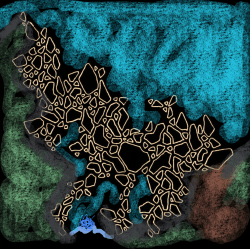
    Simple map of 100s of islands in a sea with a large waterfall in the south and mountains to the south and south east.

    What if a few of those islands floated like the bog-island of Chippewa?

    Rather than be moved by motorboat, they were moved by water elementals during the Age of Myths. The largest of these, Reylerel, at the time was the home of a power school of mages that integrated water, animals that live in and along water, and the peoples.

    As the Age was crashing they attempted to flee the city. The school wanted to isolate itself from the riots, to hide the dolphins, elementals, beaver and ducks that worked together to help the Kin survive. Reylerel went adrift, into the Sea of Sheljar.

    Now, thousands of years later the Free City of Sheljar is no longer ruled by the Necromancer. It is regrowing, discovering some of its influence from the Age of Myths. This bog-city isn’t a city of fog and depression, but a city of hope and humanity integrating gobkon teknology, love of animals and the lost magics.

    The leadership knows this is possible. Myth said it happened before, and drifting towards them is the Floating Island of Reylerel. At sea it moves with the swells and storms. The towers and buildings are rundown. Someone is going to need to go to Reylerel and find a way to prevent it from crashing into the docks.

    And that’s how you take a small trending topic on the internet and turn it into an adventure.

    Fediverse Reactions
  • Sharing your world: The power of co-DMing in the same space

    Sharing your world: The power of co-DMing in the same space

    This is a story about The Dragon.

    Which is a moon, not a big dragon. I don’t know why I called the biggest and slowest moon “The Dragon.” It was probably in honor of The Wheel of Time, one of my foundational fictions in the world. But the name never really came up in play.

    The 21-year cycle did come up. That generational marker (key for many goliaths and the Crinth Confederation) marked a cycle from the Born Generation to the present era.

    But, by expanding play in the world to a second DM The Dragon also finally became a point of clear fiction. It’s named that because during the Age of Myths that’s when the leading dragons on the Council retreated from society — Draakenmoten.

    That’s about to come up in the campaign I’m playing within my own world.

    Playing in the world I’ve invented has expanded the stories in ways I never expected. While I’ve included player concepts in world development in the past, including DM concepts in the world requires trust and grants wonderful opportunities for story-threads to be pulled into new places.

    Other things added to my world through sharing the experience;

    • Evil fungal druids that dabble in necromancy
    • Dragon Council, a ruling body of dragons and their magical allies who control the continent in a federal system.
    • Les Remoden Eisha, the intelligence and security branch of the Council.
    • Necromancy as the forbidden school of magic.
    • Elemental airships. Unlike the era where I DM, magic is common enough that it powers the airships, unlike the clackety, smog xips of the goblins.

    Those first four elements seem to be growing into the major division that leads to the sundering of the world, separating the continent with the Everflow on it from all the magical spaces in the rest of the planet. Those councils and forbidden magicks could grow into the dragon-founded schools with their abusive Proctors, supplicant Scholars and limited magic in a world that has merely love for companionship, healing waters and hope.

    Tips for Sharing a World

    First, have the creator DM and non-creating DM talk about history and key elements. Discuss where the foundational elements of the world are necessary in each campaign. Unlike Uprising & Rebellion (and the other ‘modern’ campaigns set in the World of the Everflow) the current campaign doesn’t have a foundational element about animals as life companions for example.

    Understand that things that happen in history don’t have to be understood in the future. Did Xabal discover tar-trees? Maybe someone else claims that 3,000 years later. Unless the details are vital to a plot point minor differences in the way myth-legend-history are known aren’t important. They can even both be true!

    Second, play and act with trust. Going back to point one, the details don’t matter if they don’t matter. Does the now co-DM get the name of a city wrong? That doesn’t matter. Keep playing at the table. Don’t even bother to correct it. Many cities in the real world have multiple names. That’s the way worlds work.

    Borrow heavily from each other. This is part communication, but also because you’re seeing each set of stories (every table is a set of stories that is some combination of the total number of people playing and their interactions) from different angles.

    Is there a new nugget dropped that you want to be permanently part of the tale? Take note in heavy ink and add it to your own version of the world document. Just like when a player adds something new to the world let the co-DM do the same thing.

    Be a player — you aren’t the DM, so don’t be a co-DM at the table, unless asked. The only time to speak up about some out-of-character element related to previous campaigns or lore is when the DM asks. Then you answer.

    Bonus points if you can work that into something that your character would know/do/say. I didn’t do this most recently, but wish I had. The current DM asked me what Sheljar, the bog-city, was like in the Age of Myths. I gave an encyclopedic answer rather than the answer Xabal would give.

    It’s been so much fun opening the world to more tales set within. We’ve added fantastic spaces, myths and histories that wouldn’t have existed if the World of the Everflow was merely my setting with nearly two dozen players. Adding a second DM to the world has changed the story dynamics in an exponential rather than additive fashion.

    My hope is that after this Age of Myths campaign we return to the modern era with new tales too.

  • Expanding the types of Halflings in your world

    Expanding the types of Halflings in your world

    No other early-era playable species/race in D&D history has been shoehorned into a singular type as the Halfling. Originally called Hobbits, because that’s what they were, Gygax decided to avoid a legal battle and renamed them as Halflings.

    But for nearly thirty years these small people were either the peoples who lived in homely burrows (Stouts) or peoples who lived in Buckland (Tallefellows). There were also hairfoots, which let’s be honest the three types of D&D Halfling perfectly mirrored Tolkien’s varieties of Hobbit.

    In 2024 Dungeons & Dragons, Wizards of the Coast says there are more varieties, mentioning Eberron’s street-gang house and Dark Sun’s roving cannibals. And that’s it.

    Halfling communities come in all varieties. For every sequestered shire tucked away in an unspoiled part of the world, there’s a crime syndicate like the Boromar Clan in the Eberron setting or a territorial mob of halflings like those in the Dark Sun setting.

    No longer are the differences in Halfling types subraces as earlier versions of the game. But the “all varieties” are conventional hobbits, gangsters and cannibals.

    This need not be all varieties of the small folk

    Caravans

    In Rings of Power we meet two varieties of Halflings. The first are the Harfeet, who travel in communal covered wagons travelling with the seasons over a wide land. These peoples hide quickly (a Halfling born trait) and sing proudly of their history. Though not ‘Shire-y’ they are clearly the popular Hobbit/Halfling of fantasy tropes. Caravan Halflings have been embraced by D&D in the past, fitting them in your world is easy.

    Desert cliffs

    A painting of a scene from Rings of Power showing small people living in an arid cliff and valley town with water chutes and small farms.
    Stoors from the Rings of Power (Fandom | CC BY SA)

    Season 2 introduces the Stoors, who live in cliffside holes in an arid land. You can see some Halfing behavior in the structure of the settlement. Again, they are quite communal, which I don’t like associating with a species because that feels cultural, not born, but this is part of the Halfling trope still. What makes these Stoors inspiring for small folk in my world is that they seem to embrace the divine luck of Halflings. Those aqueducts and microforms carved into cliff sides seems to require bravery, nimbleness and luck. Children scampering through that space would fall constantly without the luck of the gods.

    There are other ways that you can embrace the born traits of Halflings and build some societies, captured in their homes.

    Coop homes

    Photo of a full enclosed wooden home, sized for chickens.
    Chicken coops sold at American feed stores (Dave Clark)

    In visiting various farm and feed stores you can find fancy chicken coops. These will frequently have multiple levels, many doors and windows. Sometimes they have a small fence in material similar to the walls or roof.

    These have made me think of Halflings for some time, not just because they are made for tiny creatures. The various nooks and crannies are places to hide. Similar to modern micro-housing, a cluster of these coop-style Halfling homes would take up very little space in a fantasy city too. A cluster would touch on the communal aspect that Halflings will never escape, because their connection to Tolkien is so strong (even in Eberron and Dark Sun).

    Or one with a run extension could be a connection to terriers, cats, or other small domestic animals that live with these Halflings as companions. A design with space underneath is sensible for raising mushrooms or other foods.

    What other home types make sense for Halflings?

    Rafts and waterways

    A species of brave nimble peoples living on the waters in a mix of canals, creeks and lakes makes a lot of sense. Their small size lends itself well to working in the sails and ropes of the big people too. Narrow paths of docks and ladders would require a nimble and lucky peoples too. This also works at sea, with Halflings living in the rigging of multi-mast ships.

    Bridges

    Yes, I love this trope. My own Fort Ooshar uses it. Small folk are perfect for settling in the upper levels of a bridge-city. They also make sense in the undercarriage. The ability to slip into and out of the various rope elevators is perfect for the narrative. Halflings in this environment can be similar to the Eberron gangs or they can be families who take up the small spaces that humanity (all the medium thinking peoples) ignores.

    Tree houses

    Yes, yes, yes — this trope is heavily associated with Elves. It need not be. Halflings make a lot of sense as a tree people. They are small and light, which means they can live in a much larger variety of tree and not just the not-Redwoods. Put them in birch, or larches, or cedar. Maybe they live in briars with offices in the local oak. Being just a couple dozen pounds is a massive advantage for Halfling tree people. Their divine bravery and luck are also a great fit.

    Spire lands

    Imagine a land of natural spires with Stoor-like homes, but even more exaggeration of height with tiny bridges of rope connecting the neighborhoods. Humans would hate such a place, but a Halfling would run full speed along a rope bridge connecting two towering rocks.

    tl;dr

    Halflings can be more than just Hobbits. Your fantasy version of the small folk should embrace their born traits – brave, nimble, lucky, stealthy. Don’t assign culture due to their species, but the places where they live and how that influences them.

    Your city Halflings could be gangsters, your caravan Halflings could be communal, your bridge Halflings could be a hidden undercurrent, your burrow Halflings could be a coven.

    Embrace more options in your fantasy world so you can tell a wider variety of fantastical tales.

    Fediverse Reactions
  • Reblogging: I’ll be adding NPC ritualists to my world

    In this post Jared talks about how rules support fiction with the examples being from Tales of the Valiant’s rituals system.

    The magic of this is you don’t even have to use Tales of the Valiant as your base system to add this to your 5e world. The ritual system is essentially 5e D&D neutral.

    Take Divine Ritualists as described. They look like, and are mechanically supported like, miracle workers at a temple. The Primordial Ritualists are like less powerful Tom Bombadils.

    Thank you Jared Rascher for the inspiration.

  • 2024 D&D Player’s Handbook Review

    2024 D&D Player’s Handbook Review

    The latest version of D&D is out in the wild. I’ve been perusing it via D&D Beyond, and I bought the local shop version of the hardbound book (which already lacks the near-immediate errata updates). That cover, with its slice-of-life capture rather appealed to me. A large part of what I love about the game is imagining these heroes in their between times.

    This review isn’t going to dive deep into rules, nor the debate about this being a new edition. Instead it’s going to be why I enjoy the book. Eventually I’ll use the 2024 version of 5e as my baseline, but leaning into SlyFlourish’s ideals I’ll augment it with other 5e materials I enjoy — Tales of the Valiant/Black Flag, Advanced 5e/Level Up, 2014 Wizards of the Coast, and more. Whatever tells the story at the table best will be what’s welcome at my table, when I DM.

    I’ve played D&D in some variant for nearly as long as I can remember. My first games involved a few d6 and were kind of ad hoc, played with a red box and a DM who had to explain everything to my much too young mind. I stuck through it and grew into it, and played for more than ten years during my first run in the 80s and 90s. Then I came back to the game with 5th edition, almost twenty years after leaving the game. I bring this up, because in many ways the 2024 rule set isn’t made for me — it’s made for people who are still new to Dungeons & Dragons.

    More welcoming

    Photo of Chapter 1 of the 2024 Player's Handbook "Playing the Game"

    There are a lot of new rules, both revisions and outright new items.

    But the best, absolute best, thing about this new PHB is that it seems crafted to help someone who has never played D&D before. It leads with how to play the game rather than how to create a character.

    The examples given cover all pillars of the game, which is vital as more and more actual plays emphasize social and exploration pillars over the pure combat that birthed Dungeons & Dragons.

    Photo of the social interaction example from the opening chapter. There's also a LEGO eleven bard.

    With a layout and organization that welcomes the eye the craft of the book is immediately obvious. The larger font is welcome to my old eyes, while also helping youngsters not feel like the wall of text is an obstruction to learning.

    Massive amounts of art help too. That art sets tone, all the tones. Art throughout the book gives examples of sword & sorcery, high fantasy, magi-punk. In fact every active setting from 5e is given art at some point. There’s art that shows dirt and grit. There’s art from high fantasy superheroes. There’s art of a calm brook and a dragon and so much more.

    Art is language. It shows us what the game can do, and for people with less D&D firmware updates in their brain they can see the game as it can be.

    Having helped more than a dozen friends try to learn the game from the 2014 PHB I cannot wait for the first person to ask to learn now that 2024 is in our hands. It won’t feel like studying for a test.

    Origins

    Photo of the halfling section of the 2024 PHB. The art shows Halflings at a dinner party enjoying life.

    There are some misses in the rules of the Origins section. Backgrounds remove some of the distinct flavor elements that were great (this is fixable via expanded feat opportunities and short-form personality). Also, my halflings were simplified, which makes me sad.

    There are also wonderful new things that, once again, help new players more than old.

    Background and species art is a slice of life for both.

    With the species are every species listed but one shows at least one character with corrective lenses. Yes, this is something I harp on a lot, but it is a rather easy way to show the level of technology and acceptance within a society (even if it wasn’t historically accurate, which it is, your D&D campaign should include glasses). Species art shows the typical cultures for a species. The language also makes it clear, that you don’t have to make a character that is typical.

    This is further reinforced because the background art shows other cultures. These vignettes of life are demonstrations of what the future heroes did before. It’s a wonderful and subtle to show more variety in the worlds of D&D. There are rice patties and sailing-canal towns and magi-scribes and so much possibility. That’s really what D&D is about at the core, possibility.

    Equipment improvements

    Photo of the LEGO version of Tasha next to the gear entry on Book within the 2024 PHB

    Of all the rule tweaks and expansions, my attention keeps coming back to what the design team did with gear. In old school D&D your equipment build out helped define how you could innovate to solve exploration and social problems.

    2024 doesn’t go that same direction. Instead of innovation it goes for explanation. Every non-container (probably, I haven’t counted) has a description about what types of mechanical things it helps the owner of such gear do. A book helps with history checks. Perfume helps charisma checks. The list continues.

    This is a massive improvement for the social and exploration pillars’ mechanical support. Equipment availability also helps describe the types of worlds within D&D. With muskets and pistols and ball bearings and magnifying glasses and spyglasses this is a world similar to the Renaissance.

    A setting book can also remove or add to those elements. Eberron and Dark Sun need this the most.

    As someone who used to peruse the polearm section of the original Unearthed Arcana for hours upon hours the massive amount of drawings for mundane gear is a pleasure.

    Rules Glossary!

    D&D is a complicated game. There are quite a few rules. Within the tabletop RPG space it is somewhere between medium and high complexity, even with 5th edition’s much more welcoming ruleset.

    Photo of the Tasha figure again, holding her open spell book while atop the Rules Glossary.

    Another wise layout choice was to not waste space on an index, but instead give us a glossary of rules. A 384-page book, even one with a larger font and loads of art, can be intimidating.

    For 2024 Wizards of the Coast decided to cut back on that potential complexity via the Rules Glossary (yes, it probably should have been an index also, but the glossary aspect is most important).

    When people first start playing they consult rules frequently. During character creation they do this to understand what their PC is capable of. During play flipping pages to understand is quite common.

    A glossary speeds things up at the table. So does writing the page number of your abilities on your character sheet (another SlyFlourish tip).

    Who should get the 2024 PHB?

    • People new to D&D who will be joining a table where it is the baseline rule set.
    • Completionists.
    • DMs who want to understand the tweaks that will speed up play (like beasts no longer having rules riders with saving throws).
    • Players who want a much better monk.
    • Tables that want better representation.
    • Art lovers.
    • Me
    Fediverse Reactions
  • Diary: Success in Mihrstone

    Diary: Success in Mihrstone

    We’re flying back to Sheljar.

    I guess we did what we needed to do, but something doesn’t sit right. A family lost their father and their oxen. A town lost its feeling of safety.

    Yes, the stream is running clear again and those evils in the cave complex are gone.

    They aren’t going to be harming the town and the standard guards should be able to help everyone feel safe, eventually. The town of Mihrstone can take a small comfort in that.

    But I’m not comfortable. Artok’s mission feels incomplete. We lost an ally. We don’t know why this pungent fungal druidism rose to strength. There’s reason to think it is a danger that will be constant now.

    Cap’n Crilbort and the Sadijh are taking a group that started as two (Artok and Amos) and is now five — I guess I’m in the group, maybe? — to Sheljar. Artok and Amos will report to their factions. I ain’t got a faction, nor do Rolf and this Crag, we don’t know ‘im yet. But he’s with us, because he’s heard there’s more to this evil than just the one city.

    Aft Artok and Amos report in, what next?

    Imma little communicator and fixit. I like small problems. I like thinkin’ ’bout how to get Midqh to do new things. I don’t like mysteries. I don’t walking shroom people. I don’t like not-quite dead elves with weird molds on them. I don’t like cursed scrolls and global dangers. And I don’t like losing a friend.

    This world is getting more dangerous, not less.

    I’ll help where I can. Come up with new ideas. Mayhap they’ll be wrong, but I’ll try. That’s all I can do, that and annoy Rolf by giving him too many options.


    In our current Age of Myths campaign I’m playing Xabal, a smaller hobgoblin artificer that uses an eldritch cannon called Midqh. My goal is to be the party notetaker, but with a twist. I’m writing our recaps as if Xabal, a motormouth former Tinkerer is the author.

    Other PCs are;
    Artok — bronze dragonborn paladin
    Amos — elven wizard
    Rolf — bugbear monk
    Crag — dwarf barbarian

    Rest in peace Eustace, the gnome bard, laid to rest in Mihrstone

  • Diary: Eustace

    Diary: Eustace

    Hello again fair reader. You may be wondering why these diaries of my times with Artok and the crew are from me and not the humble bard we met. The reason is two-fold.

    1 – I happen to want to remember the journey I’m having. It’s my life and my tale.

    2 – Eustace died.

    china tour guilin reed flute cave fungal looking purple and blue
    china tour guilin reed flute cave fungal looking purple and blue by Ben Burkland Carolyn Cook (CC BY)

    Yeah… things didn’t go well in the fungal caves behind the waterfall. Some of that is my fault. Some is the fault of the funguses. Sometimes it’s just bad luck, like when that crewmem’ went o’erboard. This death in the violent life we lead has fault.

    Eustace getting stuck inside a shambling mound of vegetal horror is kinda traumatic. Especially since at one point all of the group spent time inside that mound. I nearly died too, at my last available breath Rolf slew the dread beast!

    How’d we get into a situation where the four of us were in such danger?

    It started by trying to help a mushroom man who asked for help. I’m always up for helping the needy. Plus, Rolf really trusted fun-guy. Turns out that was because of a spell. Which, we probably should have figured out, but didn’t, again, because I believe in helping the less fortunate and who is less fortunate than someone made of fungus.

    Deep in the cave the two of us were following Funguy, the shroom, and things started to get complicated. We discovered a ritual with other ambling funguses plus this thing that looked like what would happen if a fungus and elf merged, maybe that’s what was happening to poor Glovin who at least had the fortune to die before being taken over.

    Things turn violent pretty quick, luckily Eustace and Amos showed up. We’re outnumbered. Things are going well somehow. We start to get confident. Things are working, kind of. I did accidentally destroy Midqh in boom of thunder, but we’re doing well outside of that until…

    Funguy summons that mound.

    In our weakened state we struggle. I get off some decent spells. So does Amos (that wizard knows some powerful magic). Rolf is doing alright with his magic too! Eustace’s words weaken things.

    I’ve got no Midqh and I’m out of little bits and bobs to build more. I have to stand toe-to-toe with the mound eventually. It sucks me in.

    Rolf and Amos tell me later that they were in serious danger. Rolf uses a misty step to get out and then he and Amos finish off the shambling mound, last of our enemies. I thank them after they wake me up.

    “Where’s Eustace, our gnome storyteller?”

    Their faces turn sad. One points to his body.

    We search spellbooks and knowledge bases. We have nothing to help.

    We have nothing for Eustace.

    We’re stuck in this fungal cave, still no answer to what’s terrorizing Mihrstone, what killed Glovin, what stole his herd.

    And there’s one less of us.


    In our current Age of Myths campaign I’m playing Xabal, a smaller hobgoblin artificer that uses an eldritch cannon called Midqh. My goal is to be the party notetaker, but with a twist. I’m writing our recaps as if Xabal, a motormouth former Tinkerer is the author.

    Other PCs are;
    Artok — bronze dragonborn paladin
    Amos — elven wizard
    Rolf — bugbear monk

    Rest in peace Eustace, the gnome bard.