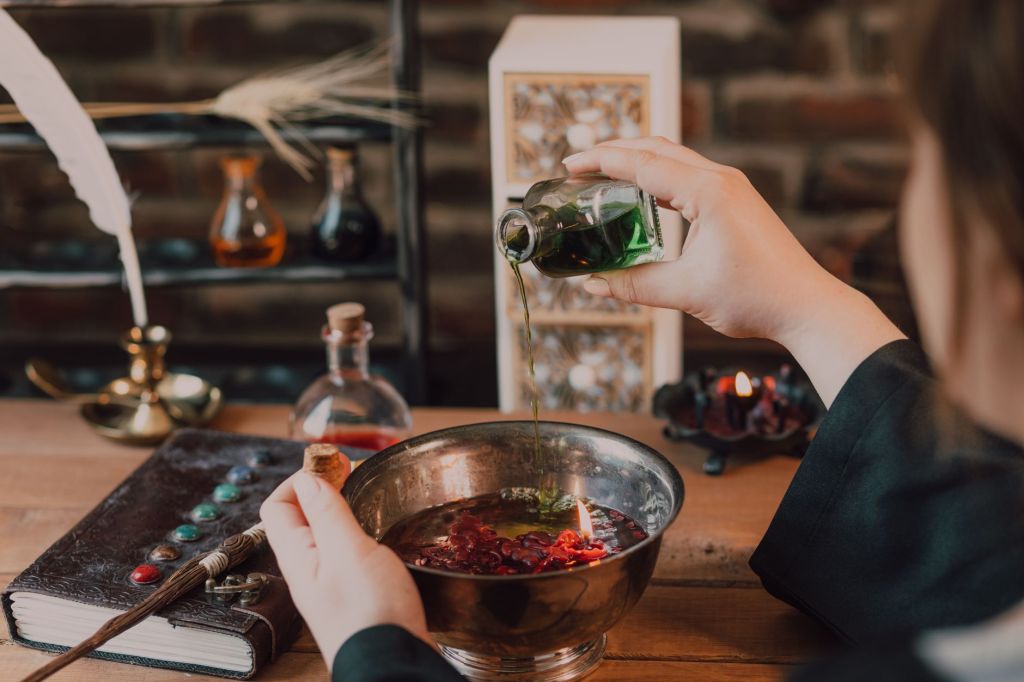
Tag: cantrips

  • Ritual casting Cantrips in D&D

    Ritual casting Cantrips in D&D

    Worlds with mild or pervasive magic, magic that’s not merely for combat should have more rituals. These rituals would be to represent the fictions around hedge mages, working mages, knacks, folk magic and the like.

    But how do we do this in a world that isn’t just low magic, but nearly no trained magic — by Ritual casting Cantrips.

    Now, that seems counter intuitive. In D&D and the rest of the 5e ecosystem we’re used to seeing cantrips as a less than six second flash of action. The non-combat ones, especially the four most flavorful ones, aren’t powerful.

    That’s exactly why we’re stealing those four and turning them into rituals for the hedge mage, the folk witch, the knacked one.

    Converting to Rituals

    Currently the casting time is one Magic Action or Action for Druidcraft, Elementalism, Prestidigitation and Thaumaturgy.

    1. Make the ritual last 10 minutes, 1 hour, or 8 hours.
    2. Expand the impact of these spells exponentially.
    3. Give them to commoners.
    4. Do not let the trained casters cast these as rituals as they are less powerful than constantly casting using an Action.
      1. Do let casters have the higher impacts when their combat cantrips get more powerful.

    Druidcraft

    From the 5.2 SRD;

    Whispering to the spirits of nature, you create one
    of the following effects within range.

    Weather Sensor. You create a Tiny, harmless sensory effect that predicts what the weather will be at your location for the next 24 hours. The effect might manifest as a golden orb for clear skies, a cloud for rain, falling snowflakes for snow, and so on. This effect persists for 1 round.

    Bloom. You instantly make a flower blossom, a seed pod open, or a leaf bud bloom.

    Sensory Effect. You create a harmless sensory effect, such as falling leaves, spectral dancing fairies, a gentle breeze, the sound of an animal, or the faint odor of skunk. The effect must fit in a 5-foot Cube.

    Fire Play. You light or snuff out a candle, a torch, or a campfire.

    Adjustments by effect

    • Weather Sensor. 10-minute ritual. The forecast is for the next two days. 1-hour ritual. The forecast is for the next four days. 8-hour ritual. The forecast is for the next eight days.
    • Bloom. 10-minute ritual. You can create two blooms. 1-hour ritual. You can create four blooms. 8-hour ritual. You can create eight blooms. These blooms last as long as the ritual.
    • Sensory Effect and Fire Play. 10-minute ritual. You may create two of those effects in a 10-foot cube. 1-hour ritual. You may create three of those effects in a 20-foot cube. 8-hour ritual. You may create four effects in a 40-foot cube. Sensory Effect and Fire Play can be combined when part of a ritual.

    Elementalism

    The various effects are similar to Sensory Effect and Fire Play, but with minor changes.

    • 10-minute ritual. You may beckon or sculpt two elements. The effect can be within a 10-foot cube or square. Effects that last a minute last two minutes instead.
    • 1-hour ritual. You may beckon or sculpt three elements. The effect can be within a 20-foot cube or square. Effects that last a minute last four minutes instead.
    • 8-hour ritual. You may beckon or sculpt up to four elements. The effect can be within a 40-foot cube or square. Effects that last a minute last 10 minutes instead.
    A thin shape of a house with script Kristin Clark inset

    Full Moon Storytelling is brought to you by Kristin Clark of Keller-Williams Lake Washington
    If you are looking to buy or sell a home in King or Pierce County, Washington support Full Moon Storytelling by supporting Kristin.

    She’s my partner in everything I do.

    Prestidigitation

    This is the most complex of the flavor cantrips.

    Sensory Effect and Fire Play. 10-minute ritual. You may create two of those effects in a 10-foot cube. 1-hour ritual. You may create three of those effects in a 20-foot cube. 8-hour ritual. You may create four effects in a 40-foot cube. Sensory Effect and Fire Play can be combined when part of a ritual.

    Clean or Soil. 10-minute ritual. The size of impacted area increases to 2-cubic feet. 1-hour ritual. The size of the impacted area increases to 4-cubic feet. 8-hour ritual. The size of the impacted area increases to 10-cubic feet or one Large (or smaller) creature.

    Minor Sensation. 10-minute ritual. The size of impacted area increases to 2-cubic feet for two hours. 1-hour ritual. The size of the impacted area increases to 4-cubic feet for four hours. 8-hour ritual. The size of the impacted area increases to 10-cubic feet or one Large (or smaller) creature for eight hours.

    Magic Mark. 10-minute ritual. The mark lasts two hours. 1-hour ritual. The mark lasts four hours. 8-hour ritual. The mark lasts a day.

    Minor Creation. 10-minute ritual. The item or image lasts for a minute. 1-hour ritual. The item or image lasts for ten minutes. 8-hour ritual. The item or image lasts for 1 hour.

    Thaumaturgy

    Altered Eyes. Booming Voice. Fire Play. Tremors. 10-minute ritual. The effect lasts for 2 minutes. 1-hour ritual. The item or image lasts for ten minutes. 8-hour ritual. The item or image lasts for 1 hour.

    Invisible Hand. 10-minute ritual. You can influence two doors. 1-hour ritual. You can influence four doors. 8-hour ritual. You can influence 16 doors at once.

    Phantom Sound. 10-minute ritual. You can create two sounds. 1-hour ritual. You can create four sounds. 8-hour ritual. You can create 16 sounds at once.

    This work includes material from the System Reference Document 5.2.1 (“SRD 5.2.1”) by Wizards of the Coast LLC, available at https://www.dndbeyond.com/srd. The SRD 5.2.1 is licensed under the Creative Commons Attribution 4.0 International License, available at https://creativecommons.org/licenses/by/4.0/

    In the Lands of the Everflow

    Before The Born Generation and the return of magic the rare, mild magicks of the world were the Bonding, the clandestine Scholars, and extremely rare ritual casters who could only cast these four Cantrips and Rituals as per Black Flag’s Ritualist Talent (page 81). Even the Scholars could only cast using rituals during the three thousands years without magic, but those rituals were casting normal spells at that length of time and then holding concentration on them until they were needed.

    Fediverse Reactions
  • Thunder Monkeys and Other Remarkable Beasts for Your D&D Campaign

    Thunder Monkeys and Other Remarkable Beasts for Your D&D Campaign

    How magic interacts with the world is often a defining space in Dungeons & Dragons. In the Forgotten Realms magic, whether arcane or divine, exists as 5th edition defines it. In Eberron magic is instead something that is common, fueling the themes of steampunk and noir with orcs and elves. Dark Sun goes the opposite direction. Magic there is not just limited. Magic continues the ecological disaster that mars the world.

    In the World of the Everflow magic burst forth onto the world in two awakenings. The first, explored mostly through short fiction and table narration gave the Kin (People of Love) a single cantrip, all of them. The second awakening brought the ability to cast spells to certain Kin and saw the return of the Ken (People of Knowledge) and Kon (People of Technology) to the shores of the Six Kingdoms.

    As my worldspace, and the associated tales continuing to develop, the thought popped into my head “What happened to the animals during the Awakening?” Throughout known time the Kin were always bonded with companions (initial rules). With the bond between beast and person so strong, did some beasts get small magics?

    The answer is yes.

    And so the Thunder Monkey became a reality in the World of the Everflow.

    Photo by Arindam Raha on Pexels.com

    The mechanics are fairly simple. The Thunder Monkey can cast Thunderclap once per short rest. They can also use the first bullet point from Thaumaturgy at will. All other stats are like the basic version of a baboon with minor tweaks that you feel are appropriate. This spectacular beast is rare within the Six Kingdoms, mostly found in Douad, a Mediterranean feeling space.

    A character, player or non-player, with a Thunder Monkey becomes more notable and memorable.

    Combining mundane beasts with other cantrips can lead to other fun combinations.

    • Lightning Lure Bugs are giant wasps without a stinger, but instead the ability to cast Lightning Lure and Dancing Lights making them useful in a conflict or able to help light the darkness.
    • Flapping Foxes are fennec foxes that cast Gust with the breeze originating from their big ears.
    • Pointers are tracking dogs able to cast True Strike as they direct their companion where the target is.
    • Slinging Spiners are porcupines that cast Sword Burst flinging more spines than their body carries.
    • Fixin’ Friends are spiders that cast Mending, using their silk to fix what is broken.
    • Tidings Birds are pigeons with the ability to cast Encode Thoughts, carrying messages throughout the town.
    • Savage Mousers are housecats with the ability to cast Primal Savagery, their normal painful non-damaging bites now capable of felling a threat.

    These remarkable companions are practically limitless. The damage dealing cantrips (probably Guidance and True Strike as well) at just 1 per short rest will not create any sort of imbalance on any world. Others can be more frequent, likely at 2 or 3 ties a short rest, so that they are used but do not overshadow the players.

    Every cantrip and every beast is an opportunity to expand the stories you are telling through the use of magic. This expands the 1,000 times a thousands tales available at the table.

    What will be the first remarkable beast your character meets?

    Fediverse Reactions
  • Cantrips and Backgrounds Are a Perfect Match

    Cantrips and Backgrounds Are a Perfect Match

    My backgrounds project continues to expand, adding in many medieval/Renaissance professions that fit in the apocrypha of D&D and related fantasy worlds. At this point there are nearly three dozen frameworks down. None of them demand a magical world.

    But, this is D&D, and in all (?) of the official, product-supported worlds of 5th edition magic is not something that is only held by leveled PCs and NPCs. If you visit a shrine in Forgotten Realms there is a great chance that one of the Acolytes there knows Thaumaturgy. The number of Guild Artisans (tailor) in Eberron that know Mending is almost certainly larger than the number that do not.

    In these worlds there should be tales of those who became heroes after their less-than-mundane lives. The fantastic is part of the D&D experience – both in heroic journeys and in everyday life.

    Exploring what cantrips make sense leads me to listing those cantrips that are not designed for warfare – essentially ignoring damage cantrips, but there are a few that make sense. Let’s take a look at the DnDBeyond list of cantrips and pare it down to just things that commoners would possibly know.

    Cantrips for Fantastic Living

    • Control Flames – Yes, it can do damage, but its primary purpose is about starting and putting out fires. I’ll explore a Firefighter.
    • Create Bonfire – Similar to above.
    • Dancing Lights – This also has combat roles, but imagine the ability of a theater designer to take advantage of Dancing Lights in ways that amplify that experience. The name does not leap to mind, but a variant entertainer using light is needed.
    • Druidcraft – The most obvious way this works is to help a Farmer, Rancher, Herder, etc. On the other hand, imagine a Weather Forecaster.
    • Gust – Sailing across the sea and stuck? Find your empowered crew who can create a tiny wind.
    • Light – The uses are nearly infinite. The Lamplighter will be both apocryphal and fantastical.
    • Mage Hand – Thieves and Wizards alike enjoy this one, but so would construction workers. Why bother with a ladder when you have Mage Hand?
    • Magic Stone – While this is a combat cantrip it feels proper for certain wilderness Backgrounds to have access to it. An Herbalist hunting for a rare shroom may need to defend themselves, for example.
    • Mending – Tailors and Tinkers around the world would be thrilled.
    • Message – This would be useful for the Pamphleteer, the Town Crier, the Spy, the City Watch, and many more.
    • Minor Illusion – Another cantrip that would suit Entertainers.
    • Mold Earth – Masons and Farmers could both find uses for this cantrip.
    • Prestidigitation – A Realmsean Dry Cleaner could profit off of making the bloodied heroes, and criminals, presentable. Similar to Light and Druidcraft the Backgrounds that could take advantage of this are nearly infinite.
    • Produce Flame – A third in the fire series.
    • Shape Water – Immediately upon reading this one I thought about construction of aqueducts and water wheels.
    • Spare the Dying – In gameplay this may be one of the weakest cantrips. In the rough and tumble alleys of Baldur’s Gate it keeps the citizenry alive – Medic and maybe for the Barber as well.
    • Thaumaturgy – Acolytes and Sages should probably already know this one. The organized faiths of the world would have plenty of priests and others able to shout above the masses. This also has great application for a Town Crier, Herald, and Soldier.

    Several more attacking cantrips have possible secondary uses. These are ignored because not every D&D world need be one of violence for the commoner.

    Next Steps

    In some cases adding these minor spells to existing Backgrounds makes sense. That would involve a slight change to the current rule set. We know that a cantrip is considered roughly equal to a skill or language based on the Feats Linguist, Prodigy, and Skilled. The product will address that.

    But knowing these cantrips also means an exploration of how certain roles in the medieval/Renaissance apocrypha of D&D change because of magic. A Lamplighter (a custom background in development) with Light should be behaviorally different than one still using flint, steel, and oil.

    Both will exist. You will be in charge of how your world borrows the ideas to come in Before We Were Heroes (tentative title).

    Your world should be apocryphal and fantastic.