Tag: 5e

  • West Thundermoon Trading Post, home the Maltunyns

    West Thundermoon Trading Post, home the Maltunyns

    Traveling the harsh lands of the Ferments? Find everything you need at WEST THUNDERMOON TRADING POST!!! Settled in the foothills of the Thundermoon Mountains a half a day’s ride west of Ourten, WEST THUNDERMOON TRADING POST is the go to location to find all of your hunting and travelling needs.

    Run by the Maltunyn family for generations, they’re knowledge of the local terrain, as well as their selection of only the finest gear will ensure your travels will be safe and comfortable. Or you could pick up some of the finest furs and rations provided by master hunter Velthuria Maltunyn, and her daughter Keesrah. If you need a quick repair, or even an herbal remedy or two, Cay Maltunyn has you covered.

    With the experience of generations, and a deep love of the land and air, the WEST THUNDERMOON TRADING POST is a must for any serious travelers of the Thundermoon Mountains. Visit the WEST THUNDERMOON TRADING POST today!!!

    You can find that brochure throughout the villages and homesteads of the Thundermoon Mountains in The Ferments.

    Keesrah Maltunyn, a human guide and drakewarden ranger with a raven named Crow, is the player character who calls the trading post home.

    The West Thundermoon Trading Post is about two days south by southeast from Orten. The post is on the southerly road towards a desert region. That road runs roughly parallel to the Thundermoon River. In the hills and mountains are a few fishing and hunting families.

    The Location

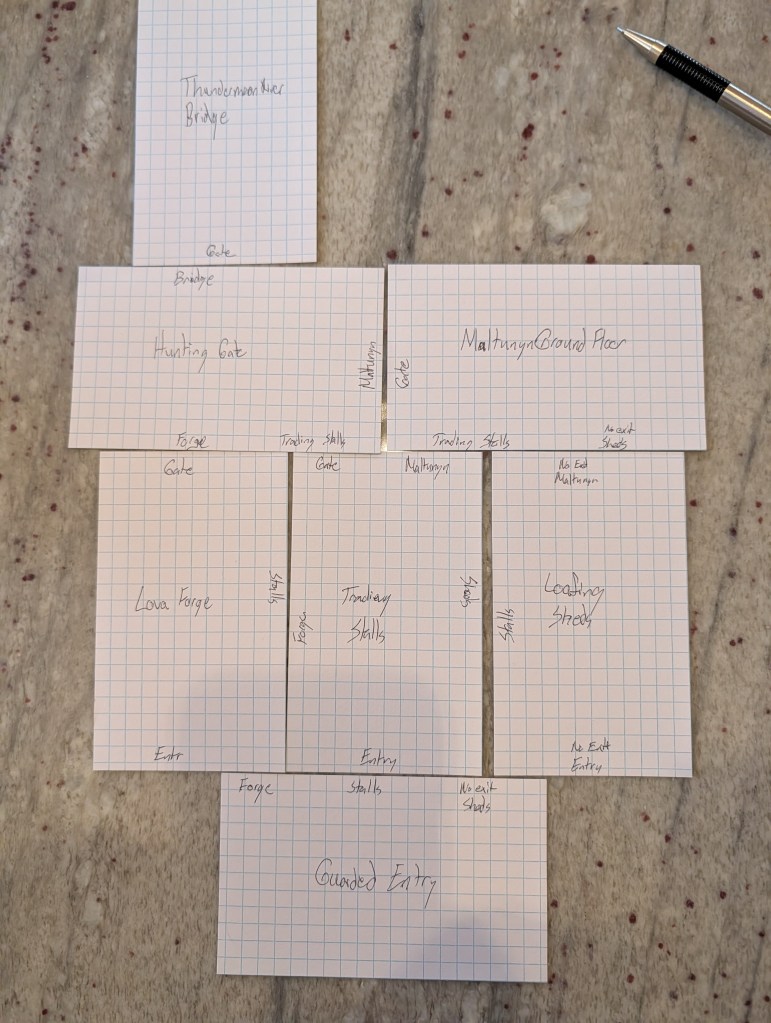
    The image displays a set of seven rectangular index cards arranged on a speckled stone surface. The cards have a grid pattern and are covered with handwritten notes. The cards are arranged in a T-shape with four cards on top and three below. Each card contains various textual labels such as locations and descriptive phrases. In the top row, the central card is labeled "Maltunyn Ground Floor," flanked by cards labeled "Bridge" and "Trading Stalls." The topmost central card features "Thundermoon River Bridge." Other notable labels on the cards include "Hunting Gate," "Lava Forge," "Guarded Entry," and areas denoted as "Stalls" and "Sheds." A pen is positioned at the upper right corner of the image.
    Zonal word map of the Trading Post

    Guarded entry

    A wooden wall surrounds the Trading Post. The entry is where all merchants and visitors arrive. There are two large doors, which are barred at night. A guard stand rises to the left of the doors, as one exits. It can hold one medium creature and grants them half cover. A ladder provides access.

    • Elemental affinity: None.
    • Hazards: Breaking down the closed door requires a DC: 15 Strength check.
    • Allies: The goblins and family can provide ranged or melee Militia Actions.
    • Max occupancy: Five medium creatures.

    The guarded entry connects to the lava forge, the merchant stalls and the loafing sheds.

    Lava Forge

    A small semi-open air forge where Cay works as a sometime smith. The heat and bellows are from an active fissure where magma surges underneath the trading post. Malk, the goblin captain, now helps out. Malk and Borkin also store their own clutter there, including the smog-buggy.

    • Elemental affinity: Earth, fire, lava
    • Hazards: Those knocked prone who fail their DC by five or more take 1d8 fire damage from the forge. Forced movement can result in the tools of the trade being knocked all over, turning the Lava Forge into difficult terrain. Oh, and beware of a lava flare — who knows when that will happen.
    • Allies: Cay, Malk and Borkin may be present
    • Occupancy: Four medium creatures.

    The lava forge connects to the guarded entry, to the trading stalls and the hunting gate.

    Trading stalls

    One large and two smaller open stalls sit in the large enclosed central space of the post. Various homesteads and outsiders come through with their wares on a seasonal basis. There’s a central fire pit with some large stones and simple benches frequently with a stew pot and hot beverages available.

    • Elemental affinity: Fire, air
    • Hazards: The cook pit can become a fire hazard, doing 1d8 damage to those who fall into it and setting their flammable gear on fire. It provides 10′ of bright light and 10′ of dim light at night.
    • Allies: Neighbors may be present depending on the season. They will almost always limit their help to rallying the Maltunyns.
    • Occupancy: 3 in the large stall, 2 in each small stall and room for 12 more medium creatures.

    The trading stalls connect to every other zone except the hunting gate.

    Loafing sheds

    Like everyone in the Six Kingdoms the Maltunyns have space for beloved animals. These sheds are designed for equines, canines as well as the rare bovine or more exotic companions. There are small cabinets for feed and tack.

    • Elemental affinity: Cold, air
    • Hazards: When occupied the animals could be feisty.
    • Allies: None typically
    • Occupancy: 7 medium creatures.

    The loafing shed connects to the guarded entry, the trading stalls and the Maltunyn home.

    Hunting gate

    Known for the gate that Caile leaves open it’s actually the place where Cay raises herbs. There’s also the gate to the hills where Keesrah and Velthuria hunt. It’s also a lower land, near the river.

    • Elemental affinity: Water, plants
    • Hazards: During heavy rains the mud creates difficult terrain. A rapid freeze after rains can lead to icy conditions.
    • Allies:
    • Occupancy:

    Thundermoon River bridge

    A few weeks ago there was a small wooden bridge over the river. Then the mephit mudslide took it out. Now a ford those that cross must be wary of mud mephits who settled in the area after the slide. Heavy rains may bring them back and upriver there is a threat that the open lava could change the river’s path.

    • Elemental affinity: Mud, water, maybe lava
    • Hazards: During floods the ford is impassable terrain without aids — ropes, other people or animal companions. Mud mephits may strike at random, the little chaos beasties they are.
    • Allies: One of the Maltunyn animal companions are frequently in the area.
    • Occupancy: This is a large space without a limit as it connects to the hills and mountains.

    Thundermoon River bridge connects to the hunting gate.

    Maltunyn home

    A two-story wooden building, the ground floor of the home is mostly accessible to the general public. The main room is a mix of general store with goods on consignment, smithed tools, dried or smoked meats and a few tables with chairs for visitors. This room can be entered from either the hunting gate through a small side door or the main entry connecting to the trading stalls. An outer stair to the second floor reaches the roof of the loafing sheds and a narrow platform along the wall running to the guard stand. There’s a small open kitchen/stove with a root cellar stretching under the homestead wall near the river.

    The second floor is two bedrooms and a small aviary.

    • Elemental affinity: Smoke
    • Hazards: Bar fights are rare, mostly because Cay is a smith and Velthuria is a scout.
    • Allies: If the trading post has visitors one of the family or goblins is always present.
    • Occupancy: 10 medium creatures
    The image is a stylized fantasy map depicting a region with diverse geographical features. The terrain is primarily sandy with scattered trees and mountain ranges. At the top left corner, the title "The Ferments" is displayed, with the region stretching across to the "Thundermoon Range" at the top center. Various areas are marked, including "Fatwoods" and "Palemarsh" to the west, represented with dense forests. "Sands Of Ar" is a large desert area in the center. To the south lies a large body of water labeled "Dark Wassr," depicted in a light blue-green color. Key locations such as "Raven Watch," "Sanctum Of The Black Witch," "Brightshelt," and "Ourten" are marked with symbols like houses or skull icons. A compass rose is placed near the water, aiding orientation. Paths, indicated by dashed lines, connect various locations.
    Created using Perilous Shores

    Allies

    Velthuria is Keesrah’s mother. A human scout with a small dog, she is the primary hunter and runs the operations such as rentals of the three stalls for merchants.

    Cay is Keesrah’s father. A human smith with a miniature pony, he uses a magma powered forge, Cay can craft anything with metals. He also grows herbs.

    Caile is Keesrah’s brother, a human with a small dog. Smitten with one of the Drudzhar Caile sometimes wanders off on his own. Ally, but adversary sometimes.

    Malk is a goblin captain and was saved in session one. A colonialist they are searching for resources for the Queen. They may become an adversary.

    Borkin is a goblin cart driver. They are less colonial and more willing to help the Maltunyns, especially in defense and general labor. Malk is still their boss.

    Henkel family

    River fishers in the ponds and streams of the low Thundermoons the Henkel family are halflings with river dogs. They are indebted to Keesrah after she rescued Taier one of their younger teens.

    Adversaries

    Clan Drudzhar

    A group of goliaths who live higher in the Thundermoon Mountains. Clan Drudzhar and the Maltunyn’s have been arguing, and sometimes openly fighting, over hunting territory in the mountains for years. One of their children is in love with Caile.

    Their home is high in the scrub mountains and was recently near the mud mephit floods. They and the Maltunyns use different styles of traps and will frequently destroy each other’s snares. Birds of prey are their most common companions.

    Elements of mud and lava

    Mud mephits, magmin and lava elementals roam the Thundermoons. These adversaries are manifestations of The Ferments, a land that refuses to be tamed.

    Children of Chorl

    Punch chickens raided a market stall, but quick action by Keesrah and her acquaintance Ellis ended the theft and the punch chickens. The two later learned that the Children of Chorl raided Ourten too. These human-animal hybrids seem to be hiding in the hills or plateau near Pirna Farms, now Ellis Mill.

    Kon colonialists

    While saving the lives of Malk and Borkin pushed off the investigation by the Queen’s goblins into how the resources of The Ferments could replace the tar trees of their homeland. That colonial raid and investigation may expand.

    Downtime and Quests

    Keesrah is researching how to create Serpent Scale Mail armor. She’s learned that the elemental drakes do not leave behind enough resources. The dragonkin raiding Spinebloom Farms do.

    Previously some work was done to reinforce the guarded entry which connects to the road Outsiders arrive along.

  • Picking the Fall release 5e products best for you

    Picking the Fall release 5e products best for you

    Somewhat overshadowed by the release of several high-fantasy systems not based in 5e D&D is that Wizards of the Coast has two starter sets, a two-book/three-pdf Forgotten Realms set, and Eberron expansion coming out from September through the holidays.

    Additionally, other 5e systems inspired by D&D are also cranking right now.

    There’s a plethora of choice, right as genre TV’s most D&D related property is coming back — Stranger Things season 5 releases Thanksgiving, Christmas and New Year’s in the U.S. Several of the early monsters based on Dungeons & Dragons are making a comeback.

    Your normie (non-RPG) friends may be interested in the game again thanks to the combination of product releases, the Mighty Nein release, Stranger Things and the general zeitgeist around being big heroes with power in a world where that feels missing.

    What game or books are the right system for them right now?

    If you read Full Moon Storytelling it is likely that you are a DM/GM. It’s also likely that you lean towards 5e D&D. That will be the focus, with a small discussion of the other systems capturing attention (million dollar+ Kickstarters and the like).

    Are you the GM/DM?

    Go with what you like best, what fits your world, and be welcoming. Cut back on house rules and homebrew, at first, as the people who are new to the game can be overwhelmed with normal rule sets that can stretch to 1,000 pages.

    Fold the new invitees into your world by asking them what they enjoy about high fantasy roleplaying. Finding out what your table’s Appendix N always helps, but it is the most helpful knowing what someone new (or returning from long ago) to the hobby wants.

    If they want something simple, but familiar like the D&D of the 80s, but modern there are a few routes. Sticking with 2014 5e one can still get the older starter sets from Target or Amazon. Dragons of Strormwreck Isle is under $16 at Target online, and some physical stores may have it. Check with your local gaming store to see if they are offloading old product.

    You can also intro them to 2014 via Kobold Press Tales of the Valiant Starter Set. It is under $14 at the time of publishing. The primary differences between Wizards of the Coast 2014 D&D and Tales of the Valiant lies in Tales having character creation that separates nature and nurture, luck replacing inspiration and the insertion of unique abilities on every monster.

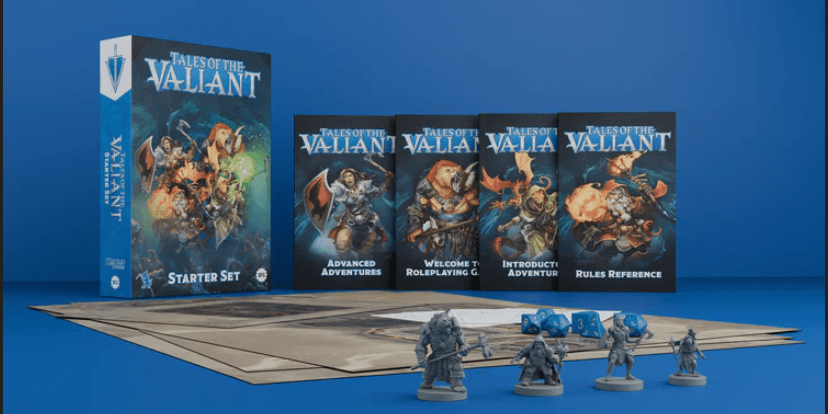
    Merchandising photo of Kobold Press Tales of the Valiant showing four minis, a set of dice, several maps, three adventures and a set of rules.

    I’d recommend Tales of the Valiant over 2014 D&D because of those changes, even if it doesn’t have the branding your friends expect. It also comes with minis! If Stormwreck Isle is 5.1 5e, ToV is probably 5.3.

    Stranger Things: Welcome to the Hellfire Club

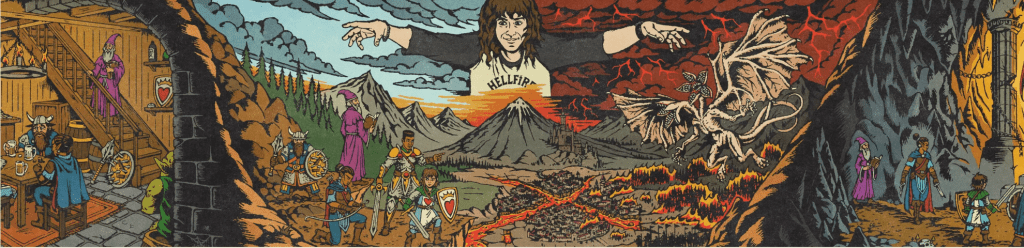
    A cartoon drawing from DnDBeyond that shows Eddie Munson looking over a medieval fantasy world of action and adventure, including a demagorgan.

    Maybe your friends didn’t get into D&D from Stranger Things season 1, or 2, or 3, or 4. Or maybe they did, but didn’t have the time, energy or mental space to play the game.

    Welcome to the Hellfire Club uses Wizards of the Coast’s modern take on starter sets — lots of tokens, handouts, cards and a written approach that blurs the line between board game and roleplaying game.

    modern take on starter sets — lots of tokens, handouts, cards

    The presentation includes a look that borrows from 80s nostalgia as expected. The four adventure books include trade dress that would make Gary Gygax and TSR proud.

    This is the second starter set built out of Stranger Things by Wizards of the Coast. Both lean heavily into using the voice of the character from the show that was the featured DM, lean into the mythology of the TV show with its ‘not quite D&D monsters, but monsters that middle/high schoolers would think are D&D monsters.’

    The first Stranger Things set was rather linear in nature, which fit the times and works fairly well for people newer to roleplaying. Welcome to the Hellfire Club uses 2024 5e D&D rules.

    D&D Starter Set: Heroes of the Borderlands

    Similar to Stranger Things pulling out 80s nostalgia to pull people into its world, Wizards of the Coast uses Dungeons & Dragons most popular adventure from the foundational period to inspire its new general purpose Starter Set.

    Keep on the Borderlands is now Heroes of the Borderlands, with three adventures. Using 2024 5e D&D’s rules, card-based character creation, tokens and maps, the intent of Heroes is to again bridge that gap between board game night and RPG night.

    Because it is 2024’s rules rather than 1974s, the set is massive. Those three little folios that could fit in a small lunchbox are gone. Instead Heroes has more than 400 cards and tokens, a quick start, a set of rules, and three adventures.

    The game of D&D is simultaneously more complex and more approachable than it was in the 70s and 80s. Being a more pervasive part of the culture is part of that. Also the decades of exposure to computer RPGs changes how one approaches teaching the game.

    Forgotten Realms expansions

    A massive two-book, three-digital book expansion coming with the brilliant marketing around “The Realms will know your name” these books aren’t necessarily great for first timers to tabletop roleplaying, unless…

    You know people who were heavy into the lore of Baldur’s Gate 3 and/or D&D: Honor Among Thieves and/or the once dominant fantasy novels set in the Realms. Those legends exist within the expansion, but the point of D&D and RPGs in general is to tell your story.

    Only dive into this if you are being joined by people who absolutely love those non-tabletop versions of the Forgotten Realms. These expansions include 50 micro-adventures that fit an on-the-fly DM rather well (similar to those in the 2024 DMG).

    Those playing with your classic group you need little guidance. If you are using the 2024 D&D rules, or at a table that permits a broad swath of 5e rules, the expansion is handy if you want to borrow factions, subclasses, new species and nuggets of lore to insert into your homebrew.

    In total the Realms expansions add about 30% more character creation options while dramatically expanding the story through the lore expansions.

    Eberron: Forge of the Artificer

    High fantasy doesn’t have to take place in a world that’s pseudo medieval/Renaissance and Euro coded.

    It can also include pervasive magic, spread widely among the populace in a world that echoes tropes related to early Industrialization with great Houses, lightning rails, elemental airships and a ‘war to end all wars.’

    That’s Eberron.

    Forge of the Artificer is a lightweight updated to the setting originally invented by Keith Baker.

    Due to a product failure on the physical book, it is being entirely reprinted with digital and print now out 9 December, 2025.

    Don’t get Forge of the Artificer unless you already have Rising from the Last War or you really want to have the magitech Artificers at your table or you are a completionist. I’ll be getting it for the first two reasons. I’m currently playing a goblin Artificer.

    The Artificer in Forge is updated for 2024 with a brand new subclass as well. From what was in the Unearthed Arcana developing this coming version of the Artificer it looks to have the quality of life improvements I would expect.

    Other RPGs

    LevelUp

    LevelUp is built on the 5.1 5e chassis, but advances it. This does make it a more complex version of high fantasy role playing. Some of the greatest improvements come from expanding the social and exploration pillars. This helps tell a wider variety of stories. Like every offshoot of D&D from the 5e era it separates nature and nurture.

    There’s now a Starter Set available. Yes, it has tokens and multiple adventure, because that’s what modern starter sets do. EN Publishing’s Starter Set is an excellent way to try on a different version of the game you already know.

    Cosmere RPG

    If you enjoy Brandon Sanderson’s writing you might enjoy the Cosmere RPG. It is not based on 5e. It is the highest earning RPG kickstarter of all time.

    Cosmere is beautiful, complex and the most extensive lore heavy game upon release likely ever.

    Draw Steel

    While not the level of Kickstarter success of Cosmere, Draw Steel was still a massive earner. The design team from MCDM is mostly people who produced wonderful 5e products, but are now releasing a system that emphasizes combat (tactical, heroic, cinematic) even more than D&D. The rules are crafted so that the feeling of conflicts is a reminder of watching a movie or TV show’s fight scenes.

    Daggerheart

    If Draw Steel is inspired by D&D, but wanting to be more combat, Daggerheart is inspired by D&D, but wanting to empower more story. Like Draw Steel and Cosmere, Daggerheart is a wholly new system. Most simply defined there is a Hope/Fear mechanic attached to the double-dice roll of players. Additionally it covers more ground about how to communally create the worlds and social interaction. Coming from Critical Role’s Darrington Press Daggerheart is designed to showcase the types of stories Critical Role excelled at.

    Similar to Cosmere and D&D there is a wealth of media associated with it already — with more coming from the media arm of what was once a D&D actual play, but is now a multimedia company.


    There are plenty of other games too — listing them all is foolhardy. Pathfinder and Starfinder, Legend of the Ring, Warhammer, Shadowdark and the list could go on.

    But the zeitgeist right now seems to be focused on 2024 D&D versus a few upstarts with million dollar or more crowdfunding campaigns all coming out in the second half of 2025.

    No matter what you choose — play more games.

    Fediverse Reactions
  • Making it easier to DM

    Making it easier to DM

    Being a Dungeon Master is intimidating. At it’s biggest level it can seem like you are supposed to run an entire world, know all the rules to the game, spotlight every player-character equally and help everyone have fun.

    There are many ways to make it simpler than that;

    • Focus only on the world with which the PCs interact
    • Skip rules that aren’t meaningful at the time
    • Rotate the spotlight as appropriate to the table
    • Get feedback from players in order to improve

    There are other ways too. I’m a big fan of the Lazy GM series.

    2024 Dungeons & Dragons helps make it easier in their Dungeon Masters Guide by incorporating some, but not all of SlyFlourish’s ideas. One notable thing is the tracking sheets — theirs and different from his, but that’s fine. Not everything needs to be the same.

    The Game Expectations tracking sheet features space for the DM's name, player names, theme, flavor, sensitive elements and more

    The layout of the new book is much better for new DMs. It also has excellent examples on how to spiral out from the characters while building a world, using Greyhawks as an example. There are micro adventures, which may not give enough information, but they do show that one doesn’t need a lot of notes to run a session. My sessions are usually a single notecard for example.

    Overall the ’24 DMG is a good to great book for Dungeon Masters early in their experience. It’s also handy that those tracking sheets are all available for free!

    But, (sorry WotC), there is a flaw in how easy it is to be a DM in this modern era.

    Those wonderful tracking sheets aren’t really part of DnDBeyond.com

    They exist, but without integration.

    What could make it easier to DM in the DnD Beyond era?

    When you Create a Campaign on Beyond it should start with that Game Expectations sheet. The notes should be replaced with the Campaign Journal.

    These are wonderful tools, and they are completely unsupported.

    Adding the sheets or similar fields to the campaign page would help a DM as they introduce the players to the game-to-be. They’d all be able to see what the story is about.

    Right now those pre-session one-sheets and the like need to be shared on the web, via email, Discord, at the table, or other tools rather than in the platform that Wizards of the Coast owns. It’s a silly gap in integration.

    Make it easier to share variant rules and setting information

    Currently, Beyond lets you share all of your books or none of your books. But that doesn’t help for a specific campaign.

    Currently, Beyond lets you share books in a deeper layer of content sharing, but doesn’t let you pick and choose rules (like attributes, extra feats, no feats, encumbrance)

    The above was updated at 8:57 pm on Nov 27, 2024

    My current Age of Myths campaign would make sense to permit Strixhaven, Theros and Dragonlance rules. It’s absurd for it to include the Illrigger, Ravenloft, or Lord of the Rings (TM).

    Imagine how much easier it would be for a DM and the table to say “these are the rules we are using for this campaign” and then toggle those rules and books either on our off.

    Currently that’s a player-by-player decision within the character creator.

    But what type of encumbrance a table is using isn’t a player-by-player decision. That’s a table decision. The appropriate setting and adventure rules aren’t most or none, but a delicate basis that sets the tone for the next several months or years of hanging out with your friends.

    Wizards of the Coast and the D&D team can make it even easier for DMs by changing some architecture of their semi-walled garden in such a way that they already believe works, because it’s in their brand new book.

    Fediverse Reactions
  • Reblogging: I’ll be adding NPC ritualists to my world

    In this post Jared talks about how rules support fiction with the examples being from Tales of the Valiant’s rituals system.

    The magic of this is you don’t even have to use Tales of the Valiant as your base system to add this to your 5e world. The ritual system is essentially 5e D&D neutral.

    Take Divine Ritualists as described. They look like, and are mechanically supported like, miracle workers at a temple. The Primordial Ritualists are like less powerful Tom Bombadils.

    Thank you Jared Rascher for the inspiration.

  • 2024 D&D Player’s Handbook Review

    2024 D&D Player’s Handbook Review

    The latest version of D&D is out in the wild. I’ve been perusing it via D&D Beyond, and I bought the local shop version of the hardbound book (which already lacks the near-immediate errata updates). That cover, with its slice-of-life capture rather appealed to me. A large part of what I love about the game is imagining these heroes in their between times.

    This review isn’t going to dive deep into rules, nor the debate about this being a new edition. Instead it’s going to be why I enjoy the book. Eventually I’ll use the 2024 version of 5e as my baseline, but leaning into SlyFlourish’s ideals I’ll augment it with other 5e materials I enjoy — Tales of the Valiant/Black Flag, Advanced 5e/Level Up, 2014 Wizards of the Coast, and more. Whatever tells the story at the table best will be what’s welcome at my table, when I DM.

    I’ve played D&D in some variant for nearly as long as I can remember. My first games involved a few d6 and were kind of ad hoc, played with a red box and a DM who had to explain everything to my much too young mind. I stuck through it and grew into it, and played for more than ten years during my first run in the 80s and 90s. Then I came back to the game with 5th edition, almost twenty years after leaving the game. I bring this up, because in many ways the 2024 rule set isn’t made for me — it’s made for people who are still new to Dungeons & Dragons.

    More welcoming

    Photo of Chapter 1 of the 2024 Player's Handbook "Playing the Game"

    There are a lot of new rules, both revisions and outright new items.

    But the best, absolute best, thing about this new PHB is that it seems crafted to help someone who has never played D&D before. It leads with how to play the game rather than how to create a character.

    The examples given cover all pillars of the game, which is vital as more and more actual plays emphasize social and exploration pillars over the pure combat that birthed Dungeons & Dragons.

    Photo of the social interaction example from the opening chapter. There's also a LEGO eleven bard.

    With a layout and organization that welcomes the eye the craft of the book is immediately obvious. The larger font is welcome to my old eyes, while also helping youngsters not feel like the wall of text is an obstruction to learning.

    Massive amounts of art help too. That art sets tone, all the tones. Art throughout the book gives examples of sword & sorcery, high fantasy, magi-punk. In fact every active setting from 5e is given art at some point. There’s art that shows dirt and grit. There’s art from high fantasy superheroes. There’s art of a calm brook and a dragon and so much more.

    Art is language. It shows us what the game can do, and for people with less D&D firmware updates in their brain they can see the game as it can be.

    Having helped more than a dozen friends try to learn the game from the 2014 PHB I cannot wait for the first person to ask to learn now that 2024 is in our hands. It won’t feel like studying for a test.

    Origins

    Photo of the halfling section of the 2024 PHB. The art shows Halflings at a dinner party enjoying life.

    There are some misses in the rules of the Origins section. Backgrounds remove some of the distinct flavor elements that were great (this is fixable via expanded feat opportunities and short-form personality). Also, my halflings were simplified, which makes me sad.

    There are also wonderful new things that, once again, help new players more than old.

    Background and species art is a slice of life for both.

    With the species are every species listed but one shows at least one character with corrective lenses. Yes, this is something I harp on a lot, but it is a rather easy way to show the level of technology and acceptance within a society (even if it wasn’t historically accurate, which it is, your D&D campaign should include glasses). Species art shows the typical cultures for a species. The language also makes it clear, that you don’t have to make a character that is typical.

    This is further reinforced because the background art shows other cultures. These vignettes of life are demonstrations of what the future heroes did before. It’s a wonderful and subtle to show more variety in the worlds of D&D. There are rice patties and sailing-canal towns and magi-scribes and so much possibility. That’s really what D&D is about at the core, possibility.

    Equipment improvements

    Photo of the LEGO version of Tasha next to the gear entry on Book within the 2024 PHB

    Of all the rule tweaks and expansions, my attention keeps coming back to what the design team did with gear. In old school D&D your equipment build out helped define how you could innovate to solve exploration and social problems.

    2024 doesn’t go that same direction. Instead of innovation it goes for explanation. Every non-container (probably, I haven’t counted) has a description about what types of mechanical things it helps the owner of such gear do. A book helps with history checks. Perfume helps charisma checks. The list continues.

    This is a massive improvement for the social and exploration pillars’ mechanical support. Equipment availability also helps describe the types of worlds within D&D. With muskets and pistols and ball bearings and magnifying glasses and spyglasses this is a world similar to the Renaissance.

    A setting book can also remove or add to those elements. Eberron and Dark Sun need this the most.

    As someone who used to peruse the polearm section of the original Unearthed Arcana for hours upon hours the massive amount of drawings for mundane gear is a pleasure.

    Rules Glossary!

    D&D is a complicated game. There are quite a few rules. Within the tabletop RPG space it is somewhere between medium and high complexity, even with 5th edition’s much more welcoming ruleset.

    Photo of the Tasha figure again, holding her open spell book while atop the Rules Glossary.

    Another wise layout choice was to not waste space on an index, but instead give us a glossary of rules. A 384-page book, even one with a larger font and loads of art, can be intimidating.

    For 2024 Wizards of the Coast decided to cut back on that potential complexity via the Rules Glossary (yes, it probably should have been an index also, but the glossary aspect is most important).

    When people first start playing they consult rules frequently. During character creation they do this to understand what their PC is capable of. During play flipping pages to understand is quite common.

    A glossary speeds things up at the table. So does writing the page number of your abilities on your character sheet (another SlyFlourish tip).

    Who should get the 2024 PHB?

    • People new to D&D who will be joining a table where it is the baseline rule set.
    • Completionists.
    • DMs who want to understand the tweaks that will speed up play (like beasts no longer having rules riders with saving throws).
    • Players who want a much better monk.
    • Tables that want better representation.
    • Art lovers.
    • Me
    Fediverse Reactions
  • Enable your table to embrace wider stories using 2024 D&D Backgrounds

    Enable your table to embrace wider stories using 2024 D&D Backgrounds

    There are significant changes between the 2014 5th edition Dungeons & Dragons Backgrounds and the way 2024 5e D&D manages the same design space. 5e14 used backgrounds to expand on the social and exploration pillars of the game while encouraging roleplay via traits, ideals, bonds and flaws.

    5e24 abandons that, turning backgrounds into a space with more mechanical heft than ever before — adding Ability Score Increases and Origin Feats. This also differs from alt-5e systems like Black Flag (no ASIs, talents are Feats) and Advanced 5e (no ASI, no Feat, single ASI adding connections, momentos and advancement).

    By nature 5e24 reduces the story available via Backgrounds. Every Soldier is a Savage Attacker and never Tough. There’s no personality assigned everywhere, not even a highly detailed matrix of choices that results in 100s of combinations. There are also assigned ability scores, which means that Soldiers aren’t wise, for example.

    So how do you inject story back into your table as you transition to 2024 5e?

    Remove ASIs from Background

    They can go back to floating like they were with Tasha’s or just included in the standard array/point buy like Black Flag.

    This has absolutely zero impact on the power balance of the game.

    Associate multiple Feats/Talents with a Background

    Tough Soldiers exist! So could a soldier trained in magic in a high fantasy world (see the Second Army in the Grishaverse). A solider could be trained in Healing or Linguistics. Make the assigned Feat the one that most members of the Background have, but do not confine your story to that.

    Pick a Feat and then justify it with a single clause in your backstory (backstories for Tier 1 play should fit in a text-based social post).

    For myself, I’ll be using a chart that puts the most common Feat in the middle with the next most common next to them and rares on the outside. This small curve helps define the world in which you play.

    Here’s an example for the Tinker

    2. Magic Initiate
    3. Tough
    4. Linguist
    5. Actor
    6. Skilled
    7. Ritual Caster
    8. Artificer Initiate

    This doesn’t impact the power level at the table at all.

    Use custom Backgrounds to expand your world’s lore

    Add more Backgrounds to enrich your world. Similar to how official Wizards of the Coast settings books have added a couple Backgrounds to help define those stories. Dragonlance added Wizards of High Sorcery and the Knights.

    Take this lesson and use it at your table.

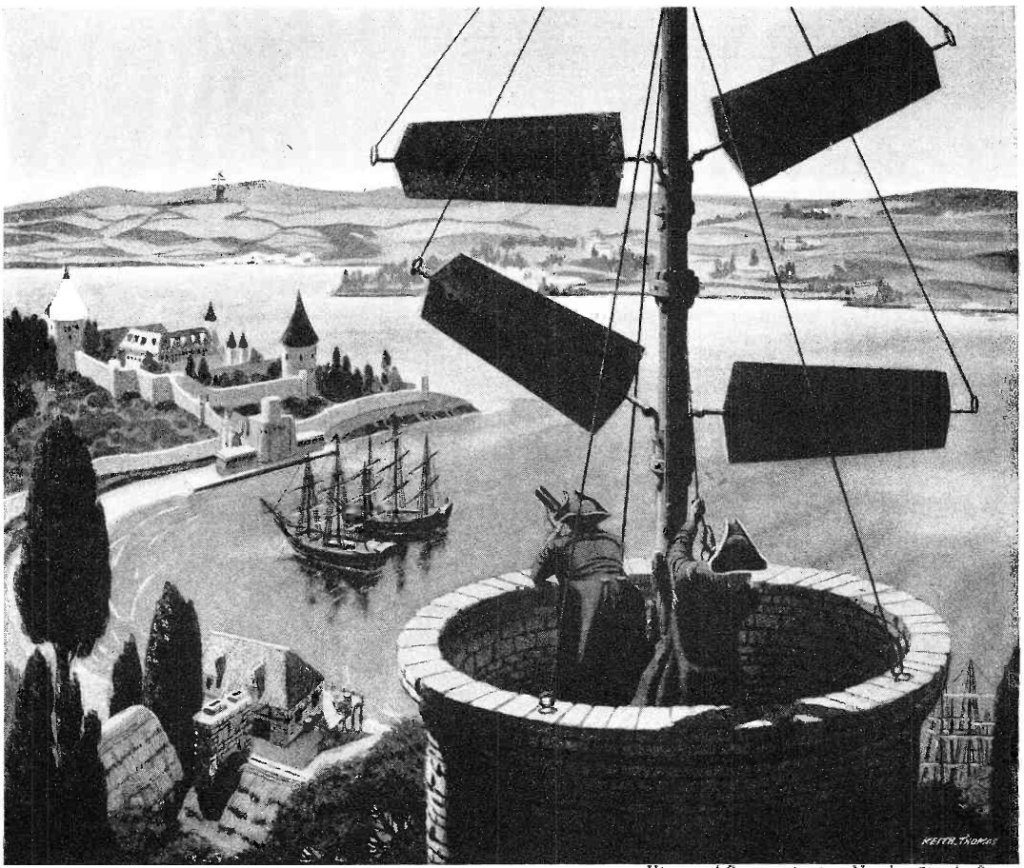
    Do your stories consist of a world on the edge of Renaissance technology? Add in Optical Telegraph Far Talkers. Is there something inspired by the Silk Road? Add the Caravanserai. Are airships common? Those shouldn’t have sailors, but flyers. It’s a different skill set and a different story.

    Again, there’s no power imbalance.

    Add personality back to the game

    Even though WotC, and the alt-5es too, got rid of personality you don’t need to. The 5e14 system is long and clunky. Alignment is tired and dated.

    Instead, use short-form personality. Having 3-5 words or phrases isn’t a bulky system. Still grant Inspiration off of this — your players should be rewarded in game for playing their role. If you’re shifting to Black Flag or borrowing their Luck system do that instead.

    This has a minimal amount of power disruption while encouraging more story through play.

    These four simple steps don’t disrupt the power balance of 5e (and variants). They add lore to your world and story to your characters.

    Best of all is that they can all be done while playing using DnD Beyond or any other virtual character sheet.

    Fediverse Reactions