Category: Piracy in DnD

  • Naval Skirmishes and Battles for 5e D&D

    Naval Skirmishes and Battles for 5e D&D

    This set of rules was shared with me by one of my fellow players in Arise & Descend. When they aren’t playing in our near-weekly game they also DM. Recently they noticed a gap in rules for naval warfare. Unlike Ghosts of Saltmarsh, this rule set is for when the party are on other vessels in a fleet or when the story may demand that the group zoom out from the single ship to a small conflict between two fleets.

    Dave, not me, my friend, asked if I would share these for feedback. I have edited for copy, but have not playtested these rules.


    On Ships and Naval Battles

    A Naval System for 5th edition Dungeons & Dragons

    By Dave

    Tall ships on the sea are a great setting for a D&D campaign. The romance of the high seas has driven stories for centuries, and finding adventure there can spice up any campaign.

    I have a homebrew campaign running, and in it my players have gotten themselves involved in a civil war on an island nation. Of course, any war like this is going to involve some pretty intense naval battles that I wanted my players to take part in.

    However, when I looked into rules and systems for running naval battles, there wasn’t anything that really worked for what I wanted. There is some really fun stuff in the Unearthed Arcana “Of Ships and Sea,” which was refined for the Ghosts of Saltmarsh adventure. Those are great if you’re running a full on naval campaign, with all sorts of rules for maintaining a crew and a ship over long periods of time. 

    What I couldn’t find, though, is something for a major set piece battle to conclude my players current story arc. So I’ve come up with some rules and a system for running a naval battle that I think could be useful to other DMs looking to change up their player’s experience.

    One quick note at the top: This system assumes your PCs will be on the ships, and that the players themselves will make decisions for those ships. Story-wise, this creates a bit of a problem. Either your players are in command of the ships they’re on or your players are controlling an NPC instead of their own character. If you’re like me, and you’ve always wondered why Han Solo was given the rank of General when he’s done nothing to qualify for that rank, the former is a bit hard to swallow. But some players won’t like the way the immersion is broken for the latter. It’s a small wrinkle, but it’s still there, and you might want to address it with your players.

    Preparation and Ship Stat Blocks

    Rather than playing as a character, each player will take over a ship. Each ship will have a stat block which will include Strength, Dexterity, and Constitution scores. Wisdom, Intelligence, and Charisma scores will all be zero. Ships are also immune to most effects, because they’re… ya know… ships. They are vulnerable to fire attacks. 

    Strength will relate to the amount of damage each attack can cause. The modifiers for various attacks will be based on this score. You add some flavor to this by giving a bonus to a STR score to a ship with a veteren crew, or a penalty to a ship with lots of novice or pressed sailors who aren’t as motivated.

    Dexterity will relate to ship movement and speed. A ship’s base speed is 300 feet, adjusted for 50 feet per Dex modifier. For example: A ship with a 14 Dexterity (+2) should have 400 feet of movement. Ships get -3 to their Dexterity score for each size above large.

    Constitution works similarly, but will relate to ship AC and hull HP. The base hull HP is 100, adjusted by 10 HP per Con modifier. For example: A ship with a 16 Constitution should have 130 HP. Ships should get +3 to their Constitution for each size above large.

    On top of hull HP, each ship will have a number of crew members. Max crew number should be equal to the length of the ship. A large ship (100 feet long) will have a max crew of 100, whereas a gargantuan ship (200 feet long) will have a max crew of 200.

    Max crew is in relation to the number of actions a ship can take.  A ship can carry more than its max crew, but cannot take anymore actions because of it.  For example, if a ship with a max crew of 100 gains 30 more crew after sinking another ship, putting it’s total at 130, it still can only take four actions.   

    Ships get one action per 25 crew members per turn, rounded down. For example, a ship with 100 crew members gets four actions per turn. But as they lose crew members, they lose the manpower to do as much. So once they go below 100 crew members, they only get 3 actions. A ship with 25 or fewer crew members cannot attack. They can only change course, make repairs, or tend the wounded.  

    • Note: When building your stat blocks, make sure to pay attention to how each ship is balanced. Perhaps a flagship of the fleet has 200 crew members, meaning it gets eight actions. But such a large ship is ungainly and probably has half the movement of a smaller ship. You might even consider saying changing course on a ship that size takes two actions.

    The ship’s actions are as follows

    • Change Course, Drop, or Raise Anchor:  Ship changes to a different heading, drops anchor to stop, or raises anchor to get under way. 
    • Arrow volley – Ranged Weapon Attack: + STR to hit. reach 150/400 ft., one target. Hit 2d10 + STR crew. 
    • Ballistae – Ranged Weapon Attack: + STR to hit. reach 200/500 ft., one target. Hit 2d12 + STR piercing damage to hull HP.
    • Take Cover – Crew members are ordered to take cover. Arrow volley damage (crew casualties) is halved.
    • Repair damage – Crew members repair their damaged hull. Heal 1d10 + CON hull HP.
    • Tend the wounded – Crew members give medical treatment to their fallen crew members, allowing them to return to the fight. Replace 1d8 + CON crew.
    • Grapple and board – When a ship moves within 50 feet of another, they can attempt to grapple and board. The attacking ship will roll a Strength check +1 for every 10 crew members rounding down contested by a Constitution save +1 for every 10 crew members rounding down. The boarded ship can choose to fail this save. Once the two ships are grappled together, they are both restrained.

    After including all the actions, a ship’s stat block should look like this
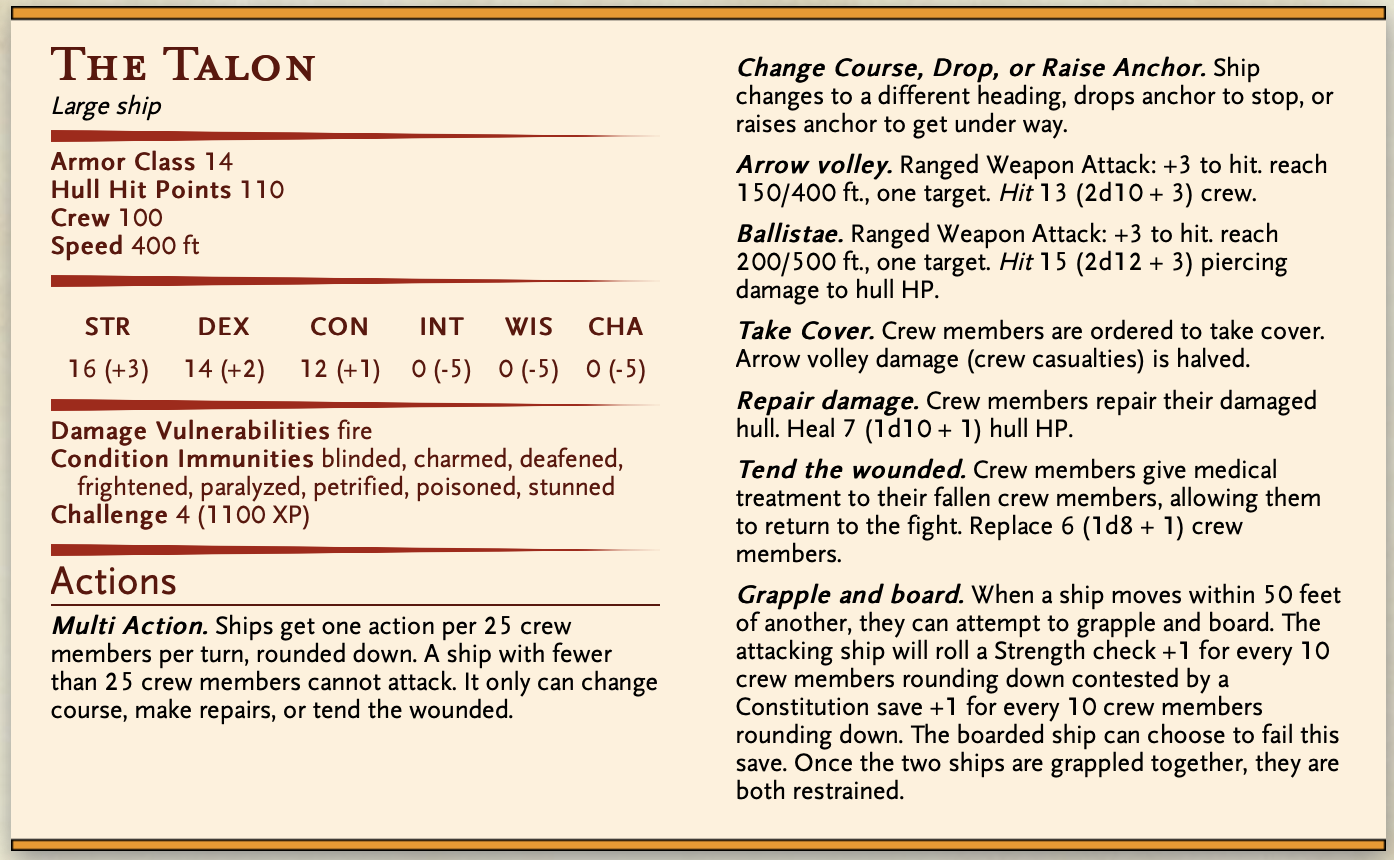
    When a ship’s hull HP drops to zero, the ship sinks. Any ship that enters the space in which a ship sank may pick up the remaining crew members. All crew members will be rescued. If an ally of the sunk ship moves into the space they add all the crew members to their current crew. If an enemy ship moves into that space they add half the crew members to their crew. 

    This is because sailors don’t want to drown and know that if they try to fight the ship rescuing them, they will be left behind. Half the surviving crew members will join the fight in the new ship because they’re either pressed or sailors for hire therefore sailing for one ship or another is all the same to them. The other half will willingly go below decks as prisoners as that’s preferable to drowning.


    Setting up Battle

    The battlemap for these engagements should be a grid on primarily open sea, though some islands or a coastline can certainly add some tactical flavor. One square on the grid should equal 50 feet. Since ships are large and slow-moving objects in a large area, each round is equivalent to about 6 minutes. Ships will be sized to 50 foot squares.

    • Medium = 50 feet long (a large yacht)
    • Large = 100 feet long (a sloop or a brig)
    • Huge = 150 feet long (galleon or a schooner)
    • Gargantuan = 200+ feet long (frigate or Ship of the Line)

    Movement

    When it comes to sailing ships, the wind is an important factor. A token should be placed on the map to indicate the direction of the wind. A ship may not sail directly into the wind, but can sail at a 45 degree angle towards the wind. Ships sail fastest going perpendicular to the wind, so when they head 90 degrees from the wind, they have full movement. Sailing away from the wind is the slowest, so ships headed the same direction as the wind have one-third speed, rounded to the nearest 50 feet. Quartering the wind (45 degree angle in any direction towards or away from the wind) will give ships two-thirds speed rounded to the nearest 50 feet.

    In practice, it should look as follows. The diagram below is for a ship with 300 ft of movement:
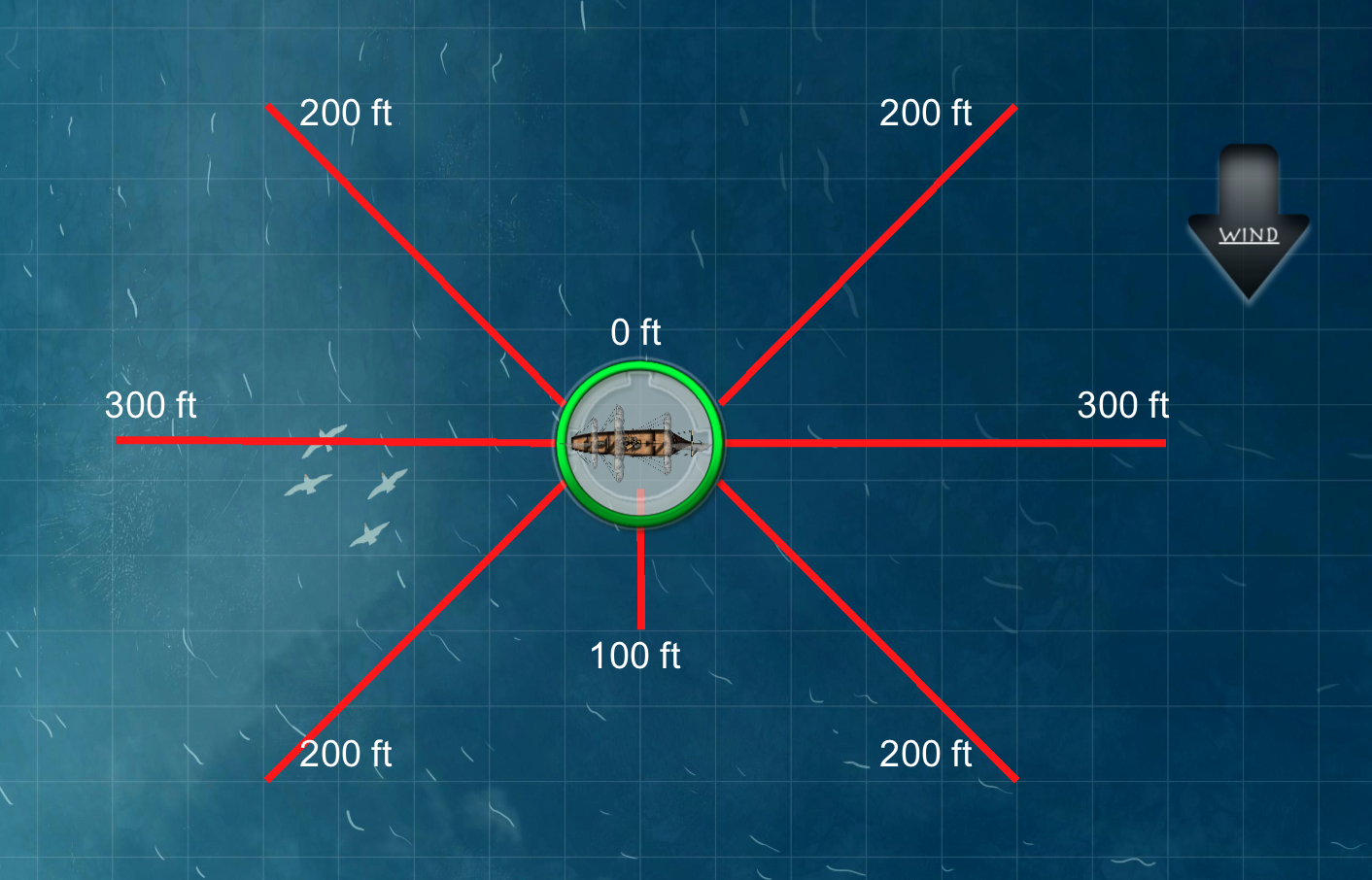
    It takes one action to change course or drop anchor to stop, but if no action is taken to correct course, the ship will spend it’s full available movement each turn continuing in the same direction.

    If a ship’s movement will lead it to hit another ship or some other obstacle, it must use one of its actions to change course or stop.

    A ship cannot attack through an allied ship’s space, but must move to a space with a clear shot at its target if it wants to take an attack action.

    Boarding Rules

    Of course, no high seas adventure would be complete without the chance to board another ship. As an action, a ship within 50 feet of another can take the Grapple and Board actions. If that action is successful, the two ships are tied together and restrained. While two ships are grappled and restrained, they attack each other. Each ship gets one action for each 25 crew members rounding down per round.  They can attack or retreat and break free. 

    • Attack: +1 for each 10 crew members rounding down. Damage 1d10+1 for each 10 crew members rounding down.
    • Retreat: Strength check +1 for every 10 crew members rounding down contested by a Constitution save +1 for every 10 crew members rounding down. The enemy ship can choose to fail this save.

    Once one ship has less than half crew, the rest of the crew will surrender. If a ship already is down to half a crew, it will surrender as soon as it is grappled. The winning ship has two options:

    • Bring captured crew aboard their own ship, adding half of the surviving crew of the captured ship to their crew member total (and taking the other half prisoner), and scuttling the captured ship.
    • Add half the surviving crew of the captured ship to the crew member total (taking the other half prisoner) then split the new crew total evenly to take command of both ships.

    If your entire party is on a single ship, or if more than one of your player’s ships grapple on to a single enemy, you might want to replace this grapple roll with a full encounter and ship-based battlemap.

    Adding Your Player’s Traits

    Most of these ships will be pretty similar in capabilities. But you can add some variation to these fights by giving bonuses based on your players’ character classes and traits. Story-wise, your player’s heroes will have spent some time with the crew members of their ship teaching them some new skills and talents, which gives those crews certain advantages in battle.

    For example, in my campaign, I have four PCs, a Barbarian, a Paladin, a Ranger, and a Wizard. For my final battle, I will have them all on separate ships (which each player will control), and give the following bonuses:

    • Barbarian: He’s great at close quarters combat so his ship will have advantage on his Grapple and Board Strength check and +5 to his boarding attack.
    • Paladin: She’s a healer and a tank so her ship will be resistant to Arrow Volley (she loses half the crew members per volley, down to a quarter with the Take Cover action), and she has a +5 to her Tend Wounded action.
    • Ranger: She’s a classic ranged fighter so her ship will have no range disadvantage for her Arrow Volley or Ballistae actions, and get a +5 to her Arrow Volley damage.
    • Wizard: He loves to cast Expeditious Retreat on himself and keep moving in battle so his ship will have an extra 150 feet of movement, and he can add fire damage to his Ballistae action.

    You should add your own bonuses based on the personality and favorite tactics of your characters. 

    Final Notes

    Another big change you could add to this is adding cannons, assuming you’re playing with the Firearms rules. Since I don’t use them in my campaign, I didn’t think too hard on how they would work. But that doesn’t mean you couldn’t adapt this for Firearms rules.

    An optional rule you might use is to add changes to the wind direction.  If you want to use this, choose a random interval (or roll for one) such as 3 rounds or 15 minutes (real time), and roll either a d4 or d8 to choose a random change in wind direction.

    And finally, this is all pretty complicated, and might be a bit much to throw at a party in one session. I would advise bringing these concepts slowly. For example, put your players on a single ship that you control, and give them each one of the ship’s actions to use as they see fit. Then you can slowly bring in concepts like wind direction, movement, or boarding one at a time, so that by the time your players reach their climactic battle, they are comfortable with all these rules and the tools at their disposal.

    Hopefully this can give you a framework to build an epic and memorable naval battle to your campaign. If you have any thoughts or suggestions for improvements to this, I’d love to hear them.
  • So, you got into ShantyTok, now what

    So, you got into ShantyTok, now what

    Nearly everyone on the internet has heard The Wellerman a dozen times, with different variations popping up every day. Maybe you’ve even experimented with other sea shanties, because frankly when you are stuck at home the unity of the working-class’s songs helps you feel like you are part of something greater than yourself.

    That’s a large part of the reason that ShantyTok exploded off of Tik Tok to take over all social media. Now, it’s even inspired people to start talking about the best film about the Age of Sail — Master & Commander.

    Frankly, you need to add shanties to your D&D game too. There lots of ways to do this, from just a single character to an entire campaign. Do it. Have fun. Embrace the zeitgeist, and make your gaming community a group of unified purpose — surviving a sea and sometimes even a captain that hates you.

    Every Class Can Be A Pirate/Privateer/Sailor

    First and foremost, realize that any and every class can be a sailor of sorts. The obvious way is through the use of the Sailor/Pirate/Privateer Background. You already know this. You also know about the Swashbuckler, because you are a wise soul.

    But there is more than that. Every single Bard in the core D&D game can fill a role on a pirate ship, so can every Rogue. Most Clerics make sense, etcetera, etc. Be creative in the roles and purpose on a ship. Your concept belongs there, even a fully armored Paladin, with those drawbacks, belongs aboard a galleon in the Age of Sail.

    Just a quick glance at Tasha’s Cauldron of Everything shows some great concepts for your shanty-singing adventurer;

    • Artificer: Artillerist – Who needs gunpowder when you have magic cannons?
    • Cleric: Order Domain – Someone has to keep the law of the ship and boost the crew.
    • Druid: Circle of Stars – The blessings of the sky are vital during a trip across thousands of miles of ocean.
    • Rogue: Phantom – The latter Pirates of the Caribbean movies lean into tales where dead men talk.
    • Warlock: The Fathomless – duh

    Making the sea even a small element of a campaign gives space for your shanty-singing glory.

    Seas of Voldari

    What if every character was part of the story of the sea? That’s what Tribality’s Seas of Voldari explores. Their words describe the setting and ruleset well.

    The Seas of Vodari campaign setting was created to support seafaring adventures that focus on the crew of a ship hunting sea monsters, exploring mysterious uncharted islands, visiting bustling port cities, following maps to find buried treasure, and battling cutthroat pirates. The setting is also well suited to running campaigns in its large port cities, with swashbuckling heroes getting mixed up with fierce rivals, notorious crime syndicates, feuding nobles, and scheming politicians.

    From the sales page for Seas of Voldari

    The added classes, races, and backgrounds make life at sea the key element of most adventures. Add them to your existing campaign and your players have more options to enjoy their sugar & rum & tea.

    Be Creative: Add Shanties As A Landlubber

    While The Wellerman is all about the Age of Sail, shanties were not confined to life at sea. There are shanties about building railroads, working mines, and every other activity that requires a group to work in unison in miserable conditions — the marching and running songs of soldiers are related to shanties.

    Hi ho, hi ho
    It’s off to work we go

    Yes, your dwarves should sing shanties. Your drudge cutting down trees for the lumberyard should sing shanties. Your Bard at the bar should sing shanties, and so should your Battle Master.

    All times of needed unity are appropriate for the musical style.

    Other Inspirations

    Step away from The Wellerman. Listen to The Longest Johns or one of the many playlists built to feature shanties.

    This can add more ideas during campaign prep or character building.

    Watch Black Sails. It’s Hulu, Starz, and Prime (season 1) for no additional charge. The season one trailer opens you to the TV prequel for Treasure Island, but it’s season 4 that gets my blood pumping.

    There’s also the now-classic cartoon Pirates of Dark Water, which is especially handy if you want a Seas of Voldari campaign. It’s hard to track it down, but if you can find it the mix of piracy and fantasy is perfect for a Dungeons & Dragons.

    The films, books, comics, and such inspired by life at sea is numerous. Your approaches to integrating that into your campaign should be as big as the ocean.

    For forty days or even more,
    the line went slack then tight once more,
    All boats were lost, there were only four
    and still that whale did go.

    The quest of the Wellerman is the quest of Ahab, and a familiar quest for any adventurer, because it’s never done, merely paused for a bit of song and rum.

  • Society of Veil and Shadows

    Society of Veil and Shadows

    The Society of Veil and Shadows are a group of rogues dedicated to obscuring and protecting their guild from spies — both arcane and mundane. While able to contribute to the uprising’s success via sneak attacks and other clandestine abilities their true power is their ability to cast a few spells, most of which help keep the rebellion secret.

    This is a work in progress for a subclass of Rogue. Language still needs adjustments to meet 5e. My purpose in sharing is to garner feedback about the concept as it fits the description and entertainment within most 5e paradigms.

    Spellcasting (3rd Level)

    Similar to what is described for the Arcane Trickster, but the two schools allowed are Abjuration and Conjuration. Every member of the Society learns the spell “Block.” This spell is one of the cantrips learned at third level.

    Block (3rd Level)

    cantrip abjuration

    • Casting Time: 1 reaction
    • Range: touch
    • Components: V S M (steel ring)
    • Duration: until next turn
    • Classes: Wizard, Cleric
    • When an Enchantment, Divination, Illusion, Transmutation spell is cast targeting yourself or an ally you can touch, you grant the target advantage on saving throws versus that spell and on any saves versus spells until your next turn.

    Safehouse (9th Level)

    You have learned certain rites and patterns in order to cast any ritual from the following schools of magic – Abjuration, Conjuration, Divination, Illusion. The spells must be on the Wizard spell list. To cast such a ritual you must have a spellbook, or similar, in your possession. These rituals may only be cast once per long rest, each.

    Cloud of Doubt (13th Level)

    You may create a 30′ by 30′ cloud of patchy fog. Any target within the Cloud of Doubt is partially obscured. In addition, any creature entering the the cloud must make a Charisma saving throw or shift its demeanor towards the positive (hostile become indifferent, indifferent become friendly). The cloud is centered on a space up to 60′ from yourself. You must maintain concentration on the Cloud of Doubt, or it dissipates in 8 hours.

    You may create a Cloud of Doubt a number of times equal to your Intelligence bonus (minimum 1) per Long Rest.

    Unchained (17th Level)

    When in shackles, handcuffs, jail, and the like, while conscious and able to speak, you are able to cast Misty Step without using a spell slot. If you cast using a spell slot you may take a number of allies with you equal to the level of spell slot used.

    Misty Step no longer counts as a known spell for you.

  • Adventuring as Pirates: Bards

    Adventuring as Pirates: Bards

    “Ho there! Sit, sit.”
    [She flings a cup of something at you. You look at the dark liquid with little flecks in it, raise an eyebrow.]
    “Yes, drink, drink! It’s rum… rum with something, don’t worry. It’s our old drink on the Charlatan. I hear you are interested in our societies. I’m out now, retired here, so maybe I tell you a bit. Nothing that will let those Royals know about them, but sure, I understand the appeal. We don’t have colleges, so how do bards study?”

    Pirate Ship by Carlo Mirante
    Pirate Ship by Carlo Mirante from https://flic.kr/p/oYzCQc

    The tale-tellers, minstrels and jack-of-all trades at sea ignore land-lubber colleges. There is little structure in an island port. These women and men do maintain connections with each other, sometimes even when their ships are at war. They will talk to Bards in Colleges, because maybe they’ll learn something useful. Those that sail under the black will never talk to those that sail under the crown.

    Under a crown a sea-going Bard is a member of a Royal Society, often Valor as one of the officers. These societies adventure to learn, to discover and to stop the plunder.

    Under the black the bards also have a society. They meet in pubs and brothels, dark corners where they swap tales and songs, wary of those with writs and honest eyes.

    This is the second of my “pirate all classes” project. The first was Rogues and explains the concept and rules of the exercise.

    Society of Lore

    Silver always knew the next step. Whether it was a tale he picked up at a brothel, on another ship, or a story from his pre-piracy days, his knowledge helped us. No one really liked Silver, but we listened. Maybe a dozen of us are alive because of him. He’d never win a vote for captaincy, but no one wants him off the ship either.

    You are the teller of tales, the knower of legends. No matter what officer or crew asks a question you know the answer. Sometimes your answer is true. Often it isn’t, but they believe you, this crew. You keep their spirits high during the storm, banging that drum, blasting the horn, or whistling the recorder. Your voice is a rallying cry. As a mere swabbie you rarely get the awful details, because others will serve for you. They’ve seen you bandage a wound, or fling a dagger. No matter what is needed, you are there. Maybe someday you’ll be an officer, but that would make port a lot less fun.

    Take six skills, it doesn’t matter. Expertise should be in history or performance for the telling of tall tales. Athletics or Vehicles (Water) should be your other Expertise. You are a sailor.

    Charisma is your key stat with Intelligence and either Dexterity or Strength in that order.

    Society of Valor

    There are better fighters than Flint. Not many, have you, but a few. He swings sword or first with the best of them. Plus, when Flint asks for help, you do it. His words, or sometimes even his look, is inspiring. He has no time for instruments, but his voice, those times he uses it, it gets you right in the heart.

    The Royals (pure blooded fools) expose themselves through valor. You’re more about winning, always. Because you can fight you’ve earned your way from mere swabbie to a lower officer – boatswain or first mate. Without a doubt you will be a captain someday. You lead the boarding party at sea and defend the ship in port. You aren’t in charge, formally. Things just go better when you are around the crew. The last fight you lost was because you felt bad for the captain. He’s a good guy and you don’t want to run the ship.

    Athletics is important as you leap from ship to ship. Acrobatics can be useful as well. Take the Soldier or City Watch backgrounds. You were once honest, but life at sea changes a man or woman.

    Strength is vital. You are a warrior with extra talents as well. Charisma is a good second stat. If you expect to swim long distances boost your Constitution.

    Society of Swords

    [This is from Unearthed Arcana:Kits of Old]

    Flynn is interesting soul. He’ll never do anything simply. When he spins his blades it isn’t just defeat the enemy, or to inspire us, it is for art. One time he did this thing where he did this thing where he spun his dagger on top of his rapier and then with just a flick of his wrist it went flying off pinning the enemy captain to his cabin door.

    You do not need an instrument. Your daggers and blades sing tunes. They can inspire fear, warm the heart or heal the soul. With a good blade in your hand, and your other hand, and on your belt, and on your boot, and in that hidden scabbard at the small of your back you can win any fight – mostly. When it is time to board another vessel you are one of the first. The regular crew follows you easily. They know that the opposing guards will head to you first. In port you work a stage or street corner juggling some blades or scarves.

    Acrobatics is a must have skill. Prior to life at sea you were likely a Noble or Courtier or Inheritor. You enjoy the thrill of discovery, and showing off your blades.

    Dexterity and Charisma are the most important attributes. You use finesse weapons, so Strength isn’t important.

    Society of Satire

    [This is from Unearthed Arcana:Kits of Old]

    I knew Sparrow before he had his own ship. I don’t think he was ever drunk, it was more an act to fool the rest of us. Fool, ha! That’s what he was and is. All jokes and cutting words, that Sparrow. Somehow he found a ship willing to put up with his constant humor.

    When you work the rigging you make monkey noises. When you swap the deck you make certain it’s wet enough to trip that crew member you do not like. If you are on lookout you might tell the ship you see something that doesn’t exist. You aren’t the best crew member, but when a sail rips, or someone is trapped in the rigging you can fix that faster than anyone else. Your “drunkeness” gets you into and out of trouble in a dash. Some crews love you, others hate you. That often times has no relation to the ship you are currently working.

    Performance, Intimidation and Insight are highly useful for the Satirist. Any background can inspire the woman or man that finds that the only way to deal with life is through jokes.

    Charisma, and then some more Charisma. You likely have a high Wisdom, as you understand what makes people tick.

  • Adventuring as Pirates: Rogues

    Adventuring as Pirates: Rogues

    Character creation is one of my favorite things, which might be why I prefer to DM. By managing the game I get to create hundreds of characters – some fully fleshed out re-occurring NPCs and others are simple one shot monsters. For a friend’s campaign I needed to create a PC, something which I haven’t done often in the past two years (this is my second playable PC). While I do make a lot of NPCs with the rules for standard players, as it helps me think about how the more complex enemies and allies behave.

    For my character I wanted to do a few things a bit different. As most of the players are new to 5th edition and some to D&D at all I wanted to be a support caster. I decided on a Cleric. I always like Krynn’s Minotaurs so went with that. Wanting to justify my greater player knowledge I thought about going with the Knowledge Domain. But where does a ocean going minotaur fit into the Forgotten Realms as a Cleric of Knowledge. My answer was as a pirate ship’s quartermaster. As a follower of Deneir Golrian Hershmakil the Quartermaster of Estadia keeps precise records, logs and maps of the Estadia’s forays at sea and land.

    Pirate Ship by Carlo Mirante
    Pirate Ship by Carlo Mirante from https://flic.kr/p/oYzCQc

    And then I thought, “what role would every archetype have on a pirate vessel?” This launched a ton of thoughts about a piracy campaign, which I have no time to run, but it lets me use creative processes that the current Everflow campaign does not.

    Rules of the ‘Pirate All Classes’ game

    • Use third level
    • At least 50% of the concepts must have Vehicles (Water), Athletics (for swimming, climbing jumping) or Acrobatics (for working in the rigging)
    • Some may be Privateers rather than pirates, but the goal is to mostly represent those that were unsanctioned
    • Assume no gunpowder
    • Recognize that no ship will have every concept created so more than 1 can be a captain
    • Recognize that pirate life is as much about life in port as at sea
    • Don’t use stat groups, instead show the interaction between class, background and ship role.

    Starting with Rogues as they are the most pirate-like by nature. The Player’s Handbook and Sword Coast Adventurers’ Guide includes the following archetypes – Thief, Assassin, Arcane Trickster, Mastermind and Swashbuckler.

    Thief of the High Seas

    On the ship you are a mild rigger working the sails, scrambling up and down the ropes faster than anyone else. Sure, when your boat needs to board another you are ready, swinging across either sneaking into quarters or taking out lookouts, but it’s in port where you make the real difference. Stealthily listening in on merchant captains, stealing keys or maps, or breaking into that jail to let your people free, you are the eyes, ears and rogue of the crew.

    Take expertise in two of Stealth, Thieves Tools and Acrobatics. Also have Sleight of Hand, Deception or Athletics (for swimming) as well. Pick a background like Urchin or Sailor to try and get another way to get one of the key skills so you can make certain to have Perception. It’s great when you are 50+ feet above the ship and can see everything that happens, probably with Advantage.

    High attributes should be in Dex and either Wisdom or Charisma depending on how much fencing (the selling kind) you do.

    Assassin

    Most of the crew considers you the cook, and you do that. But it seems when the ship is at battle you disappear. What you are really doing is seeking out the highest value target on the opposing ship as you swim over to it and get the drop from an unexpected angle. In port you slip into parties to pick up information from the authorities, maybe slipping a little poison into a glass or two.

    Take expertise in Athletics and Stealth. It’s also handy to have Insight, Persuasion, Deception and Sleight of Hand. Any background is suitable, try not to be a sailor or pirate. You don’t have sea legs. Noble and Guild Artisan (Cook) can create great cover stories for yourself. Get Gourmand as soon as you can.

    Charisma is an important stat with your role on land. A high Dex and Strength can both be useful too, especially if you choose to swim a lot.

    Arcane Trickster

    Being at sea for days and days and days can be boring. You know what brightens a day? Illusions and parlor tricks. That’s why most of the crew has you around, but the captain and quartermaster know better. They have you around because it’s a lot easier to get a good deal selling the ship’s “merchandise” through Enchantment or Illusion. Swabbie by day isn’t a fun gig, but your Mage Hand helps make the work go quickly, just not too quickly, then they would give you more work to do.

    Expertise in Deception, Insight or Persuasion are key. Sleight of Hand can be useful as well. Take the Sailor (Pirate) background so that you know Vehicles (Water).

    Charisma will be your key stat, but as for all Rogues one of your top two should be Dexterity.

    Mastermind

    The crew handed over control of the ship to you a few ports ago. They understand that you understand and know command. The galleon practically leaps at your command. You can find wind where others are helpless. In port you can infiltrate parties, or go as yourself. You have a reputation. When your black flies, people tremble. Other sailors respect you for you have put in the work. They also know that when you are around you Help them.

    Expertise in Intimidation, Insight or Deception are key. You are a ship’s Urchin, use the Urchin background, but modify it a bit. Rather than the Disguise Kit take Vehicles (Water) and replace Sleight of Hand with Performance. You grew up on this ship and now it is yours.

    Charisma and Wisdom should be your two highest attributes. You do not get in fights, you prevent them or win them so quickly your opponent does not get to attack.

    Swashbuckler

    As the Master-At-Arms you lead the boarding party. With a blade in each hand you dart in and out of the battle. When not overwhelming those foolish enough to stand up to you are “training” the crew in the art of swordplay. Most of this involves you embarrassing them just enough to try harder. Most of the crew do not like you, but they respect you. You’ll never be a captain, but you will be feared and respected.

    Expertise in Acrobatics and Athletics are vital for the fancy moves you do as you tumble from ship-to-ship or swing through the nets and ropes. Intimidation can be handy, and the little flourish with your blades show that you are tricky with your hands too (Sleight of Hand). Once a fancy Courtier (background from SCAG) you are now on a pirate vessel, raising funds so that someday you will have courtiers.

    Dexterity and Charisma should be your highest attributes.

    Above you have the start of a crew. A captain, a cook, a swabbie, a rigger and the master-at-arms may even be enough for a small sloop.