You don’t have to be a map maker to make adequate maps for gaming. A map can be as simple as showing the relative relationship between distance and location of the important elements. Even putting a few words on a page can be a map.
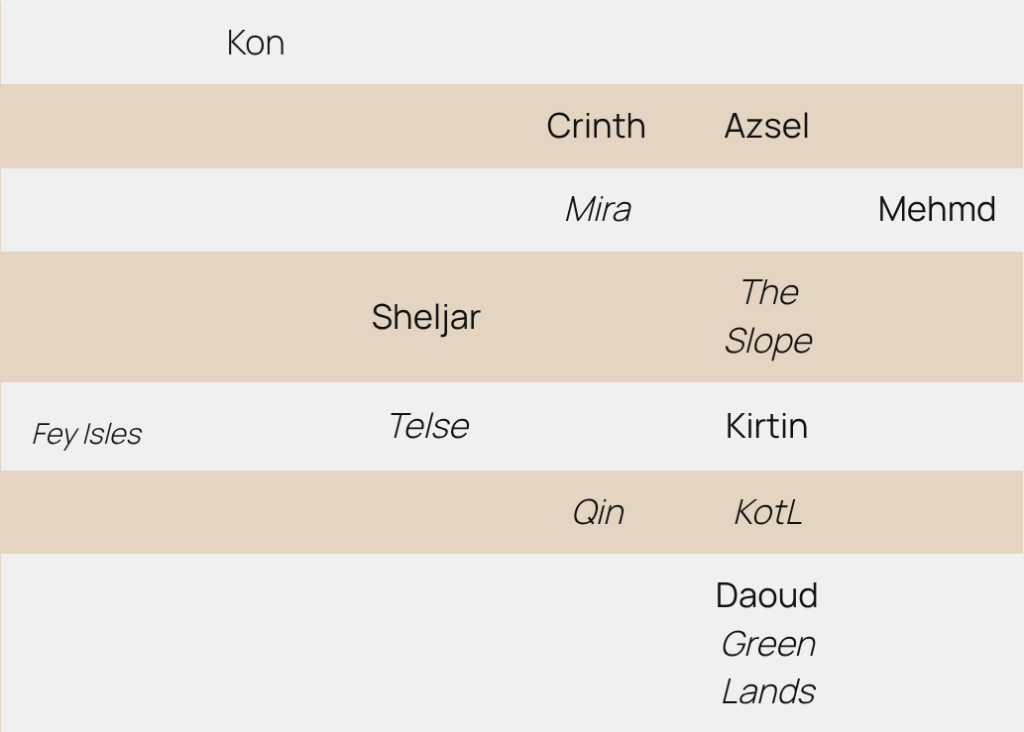
Take the word map of the Six Kingdoms. It shows the relative locations and rough distances between the various kingdoms, their major cities and the other lands that interact in the World of the Everflow.
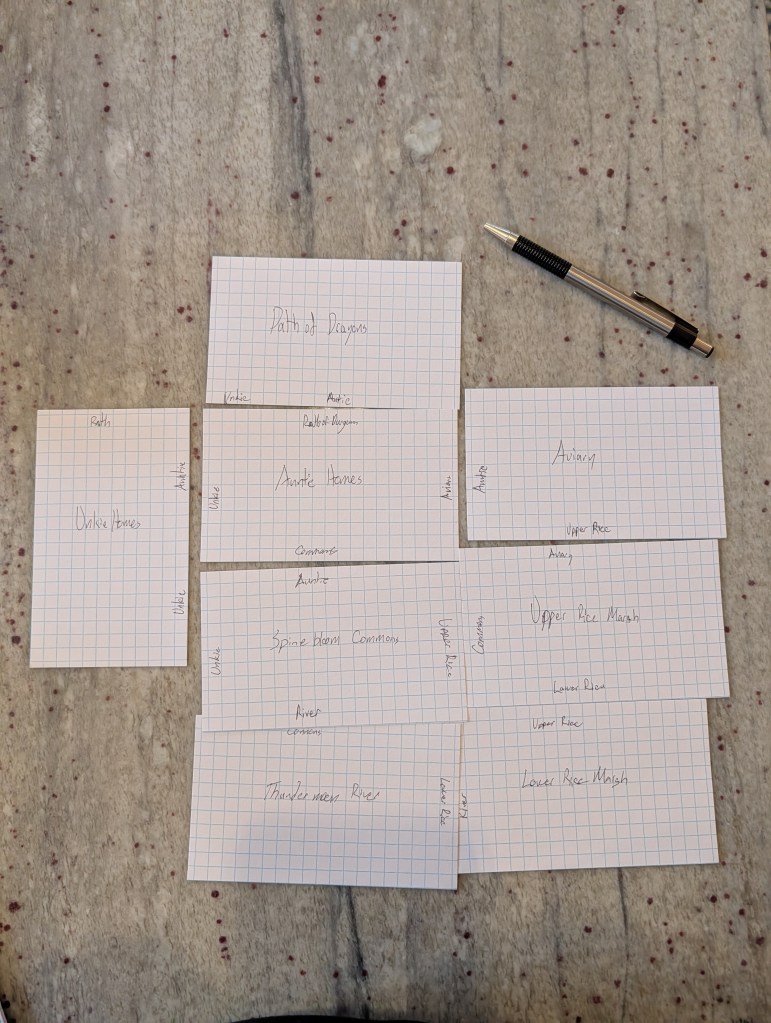
Word maps can also represent a homestead, village or neighborhoods of a city.
Any player can take a quick glance and know what each location is and what they connect to within the compound. More thorough descriptions in a blog post and in the character’s notes, but these quick notecards reminds us of Spinebloom Farms at the table.
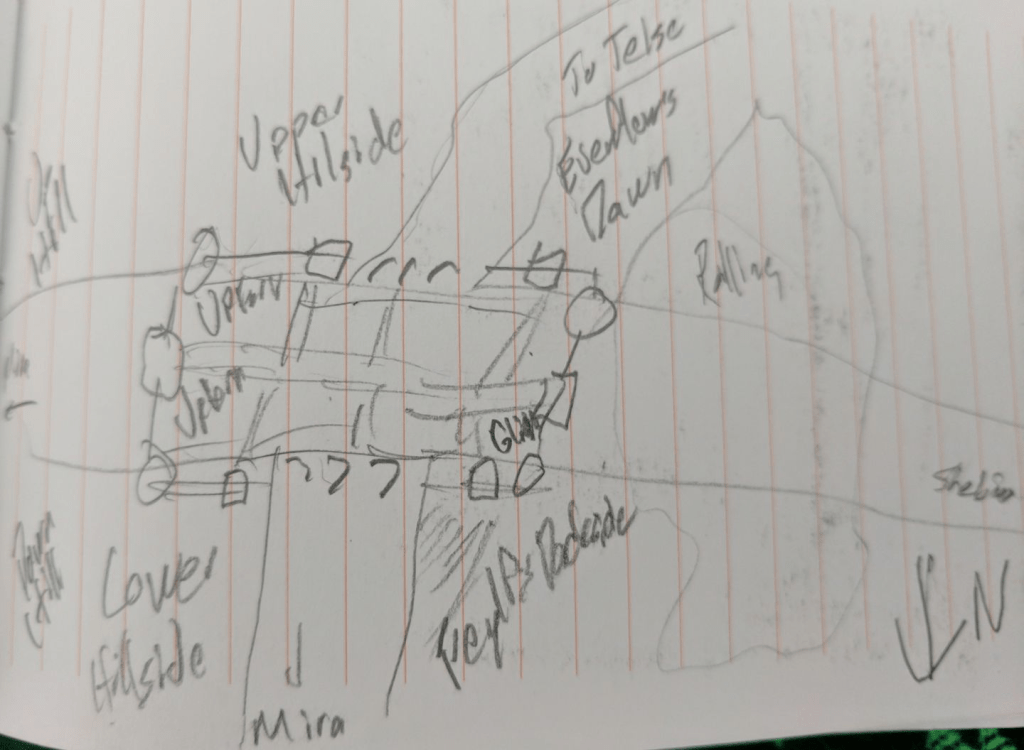
Fort Ooshar is a bridge-town that turned into a fortress when Sheljar fell to the Necromancer. This quick sketch lays out the neighborhoods of the bridge-town, the gates, the fields and the nearby hills.
Yes, a better mapmaker would be better. My favorites are Deven Rue and Dyson Logos. I support both via Patreon and use their works in my games.
But sometimes I want something that is unique to my world. That leaves me with my lack of art. I then build a word map.
Keys to making a quick word map.
Decide on the central space
Build outward using relative distance to represent a unit of time
Include evocative names, especially when in tight focus
If building a dungeon, point crawl or town having connective tissue — this can be a road, river, or other path
Leave yourself space to build details and add discoveries
Doing this as a player
Old school D&D involved at least one player making highly detailed maps. But a word map may be all that’s necessary to prevent your party from getting lost. Using a room-and-halls word map by the player helps represent how the characters think.
In essence you are channeling the concept of ‘turn left after the big red barn, go over Herringbone Bridge, take the third path’ into a simplistic drawing.
These are quick, simple and can be done on a 3-by-5 card or as a sketch in something as simple as Paint, Slides, Canva or even in a Spreadsheet (the Six Kingdoms started as a spreadsheet).
One of the special powers of the word map is that they’re quick. You don’t need to search for anything. It’s a sketch that can be done in a few seconds.
Whether as a player or a DM this tool can help you understand your fantasy world better than without a map at all.
Professionals fail all the time — in roleplaying games, in elite athletics, in special operations, in life.
The idea that they shouldn’t miss in a game is built on a foundation of water, not even sand.
There are still some valid reasons that one wouldn’t roll to hit, but they have nothing to do with professionalism.
Matt Colville on Mastering Dungeons
In a recent edition of Mastering Dungeons Matt Colville talked extensively about the business of RPGs. It’s a wonderful listen.
Something stood out to me though.
“You’re professionals; you shouldn’t roll to hit.”
Now, the idea of not rolling to hit is part of Colville’s quite intentional design. I’m certain he’s said it before and will say it again. There are reasons in games to not roll to hit.
Let’s break down the idea of professionals not needing to roll to hit.
Elite Failure
Elites fail regularly. They fail when contested. They fail when on their own. Failure at elite levels may not be as common as for us normal people, but it happens.
This is true for the real, actual elites, not those mere professionals. My personal history is blessed to experience a few elites in fashions that many do not.
Special operations
Assigned to 5th Special Forces as a peacetime soldier my Army days were defined by the Quiet Professionals — the Green Berets. Working alongside these masters in warfare I saw failure every single day.
On the range those trained to be snipers, an uncontested contest in gaming terms, missed. There are reasons for each miss, but missing happened.
When soldiers, even in highly trained units such as the Special Forces, go to war they miss even more. The human brain does not like to kill things, plus there is chaos all around you. Errors happen. They always will.
Elite failure isn’t limited to elite warfare.
High-level sports
Leaving 5th Group I decided I wanted nothing to do with my high school dreams or hard journalism. I turned to sports. During that era I worked as a producer for the Sonics broadcasting network, baseball’s best postgame show, as an on-air analyst for soccer and founded Sounder at Heart.
At the field and court level I’ve watched Ichiro, Ken Griffey Jr., Gary Payton, Michael Jordan, Megan Rapinoe, Kasey Keller and many others.
The list of these Hall of Fame talents failing would be immense.
But let’s use hard numbers.
Ichiro is the best contact hitter of the modern era. The ten-time All Star and MVP had a batting average on balls in play forty points higher than his contemporaries, but it was still only .338.
Failure among the elite is regular and normal. They roll to hit and fail.
Business
Pick your favorite business leader and their success rate is higher than average, but whether its Howard Schultz launching a magazine, or Steve Jobs launching NeXT, or Warren Buffet investing in a shoe company, they fail too.
Gaming reasons to not roll to hit
So professionals do miss. Elites miss.
Are there good reasons to not roll to hit? Yes, absolutely, as part of intentional design choices for a style of play that has nothing to do with professionalism of the character
Hit points vs meat points
The long standing D&D debate about hit points being more than meat points can be ignored here. Games developing to-hit rolling or direct-to-damage techniques do not need to burden them with Gygax’s decisions.
Direct-to-damage rolling is excellent when hit points are, as in D&D, a symbol of morale, luck, fortitude, energy and more than merely meat. Since every attempt to physically damage an opponent wears away at those elements you don’t necessarily need to roll to hit. Missing still costs luck, energy, mental health and morale.
The meat of the opponent can be damaged eventually, even without rolling to hit.
Speed of play
Colville did this in MCDM monster design for his 5e books — minions and the like can be hit easily. And then eliminated easily. This speeds up the action at the table and mimics narratives from movies, TV, video games within role playing games. Slicing and dicing through waves of small threats feels great. Having that take only a few moments rather than many minutes is good.
Additionally in games like Draw Steel, with extensive tactical choices being a goal, eliminating a set of rolling helps speed gameplay up. This is a wise and intentional design choice that amplifies the other intent of bundling morale with meat.
This supports the designer’s desires for their game — and need not be connected to reality or even lore.
A wrong justification, with the right idea
Professionalism in the real-world elite activities includes failure. Even the arts that inspire our gaming include failure. Black Widow misses. Skywalkers miss. Robin Hood misses.
Designers should embrace failure when missing, because Ichiro, Rapinoe, every special forces soldier, every business leader, every legendary hero misses.
And when they do design away the miss they should do so with intent that supports their game, no matter what reality and lore suggest. Just as Colville’s done in Draw Steel.
Creating memorable scenes and adventures is easier when fantastic elements are included. Many of these fantastic elements can simply be things from the real world, but amplified or expanded. In this case we’ll walk through the concept of floating islands and make those even more mythical.
First off, yes, floating islands are real. In Lake Chippewa one is large enough it has to be pushed by motor boats so it doesn’t damage bridges.
A floating island that drifts about on a lake or sea is already pretty fantastic. How can we up the fantasy to make it more memorable in D&D when the players are getting together every few weeks?
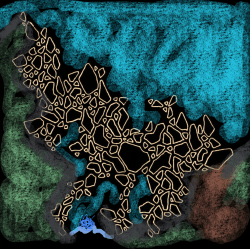
This example is going to be for Sheljar, the bog-city once ruled by an intending-to-be-good necromancer, but could apply anywhere. Sheljar is a city of 100s of islands.
What if a few of those islands floated like the bog-island of Chippewa?
Rather than be moved by motorboat, they were moved by water elementals during the Age of Myths. The largest of these, Reylerel, at the time was the home of a power school of mages that integrated water, animals that live in and along water, and the peoples.
As the Age was crashing they attempted to flee the city. The school wanted to isolate itself from the riots, to hide the dolphins, elementals, beaver and ducks that worked together to help the Kin survive. Reylerel went adrift, into the Sea of Sheljar.
Now, thousands of years later the Free City of Sheljar is no longer ruled by the Necromancer. It is regrowing, discovering some of its influence from the Age of Myths. This bog-city isn’t a city of fog and depression, but a city of hope and humanity integrating gobkon teknology, love of animals and the lost magics.
The leadership knows this is possible. Myth said it happened before, and drifting towards them is the Floating Island of Reylerel. At sea it moves with the swells and storms. The towers and buildings are rundown. Someone is going to need to go to Reylerel and find a way to prevent it from crashing into the docks.
And that’s how you take a small trending topic on the internet and turn it into an adventure.
Back in the 1980s there was a cute little movie called Willow. Featuring Warwick Davis, Val Kilmer and others, the film opened well and then petered out. But among certain fans it maintained this legacy and appeal. There’s a little person (Davis), even littler people (two Brownies), Kilmer with a sword! and extraordinary effects. The story is quite a traditional tale of people without anything in common trying to save the world.
Eventually when it was on video tape it developed a reputation as a grand adventure and we all loved it.
Now, there’s a new Willow — with the same message, better effects and even more of everything. The cast is wider and the story more grand. It looks like an epic Dungeons & Dragons tale.
That trailer shows every member of the party featured in the spotlight. Some are noble. Others are urchins. There are sorcerers and fighters. Davis is back and so are the Brownies. The princess is now longer a baby. Where the original Willow explores just a single continent in the world the new series explores the world and more.
It’s an epic fantasy tale and another example of the wide variety of fantasy that is available in the 2020s. Sword & Sorcery, Epics, Grim dark, Magipunk, comedy and more subgenres of fantasy are available. Every streaming platform is hoping for a tentpole series, with none dominating right now.
Like, there’s a lot of fantasy and there’s more to come.
Outlander, Last Kingdom and Black Sails are genre adjacent in that they are period shows that people who play D&D think of when they play D&D.
All of this isn’t powered by franchises like Marvel, DC, Star Wars or Star Trek.
Fantasy is capturing global imaginations and our dreams. We’re watching. We’re playing. We’re creating new stories with the old tropes seen a right angle so as to capture the people who we’ve always been. Fantasy is built around tales of cooperation among those with different backgrounds, skill sets and races. Fantasy is built around the authentic statement that the diverse group is the strong group — it’s been true for the millennia of myths about dragons and the people who fight them.
Naming characters can be hard. For a DM coming up with names at the spur of the moment can lead to a stoppage in play as their mind struggles to find something appropriate for the NPC that was supposed to be a background character, but your players have thrust that individual into a major role.
For most players, naming a character is a rare event. It is usually the first or last thing that they do. Then, it’s over until the next campaign starts. Still, you want to get the proper name for your character, because you will carry it with you for a long time*.
*strong exceptions for rogues, criminals, urchins, and the like.
As someone who both creates way too many PCs, and once named a formerly non-notable NPC “Anderson” after the car dealer across the street from the restaurant hosting our session I’ve developed a few tricks to naming characters.
Easy Button
Those of you using DnDBeyond.com probably already know this, but the Fantasy Name Generator has well over 100 different naming categories. Click the category and it will spit out ten names. Simple is as simple does. Sometimes you’ll hit those buttons a dozen times to get the one you like.
Xanathar’s Guide to Everything
All the way back in November of 2017 Wizards of the Coast released Xanathar’s Guide to Everything. The book is most well known for being the first official significant expansion of character classes in 5th edition. Those people into optimization ranted against the inclusion of almost 20 pages of names.
Frankly, it was a poor critique.
There are so many more people picking up the game every day, every month, every year. They don’t have the knowledge base that stretches back editions. They may not want unofficial sources for fantasy names.
Xanathar’s includes official lists of fantasy names as well as dozens of real cultures that are often captured within your gaming table. This section is one of the forgotten joys of Xanathar’s Guide to Everything. Cracking the book open to those sections should help inspire your next character’s name.
Use Athletes for Inspiration
After working in sports for nearly 15 years, there should be little surprise that they become part of my gaming paradigm. There’s a reason that Sports as a Tool exists in my worlds.
Sports, particularly Olympic sports and soccer/football, are an excellent way to discover wonderful inspiration for names. Just look at the recent MLS SuperDraft.
Mitch Guitar was drafted. Who doesn’t want to make a Bard called Mith Lyre now?
Sondre Norheim was drafted. Could that be your next dwarf named after a powerful elven king? Yes.
Real people and cultures can inspire your name. Honor those peoples through the name of your character.
To discover new names head to a reference website covering a sport with international play. Click on a league outside of the mainstream, click a team at random, and combine a two-four players’ names. Drop a couple letters, or add a few. Research those players because their lives can help inspire you the same way that reading Tolkien can inspire you.
As a DM, I try to have a small selection of NPCs already made up ahead of a session. These index card sized characters are there because my players will always surprise me. Most of their names have come from various athletes around the world. Some will be consistent within a certain set of cultures, while others recognize that the fantasy worlds in which we play are generally as interconnected as the modern world in which we live.
Your naming conventions should embrace the fact that the peoples travel extensively.